
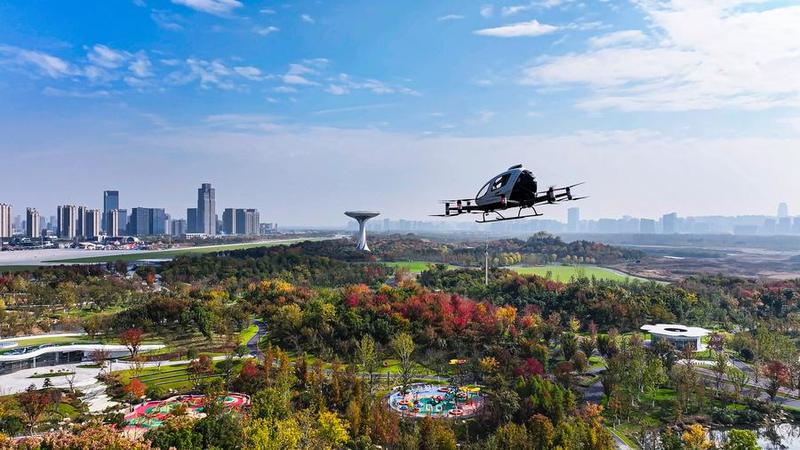
An undated aerial drone photo shows an electric vertical take-off and landing vehicle performing flight demonstration at Luogang Park in Hefei, East China's Anhui province. [Photo/Xinhua]
"Resilience", or ren (韧) in Chinese, has been chosen as China's character of the year, while the homegrown AI model "DeepSeek" is the phrase of the year for 2025, highlighting the country's persistent drive for technological self-reliance amid a complex global landscape.
The annual Chinese language review also selected "tax" as the global character and "geopolitics" as the global phrase, reflecting heightened tensions and the widespread impact of protectionist tariff policies implemented by the United States.
The results, unveiled on Friday, were based on public suggestions, data analysis and panel discussions. The event, jointly organized by the National Language Resources Monitoring and Research Center, the Commercial Press and Xinhuanet, is now in its 20th edition.
Lu Xiangao, vice-president of the China Media Culture Promotion Association, said "resilience" reflects the robust responsiveness of China's economic and social systems. This includes the recovery elasticity of industrial chains amid global economic headwinds, sufficient strategic resolve to navigate regional conflicts, and the efficient response of institutional mechanisms to technological disruptions, he said.
Lu added that resilience is a national spirit, reflected in the persistent innovation of enterprises across economic cycles, and the developmental consensus and tacit coordination of the entire society amidst transformation. "In this era of uncertainty, 'resilience' offers us a form of certainty," Lu said.
Meanwhile, early this year, the domestic large language model DeepSeek made a dramatic entry, profoundly reshaping people's lives, he said.
Its selection as the hottest phrase of the year reflects the openness and inclusivity of this year's review. Its significance extends far beyond a mere technological breakthrough — it symbolizes Chinese science and technology's deep dive into building foundational driving forces and shifting from learning and catching up to the quest to independently define the rules, he said.
Zhu Huaxin, executive council member of the China Society of Economic Reform, noted that the US has rolled out so-called "reciprocal tariffs", intensifying geopolitical maneuvering, which dominated much of the 2025 international discourse. The post-World War II multilateral trading system risks systemic collapse, creating an international environment more severe than ever before, he said.
Yet, rational and clear-thinking political voices worldwide believe that in the age of artificial intelligence, promoting multi-agent sharing, interconnection and collaboration should not mean reverting to the law of the jungle, nor a regressive return to a tribalized global society, Zhu said.
At this critical juncture, China's stance is best captured by remaining composed amid change and pursuing strategic goals with unwavering determination toward Chinese modernization, he said.
These annual words and phrases are not mere symbols. They are deeply rooted in the life of every individual, each interpreting this resilience and practicing the spirit of deep exploration in their own way, Zhu added.
