

Co-hosted by the China Audio-video and Digital Publishing Association and the government of Xuhui district, the 2025 China Game Industry Annual Conference is held in West Bund from Dec 17 to 19, unveiling the latest industry achievements. [Photo provided to chinadaily.com.cn]
The sales revenue and user base of China's domestic game market in 2025 reached historic highs, while the overseas market also showed strong performance, according to the 2025 China Game Industry Annual Report released on Friday in Shanghai during the 2025 China Game Industry Annual Conference.
Co-hosted by the China Audio-video and Digital Publishing Association and the government of Xuhui district, the conference was held in West Bund from Dec 17 to 19, unveiling the latest industry achievements.
The report highlighted that China's domestic game market achieved sales revenue of 350.79 billion yuan ($49.8 billion) in 2025, marking a 7.68 percent increase from the previous year. The user base expanded to 683 million, up 1.35 percent year-on-year, with both metrics reaching historic highs.
Domestically developed games generated 291.1 billion yuan in domestic sales, reflecting an 11.64 percent year-on-year growth. Mobile games dominated the market, contributing 257.08 billion yuan in sales, a 7.92 percent increase, and accounting for 73.29 percent of total revenue.
Zhang Yijun, first vice-chairman of the association, highlighted the industry's growth: "In 2025, China's game industry demonstrated robust growth, innovation, and a shift from scale to quality."
Meanwhile, Chinese games excelled overseas, with sales reaching $20.46 billion, a 10.23 percent increase, surpassing 100 billion yuan for the sixth consecutive year. The US, Japan, and South Korea remained key markets, while expansion continued in emerging regions like Latin America and the Middle East.
Sun Shoushan, chairman of the association, emphasized the cultural significance of games: "Games are a vital medium for sharing Chinese culture globally, serving as a cultural bridge."
"We must uphold our cultural roots and strengthen the dual drive of technology and culture, transforming games into a 'modern classic' that carries civilization, preserves culture, and empowers innovation," Sun said.
Ge Jianxiong, a senior professor at Fudan University, echoed Sun's sentiments and noted that China's rich history and culture are invaluable for game IPs, inspiring both domestic and foreign developers. Ge emphasized that the global expansion of Chinese games is a cultural exchange, integrating traditional Chinese culture with global influences to create new, globally recognized game IPs.
Highlighting industry successes like Black Myth: Wukong, Pang Dazhi, vice-president of Guangzhou NetEase, cited Where Winds Meet as an example of a game that has captivated international players, especially in Europe and America, with its high-quality production and cultural depth, such as extraordinary architecture and cultural symbols.
He said, "When the content is genuine and compelling, the world listens to China's voice."
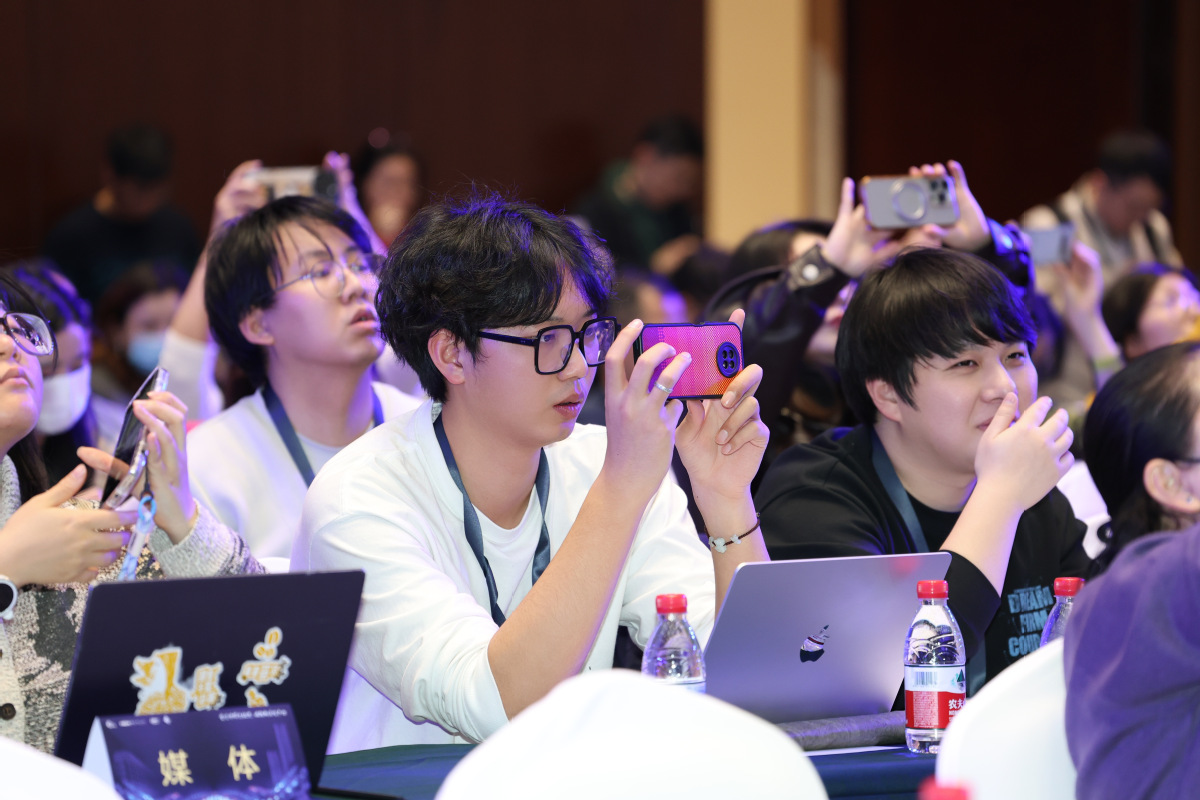
Co-hosted by the China Audio-video and Digital Publishing Association and the government of Xuhui district, the 2025 China Game Industry Annual Conference is held in West Bund from Dec 17 to 19, unveiling the latest industry achievements. [Photo provided to chinadaily.com.cn]
The conference also released key reports, including the women-oriented game research report and the 2025 progress report on minor protection.
Tang Jiajun, deputy secretary-general of the association, noted the rapid growth of women-oriented games, which have significant commercial potential and cultural impact. These games creatively incorporate traditional elements, appealing to younger audiences and promoting cultural heritage.
The minor protection report revealed that by June 2025, 209 million Chinese internet users were aged 19 and below, highlighting the need for strengthened family education to address issues like excessive gaming among minors, Tang pointed out.
Beyond minor protection, Sun noted other persistent industry challenges, such as rising development costs and intense global competition, urging industry collaboration for sustainable growth. He called for industry-wide collaboration to achieve sustainable development and emphasized the importance of cultivating young talent.
This conference marked the first time it was held in Shanghai, reflecting the city's burgeoning game industry.
