
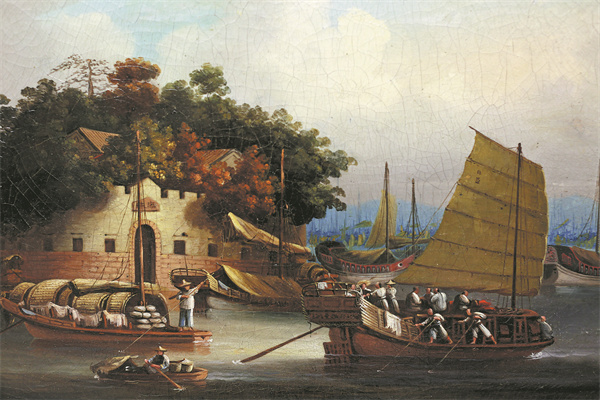
An oil painting of Haizhu Fort (top), featuring its name on the front of the structure (as shown in detail above), and The Dutch Folly (center) are two representative works of Qing Dynasty (1644-1911) trade paintings collected by Kuang Lin.[Photo provided to China Daily]
Inside his Marscloud Art Gallery in Manassas, Virginia, Kuang Lin doesn't begin by talking about brushwork, composition, or color. Instead, he talks like an investigator, pointing to what he considers evidence.
On one painting of a fort, two Chinese characters, hai zhu (sea pearl), sit high like a nameplate, anchoring the scene to a location that no longer exists.
On another, the evidence isn't on the front but on the back — a handwritten note describing a battle, a death at a porthole, and a line of pidgin English that still echoes — "Sick man yami guns?"
Kuang's habit of interpreting images as evidence makes him an unusual figure in Guangdong "China trade" paintings, which were produced in southern China from the late 18th to the 19th centuries for export to Europe and America.
Trained as an engineer and long employed in computing, Kuang is a self-taught collector and researcher whose decades of collecting Chinese art in the United States led him to a trove of Qing Dynasty (1644-1911) trade paintings.
The pipeline that carried these works overseas was already forming by the late 1700s. Canton, or Guangzhou, the capital of Guangdong province, had been the key source of supply.
Foreign merchants, restricted to a small area outside the city walls, were assigned hong (trading houses), and Western demand — what Carl L. Crossman described as an "insatiable" interest in "things Oriental" in his 1972 book, The China Trade: Export Paintings, Furniture, Silver and Other Objects — helped drive a flood of made-for-export goods, including paintings such as portraits and port scenes, that found eager buyers in Europe and the US.
Today, Kuang's gallery holds 30 such Qing-era oil paintings alongside more than 70 watercolors on paper, pith and mulberry leaves, grouped by the gallery as "Qing Dynasty Guangdong Historical Paintings".
"In an era before photography, China trade paintings of forts and others were the sole visual chroniclers of a world now lost to time," Kuang says.

An oil painting of Haizhu Fort (top), featuring its name on the front of the structure (as shown in detail above), and The Dutch Folly (center) are two representative works of Qing Dynasty (1644-1911) trade paintings collected by Kuang Lin.[Photo provided to China Daily]
A tale of two fort frames
While each of the "trade paintings" has its own story, Kuang's favorite is a tale of two fort paintings — featuring a fort preserved in pigment, and another with a note that turns art into evidence.
About 20 years ago, while browsing an American antique shop in Washington, DC, Kuang encountered two paintings displayed as a pair: one of a "country theater" and the other of a riverfront fort, a key part of Guangzhou's coastal defenses during the Opium Wars in the 19th century.
Kuang recognized the paintings as "sisters" and couldn't bear the thought of separating them.
"I knew their importance. I had studied China trade paintings, and I knew Haizhu Fort was famous," Kuang says.
While many depicted the famous fortification, this one uniquely displayed the two Chinese characters for its name, hai zhu, on the front of the structure. That detail, Kuang says, "predetermined its irreplaceable historical value".
The painting offers a rare snapshot of Qing Dynasty coastal defenses, as Haizhu and other forts were critical in resisting foreign invasion, according to Kuang.
"The work witnessed — and in a sense lived through — a war that remains an enduring humiliation in Chinese history. The once-magnificent Haizhu Fort and the enormous Haizhu Rock no longer exist; what remains is only the crystallization of the painter's emotion," he says.
During the Second Opium War (1856-60), Britain launched military action using the so-called Arrow Incident as a pretext. On Oct 25, 1856, British forces captured Haizhu Fort, seizing all 50 of its cannons, Kuang writes in his book China Trade — Qing Dynasty Guangdong Historical Paintings.
Kuang notes many similar paintings are mislabeled "The Dutch Folly", a label he considers unreliable as they often depict structures instead of the Haizhu Fort.

Portrait of Wu Guoying in Casual Attire, painted around 1800.[Photo provided to China Daily]
Years later, Kuang spotted what he called "Haizhu II" on a California gallery website. He negotiated for five years until the work came within his price range.
When it arrived, he found an old handwritten note affixed to the back — a detail the seller never mentioned.
The note stated the painting had been purchased in 1845 by William Roache, who served aboard a 74-gun warship.
It is a piece of evidence preserved by the family of a British marine that reclaims a moment of fierce and effective Chinese resistance.
The note provides a dramatic eyewitness account unknown for at least one and a half centuries: Lord John Churchill, the commander, was killed by fire from a Chinese fort while speaking with Roache at a gunport.
This stands in stark contrast to official British records, which claimed the commander died of a long illness and was buried in Macao.
"Only after it arrived did I realize the note was even more important," says Kuang.
"When I saw the note, I felt the soldiers of that time deserved recognition and reward, because it might have been an important victory, but history left no record of it."
Kuang says he believes the British likely hid the truth to avoid damaging the morale of an expeditionary force already facing supply shortages far from home.
"When people talk about coastal defense, it's true that Qing forts and warships were technologically weak. But that does not mean they had no effect. If soldiers had today's defense conditions, many wouldn't have died. Yet, under those conditions, they still resisted invasion, and may have won certain battles," he says.

An oil painting of Haizhu Fort (top), featuring its name on the front of the structure (as shown in detail above), and The Dutch Folly (center) are two representative works of Qing Dynasty (1644-1911) trade paintings collected by Kuang Lin.[Photo provided to China Daily]
Such episodes likely occurred more than once, but reconstructing them requires painstaking comparison of naval logs, marine accounts, diplomatic correspondence and even missionary records, he says.
The note also explains that the painting's title, The Dutch Folly, was suggested by a story that reeks of mistrust or deception even today.
Chinese officials, it says, had initially granted the British a concession to build a hospital. As the walls rose and portholes were cut, the Chinese discovered the true intent behind the construction.
The officials realized the building was secretly being constructed as a powerful fortified position.
"They at once canceled the concession and indignantly asked 'Sick man yami guns?' or literally — 'Do sick men eat guns?' The fort was never completed," Alex P. Roache, the buyer's descendant, wrote in the note.
For Kuang, uncovering the story behind the fort paintings is an antidote to the "second injury" of modern Chinese history: the emotional wound of understanding one's past through the eyes of invaders.
In many online Opium War archives, widely circulated images are labeled "painted by British war artists", a curatorial choice that determines whose perspective shapes the narrative and highlights the need to preserve and rediscover China's oil-painting heritage.
"That was a huge shock to me," he says, describing the visceral pain of scrolling through archive after archive of dramatic scenes of "Chinese wooden ships being blown apart by British ships", only to find the works attributed, again and again, to the British side.
For him, the label isn't neutral; it is a warning about what gets lost.

Alex P. Roache's note on the back of The Dutch Folly.[Photo provided to China Daily]
The collector as detective
When Kuang talks about old paintings, his language often slips into the vocabulary of criminal investigation — cold cases, broken chains of custody, and the need to assess the evidence rather than simply assert it.
The habit dates back to his youth. In the 1970s, while helping at a local police station, he read through hundreds of original criminal case files.
"Even then, I wanted to be a detective," he says.
That instinct never left him. In 1990, after graduating from the postgraduate program at the Harbin Institute of Technology in the capital of Northeast China's Heilongjiang province, Kuang began to apply what he called "engineering optimization plus philosophy plus criminal investigation principles" to solve "millennium cold cases" in art history.
This methodology sharply contrasts with that of conservative museum professionals who, according to Kuang, rarely see major works outside museums and often "don't dare touch them" due to fear of academic criticism.
Lacking traditional art history credentials, Kuang embraces his status as an "outlaw", which he believes gives him the freedom to take intellectual risks.
His initial foray into collecting, around 1998, was fueled by a "simple emotion". While commuting to a programming school in Virginia, where he taught, he started visiting American antique stores to admire Chinese artworks.
"If you encounter these works, it's like seeing a baby crying by the roadside," he says.
"You can't just walk past; you have to pick them up."
Each acquisition came with an effort to trace provenance and clarify historical clues.
A Northern Song Dynasty (960-1127) painting he purchased early on became a turning point.
After nearly two years of self-directed study, he determined that the work was a later copy rather than an original.
The process led him to read foundational art history texts, forming what he describes as a solid practical and theoretical base.
Kuang and his wife narrowed their focus to oil paintings featuring Qing Dynasty coastal defense infrastructure like forts and warships.
These images, they believe, are not only artworks, but also irreplaceable historical records of a world that largely drifted overseas.
"We call it 'drifting history'," Kuang says.
"The more we studied, the more we realized how much of the Qing Dynasty's visual record was not preserved in China. We started writing articles about China trade paintings."

Kuang Lin, collector and founder of Marscloud Art Gallery in Manassas, Virginia.[Photo provided to China Daily]
Capturing raw authenticity
Beyond their value as visual history, Kuang argues these works represent a "lost chapter" that could rewrite Chinese art history.
He divides Qing oil paintings into two broad streams: court paintings produced by Western missionaries like Giuseppe Castiglione (1688-1766) under strict imperial supervision, and Guangdong export paintings that captured the raw authenticity of Chinese life, far exceeding court art in scale and scope.
This isn't just a matter of aesthetics; it is a matter of correcting the record of Chinese intellectual and artistic evolution and acknowledging a vibrant, commercial art scene that thrived outside the palace walls.
One of his prized examples is the Portrait of Wu Guoying in Casual Attire, painted around 1800. Wu founded the powerful Ewo Hong, one of the leading firms in the Thirteen Hongs.
Capturing the merchant with surgical precision, the artist rendered a lifelike presence that Kuang considers a pinnacle of global oil painting for its time.
He points to the way the light catches the silk of the robe and the weary, intelligent expression in the merchant's eyes.
This chapter remains absent from textbooks largely because the physical evidence drifted overseas, and anonymous masters were too embarrassed to sign their names to what the elite dismissed as a "minor trick".
"The history of oil painting in China should be moved back by about 100 years," Kuang says.
This conviction was reinforced when Gong Naichang, a student of renowned artist Xu Beihong (1895-1953), viewed the portrait.
According to Kuang, the elder artist's hands shook as he studied the canvas; Gong admitted that no one in his teacher's generation could have painted with such anatomical depth.
A race against time
Kuang says he holds two primary hopes for these paintings. First, a museum in Guangdong will acquire them as a complete set. Second, he envisions the paintings as prototypes for AI-driven digital reconstructions.
"To build a digital museum, you need models. AI could help reconstruct scenes of the Thirteen Hongs and coastal defenses — that would be invaluable," he says.
Underlying both is a deep-seated urgency. Time has not been kind to China trade paintings; many suffer from aging materials and environmental damage.
Kuang hopes China can accelerate restoration capacity with more funding, trained conservators and international collaboration, so these works survive to be studied.
"What happens after we're gone?" he asks.
"They will go back into the market, auctioned again and again. If the buyer doesn't understand, they might treat a masterpiece as a minor imitation — that would be tragic."
For now, Kuang is holding "drifting history" in place, hoping the paintings finally find a stable home beyond the market.
