
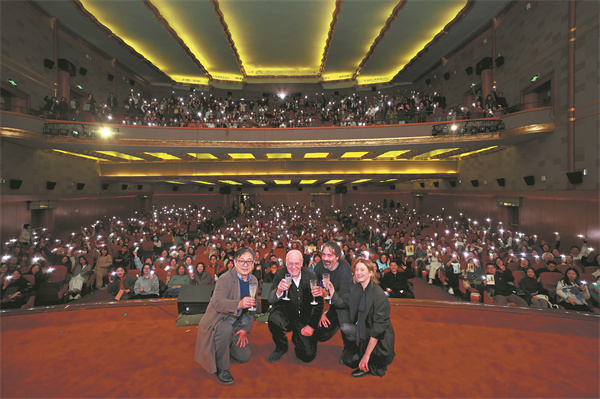
Costanzo (second from right) and Rohrwacher celebrate New Year's Eve with a Chinese audience during the Italian film week in Shanghai.[Photo provided to China Daily]
During his recent visit to Shanghai for an Italian film week, Italian director Saverio Costanzo discovered an unexpected depth of cultural connection, where Chinese audiences demonstrated a personal approach to engaging with international cinema.
"What impressed me most about Chinese audiences is how they put themselves into the dialogue," Costanzo observes. "They ask millions of questions, and each one starts from their personal experience. It's very humble and genuine — quite different from what I experience in Europe."
The film week — Un Nuovo Anno con il Cinema Italiano (A New Year with Italian Cinema) — showcased several of Costanzo's notable works, including Hungry Hearts, The Solitude of Prime Numbers, and the television adaptation of the pseudonymous Italian author Elena Ferrante's Neapolitan Novels, of which the first is My Brilliant Friend. The latter has achieved particular success in China, maintaining ratings of 8.6 to 9.5 out of 10 among all four seasons on Douban, a Chinese review platform.
For Italian actress Alba Rohrwacher, who starred in several featured works, the New Year's Eve screening created a precious moment of connection.
"I looked around the packed theater and saw faces of all ages, from teenagers to elderly couples, all sharing this moment," she recalls. "I'm so happy to have had such an unforgettable moment here in China."
The cultural resonance extends beyond cinema, Costanzo says. "There's something that links our societies that continues to surprise me. Perhaps it's our shared emphasis on family, or our passionate approach to cuisine," he explains. "When I'm in China, I feel closer to home than I do in some European countries."
A walk along Shanghai's Bund offered him further insight into Chinese culture. "I witnessed elderly Chinese tourists viewing the skyline with collective pride, saying, 'look what we did'. Even a farmer from China's countryside would regard Shanghai's skyscrapers as a shared achievement," he notes.
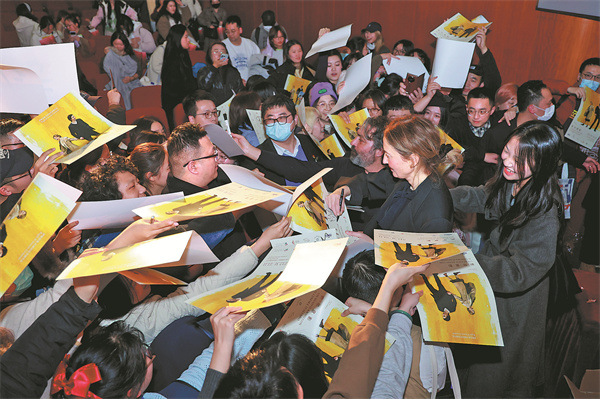
Costanzo and actress Alba Rohrwacher sign autographs during the event.[Photo provided to China Daily]
Teng Junjie, chairman of the Shanghai Art Film Federation, emphasizes the broader significance of such cultural exchanges. "Through these film exhibitions, we create opportunities to experience the richness of diverse lives," he says. "Each screening becomes a window into another culture's soul, helping us discover the extraordinary in everyday life."
The cultural exchange has opened doors for future collaboration. "I'm discussing potential coproduction opportunities with Shanghai Film Group," Costanzo reveals. "One project may explore friendships between Chinese and Italian characters — a natural extension of the connection we're building."
My Brilliant Friend's success in China adds another layer to its journey. The series, which portrays a complex female friendship spanning decades in postwar Italy, came to Costanzo through an unusual channel — a request from the mysterious author herself.
"Ferrante asked me to direct the series through her publisher," Costanzo explains. "She gave me pure trust and told me that whatever I made would be closer to her vision."
Working with an anonymous author created a unique creative dynamic. "I've never met her or seen her face. It's like communicating with a soul, yet we maintain perfect understanding," he reflects.
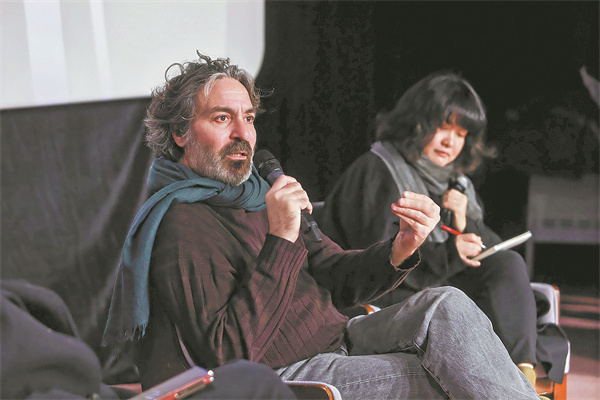
Italian director Saverio Costanzo at the post-screening discussion.[Photo provided to China Daily]
The series' impact in China transcends entertainment. Costanzo recalls a touching moment: "A young woman traveled from a distant province to Shanghai just to give me a letter, telling me that whenever she feels vulnerable or discouraged, she turns to the series for strength. It has become her source of courage to pursue her aspirations."
For Costanzo, the primary challenge lay in translating the dense, introspective nature of Ferrante's work to the screen. "The books are written in the first person. It's very much inside herself," he explains. This led to the implementation of the voice-over narration of the main protagonist Elena Greco, also known as Lenu.
Rohrwacher, who voices Lenu in the first three seasons before physically embodying her in the fourth, describes her approach as a psychological metamorphosis.
"I had to empty myself entirely, becoming a vessel for Lenu's experiences," she explains, noting the challenge of maintaining character consistency while portraying her evolution to maturity.
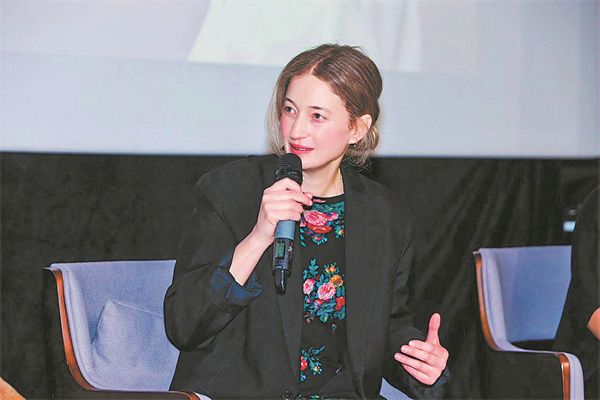
Rohrwacher at the post-screening discussion.[Photo provided to China Daily]
This transformation extended to understanding controversial character choices, including Lenu's marital departure. "Initially, reading as myself, I felt critical of her decisions," Rohrwacher recalls. "However, once I truly inhabited her perspective, I had to suspend judgment. Living as a character reveals how personal truths can obscure our own missteps.
"This transformation not only deepened my understanding of Lenu, but also prompted self-reflection on my own preconceptions as Alba," she adds.
The actress, who won the Volpi Cup for Best Actress for her performance in the movie Hungry Hearts, approaches her craft with measured introspection. "I avoid defining myself through success or accolades," she says. "It's like crossing a turbulent stream — you must focus on the next stable stone. Looking too far ahead or behind risks losing balance. The key is identifying the immediate next step that will support your journey forward."
Both artists see the series as part of a larger transformation in Italian cinema's portrayal of women. "Traditional Italian cinema often portrayed women as mere appendages to male narratives," Rohrwacher says. "Through collaborative efforts of male and female directors, we're creating more complex, independent female characters with their own distinct qualities.
"Cinema uniquely bridges cultural divides," she concludes. "My Brilliant Friend exemplifies how film can forge connections across distant cultures, creating miracles of understanding and serving as a conduit for intellectual exchange between civilizations."
