
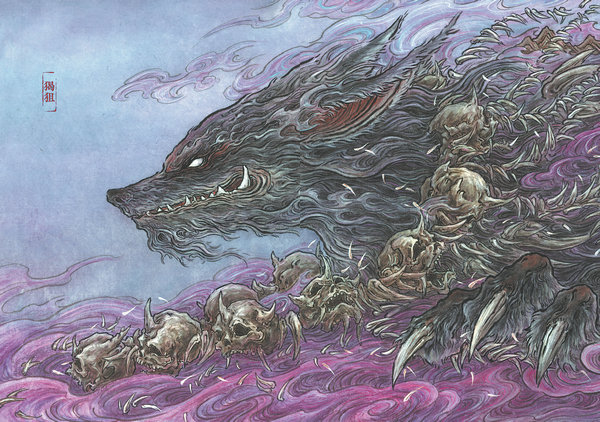
Geju, a man-eating beast with a body resembling a wolf. [Photo provided to China Daily]
No matter how advanced artificial intelligence becomes, human emotions are dynamic, which means even if AI integrates everything it knows into a perfect presentation, it cannot predict the flow of human emotions, says artist Li Yifan.
"Whether it's a writer or someone involved in music or other art forms, I truly cherish the works created by humans because I can sense their vibrant humanity. It's like the difference between basking in the sun and standing under a heat lamp; they are completely different experiences," he says.
Li, 34, recently published the second edition of his illustrated book, The Classic of Mountains and Seas — Guan Shan Hai, a work he created under the pen name Shanze, together with Liang Chao, who collected reference materials and wrote the book's text.
The first edition, one of the first books of its kind, was published in 2018. Guan Shan Hai, with its wild imaginings, vivid colors and detailed depictions, won many fans, with nearly 10,000 users rating the book 8.5 points out of 10 on the review platform Douban and making it one of the most well-received books that year.
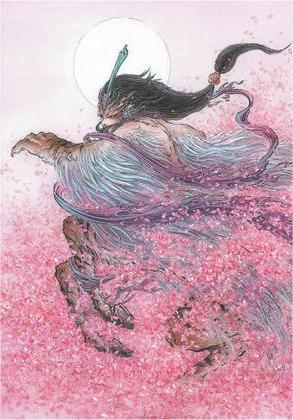
Mythical creatures from the illustrated book, Guan Shan Hai, including Yingzhao with a human face and a horse's body. [Photo provided to China Daily]
The Classic of Mountains and Seas is an ancient Chinese text that blends mythology, geography, folklore, and natural history. Compiled over centuries from the Warring States Period (475-221 BC) to the early Han Dynasty (206 BC-AD 220), the book is divided into 18 sections covering mythical lands, creatures, deities, history, medicine, religion, and geographical features in primeval times.
Despite its fantastical content, it offers valuable insights into ancient China's worldview and perceptions. It is said that the original version included illustrations, but they were lost over time, leaving only the text.
The recent release of the second edition of Guan Shan Hai is published by Xiron.
Li Zexin, the book's editor, says it is a good time to release the second edition.
"Our readers have shifted from being merely curious to genuinely passionate, so we must provide more substantial content to satisfy their interests. Additionally, the China-chic trend demands cultural products with deeper roots and significance," he says.
"Over the past few years, the artist has deepened his understanding of The Classic of Mountains and Seas and honed his artistic skills, which are obvious in the new book", he says.
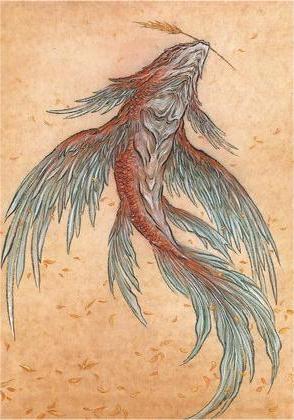
Wenyao Fish that flies at night. [Photo provided to China Daily]
The latest edition includes 25 new artworks of mythical creatures, 255 patterns, and four long scrolls, creating a more expansive worldview of The Classic of Mountains and Seas. His designs are inspired by the ancient patterns of the Warring States Period and the Han Dynasty.
Commenting on the new book, Yu Minhong, chairman of New Oriental Education and Technology Group, says it is a cultural bridge spanning ancient and modern times.
"This work not only carries forward the spiritual totems of our ancestors but also inspires contemporary individuals to explore the unknown with courage," Yu says.
More than 10 years ago, when Li Yifan was a graduate student studying graphic design at the College of Arts, Sichuan University, he made good use of the leftover pigment by painting monsters or demons from ancient Chinese legends and myths for the sake of frugality.
"I stuck to hand-drawing because I couldn't master the drawing software," he says.
He regularly drew monsters and demons as "reading notes" in cheap Xuan paper sketchbooks. The Classic of Mountains and Seas served as a good reference.
For months, it generally took Li two to three days to complete a piece of work. He posted the pictures on social media platforms, which received positive feedback.
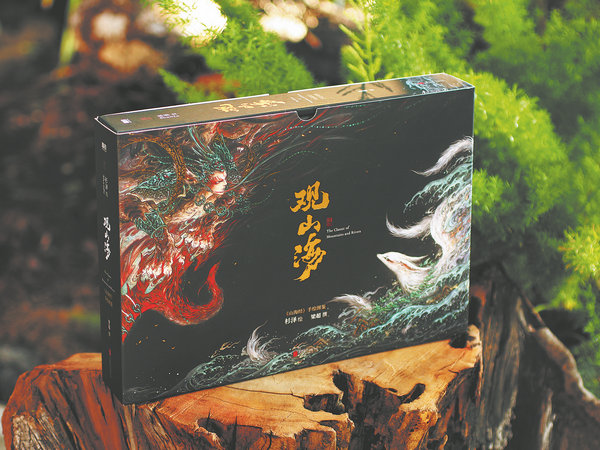
Cover of The Classic of Mountains and Seas — Guan Shan Hai, an illustrated book that depicts many mythical creatures. [Photo provided to China Daily]
"They said that compared to the images of the creatures they saw before, my interpretations presented a wilder atmosphere, which encouraged me to continue the series," he says.
In 2018, Li and Liang published the first edition of Guan Shan Hai, at a time when few books of its kind were available. Many parents bought the book for their children to teach them about the fantastical creatures from ancient Chinese legends and myths.
Two years ago, the book's contract expired. Rather than immediately releasing the second edition, Li spent two years designing patterns for each creature and improving the original illustrations.
"I tried to refine some illustrations that I felt weren't aesthetically pleasing. Some designs were not accurate," Li says.
For instance, the Shui Ma, a horselike aquatic creature, is described in The Classic of Mountains and Seas as having an oxtail, a detail the first version missed.
"For this edition, I changed inaccuracies and re-created some images," Li says.
To ensure accuracy and avoid mistakes, Li extensively studied various annotated editions of the classic.
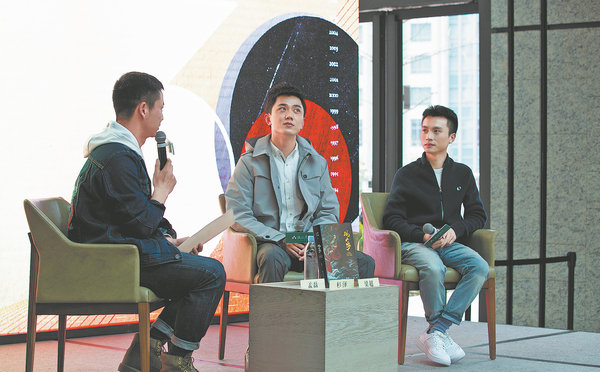
Li Yifan (middle), author of Guan Shan Hai, shares his method for creating stories with readers at Eslite Bookstore in Suzhou, Jiangsu province, in March 2019. [Photo provided to China Daily]
Subingxiang, a user on Douban, commented, "The series has a simple and authentic feel to it. The lines are strong and rustic, and the colors aren't overly flashy, yet it has a warm and familiar charm; the perfect style for illustrating the classic".
Li says that the rustic, stunning and unique style comes from his earlier study of classical Chinese dance, which he is enthusiastic about.
"I often watch dance contests, and I integrate some movements when I design the creatures' posture," he says.
Additionally, Li draws inspiration from cultural relics from the time between the Warring States Period and the Han Dynasty, such as lacquerware and stone carvings, "to convey a feeling that aligns with the aesthetic and spirit of that era."
Among the nearly 300 creatures in the ancient classic, Li says he chose to draw the characters that he considers the most interesting.
By "interesting", he means creatures that are utterly impossible in reality, such as a snake with multiple wings, eyes and claws.
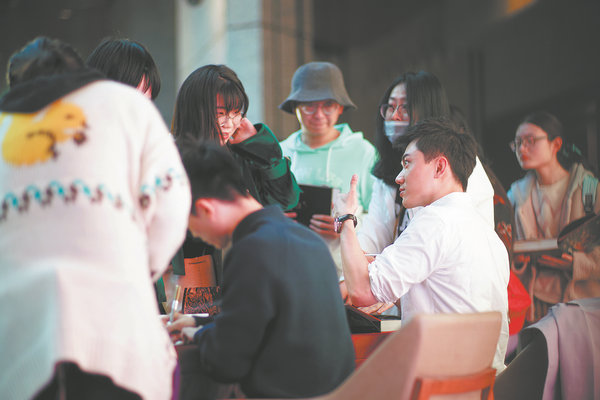
Li (right) signs his book for readers after an event in Suzhou. [Photo provided to China Daily]
Like many artists, Li sometimes struggles with self-doubt during the creation process, unsure if his work is worthwhile or will be appreciated. When this happens, the book's writer, Liang Chao, offers encouragement. Liang, a journalism student at Sichuan University with a passion for The Classic of Mountains and Seas, met Li through shared interests, which led to their collaboration.
"He wanted our work to engage with mainstream culture rather than being too niche or unconventional. While I was creating, if my work became too dark or offbeat, he would guide me back on track," Li says.
"With his knowledge of ancient mythology, he believed my work could engage in a dialogue with mainstream mythology, which gave me confidence," Li says.
In the original text, the creature called Qie Zhi is described as having an owl-like head, but Li gives it a hawk's head, a choice he says was deliberate.
"I had many discussions with Liang about how to design certain creatures," he says.
"For modern people, mythology might simply be something rich in imagination and stories, like a treasure trove of creativity ready to be explored. But for ancient people, it was more a way for them to know the world," he says.
"Those creatures might really exist, but people who created mythology or The Classic of Mountains and Seas, limited in their language, experience, and knowledge, could not describe the creatures accurately," he notes.
For example, when encountering a squid for the first time, an ancient northerner might describe it as a human head with eight walking beards, which could sound frightening, he says.
"You're not simply interpreting things from a modern perspective; you need to put yourself in the shoes of an ancient person whose knowledge about the world was minimal," he says.
