
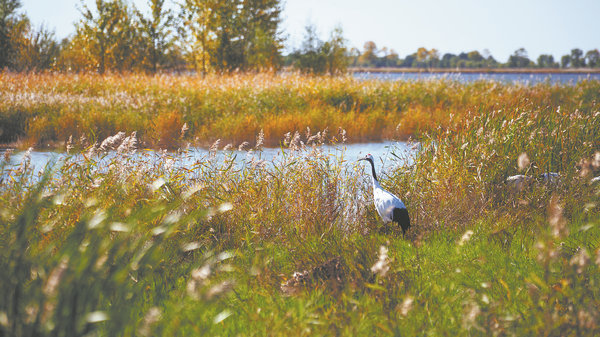
Zhalong National Nature Reserve in Qiqihar, Heilongjiang province, is one of China's key habitats for rare waterbirds, particularly cranes and other large aquatic species, and is the world's largest breeding ground for the red-crowned crane. [Photo provided to China Daily]
Under the blue skies of the Zhalong National Nature Reserve in Qiqihar, Heilongjiang province, actor Shen Teng and fellow cast members dash through fields of towering reeds, laughing their way through a series of playful challenges.
The scene is lighthearted, but it also captures something more profound: a reality show rethinking how entertainment and travel can work together in storytelling.
As travel-themed programs crowd an increasingly competitive market, Natural High has carved out its own niche with a simple but distinctive formula — games plus tourism.
Now in its third season on Tencent Video, the show has pushed this concept even further, experimenting with richer cultural experiences and more immersive storytelling.
This fusion has resulted in a strong synergy: each episode highlights the unique characters of its destination while sparking genuine interest among viewers, creating a win-win for both the show and local tourism.

On the third season of mainstream game-based variety show Natural High, a group of celebrities is brought to Qiqihar. [Photo provided to China Daily]
In Qiqihar, the show's impact was immediate. Hashtags linked to the city surged past 100 trending entries across platforms, related videos drew nearly 50 million views, and the Zhalong Nature Reserve shot to No 1 on Fliggy's local attractions list, and remained there for 13 consecutive days.
On the day the fourth episode about Qiqihar aired, the show achieved its highest viewership of the season, ranking at No 1 on Tencent Video's reality show list.
By turning every game into a gateway to culture and every destination into a character of its own, together with local tourism bureaus, the third season of Natural High is redefining the mainstream game-based variety show.
The show's producer, Zhang Yu, explains that the most crucial goal of Natural High is to deliver joy.
"No matter how many seasons we make, we want viewers to feel genuine happiness through the show and believe, 'I can have this kind of joy too'. We hope to spark a sense of longing and inspiration," she says.
Guests feel the warmth of the culture, and viewers can more naturally and vividly sense the vitality of each place," Zhang says.
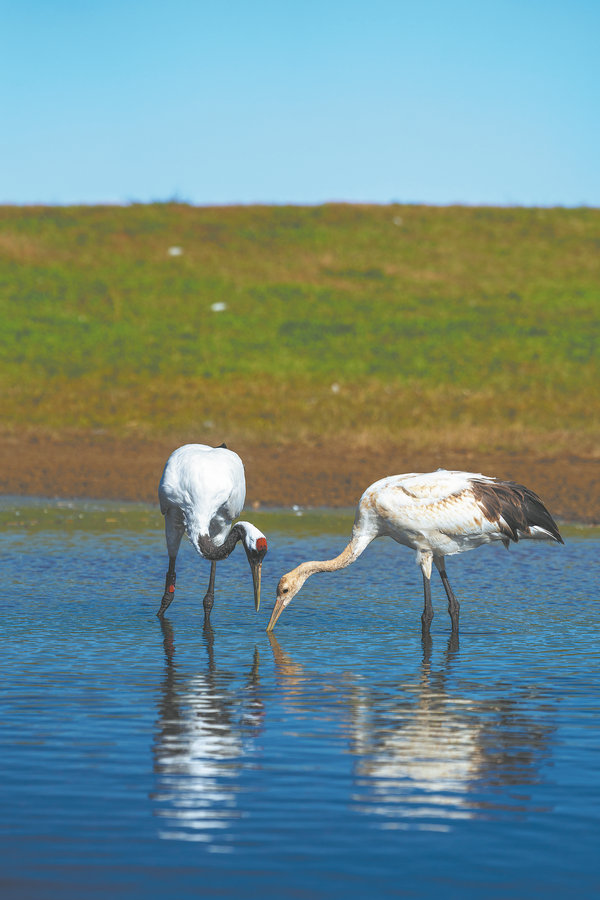
Red-crowned cranes at Zhalong National Nature Reserve. [Photo provided to China Daily]
After the first two seasons, which focused heavily on nature and biodiversity, the third season deliberately turns toward human stories and community traditions. "Human cultural vitality is easier for the audience to empathize with," Zhang says.
Choosing each destination is equally deliberate. Zhang says the team first agrees on a location's most striking and representative landscapes. Their top priority is finding scenery strong enough to trigger a physical reaction — places where guests instinctively "oh" and "ah" or reach for their cameras.
The second priority is finding an environment where the cast can relax and feel the restorative power of nature. With three seasons behind them, the production team now selects locations that amplify their chemistry, helping guests shed their everyday identities.
For example, in Qiqihar, the guests naturally discussed northeastern breakfasts and dialects. They took part in local folk activities which, in turn, created a sense of ease from the perfect combination of destination and guest atmosphere.
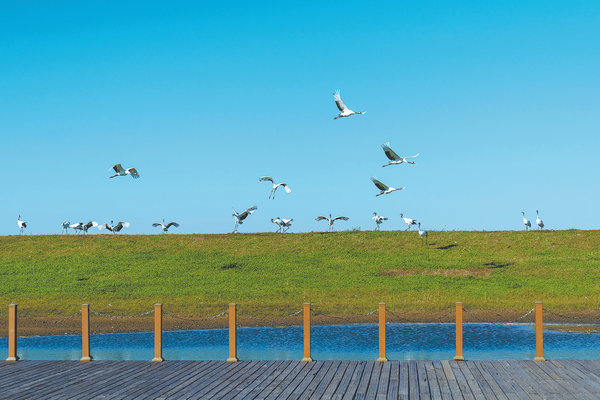
Autumn is the best time to visit, when golden reed marshes provide a dramatic backdrop to scenes of cranes foraging and at play. [Photo provided to China Daily]
Cities serve as inspiration
Behind the scenes, local governments are increasingly active in shaping each episode. Co-producer Deng Juncheng says the team typically spends about a week scouting each potential location, with cultural tourism departments providing crucial insights.
"Local cultural tourism offices are very welcoming and often take us to special places we wouldn't discover otherwise," Deng says.
For instance, when the crew arrived in Nyingchi, Xizang autonomous region, the local tourism authority brought them to the city's cultural center, where they showcased the region's most treasured ethnic products and highlights, inspiring the team's game designs.
"These materials were passed to the writers and directors and quietly integrated into the mechanics of each game, making the show both fun and deeply connected to the region," Deng says.
Zhang sees this as a sign of a broader transformation. "The support from cultural tourism departments isn't just about recommending resources; moreover, they're deeply involved in content co-creation," she says.

Qiqihar, the hometown of actor Shen Teng, is featured this season as Natural High was there for filming. [Photo provided to China Daily]
This collaborative approach reflects a shift in how local governments engage in cultural tourism promotion.
Liu Haoran, an official at the Qiqihar municipal bureau of culture, radio, television, and tourism, says the change is profound. "In the past, it was 'I'll tell you what we have.' Now it has become, 'What do you want to see?'" Liu says.
As online culture reshapes expectations, Liu believes that emotional resonance, authenticity, warmth, and youth-friendly language are increasingly important tools for tourism promotion. "This era presents a big challenge for cultural tourism departments, as well as a huge opportunity," he says.
In one of this season's episodes set in Qiqihar — hometown of guest Shen Teng — the show uses his affection and familiarity with the city to give viewers an intimate first-person experience of its food and scenery.
"Qiqihar has two signature identities," Liu explains. "One is our ecological identity: the Zhalong National Nature Reserve is the world's largest breeding habitat for wild red-crowned cranes. These birds have stringent environmental requirements, so visitors can feel the harmony between humans and nature.
"The second identity is food," Liu continues. "Qiqihar is a multiethnic region. Our famous barbecue tastes so good because it blends techniques from different ethnic groups, including Korean, Manchu, and Mongolian traditions."
Sitting at 47 degrees north latitude, Qiqihar hosts a globally recognized "golden zone" for cattle raising, which contributes to its renowned beef. The city now has more than 11,000 barbecue restaurants, with nearly 13,000 more outside the region operating under the name "Qiqihar barbecue".
After the episode aired, Liu says many viewers began planning trips to the city. "As locals, we're thrilled. We hope to turn this huge wave of online attention into authentic, joyful travel experiences," Liu says.
To welcome visitors, Qiqihar has enhanced tourism services at key transportation hubs and launched five curated travel routes, along with winter events ranging from ice hockey to snow-camping festivals.
Preparing for the future
As the season approaches its finale, Natural High continues to dominate Tencent Video's variety show rankings and holds a standout rating of 9.8 out of 10. This performance has viewers already anticipating what comes next.
Preparations for future seasons are underway. "We will enrich our creative inspiration as we take in the scenery and embrace changes and surprises throughout the filming process. Every encounter along the way becomes a muse, allowing nature and culture to become part of the narrative," Zhang says.
"For example, this season, through each destination's unique landscapes, we unintentionally moved through 'early autumn to mid-autumn to late autumn' in different places, forming a thematic journey of 'searching for autumn'."
The team is also exploring new formats, such as occasional visits to the cast members' hometowns to see how the locals welcome the group. "We also want to explore cities that aren't traditional tourist hot spots and showcase hidden gems that offer unexpected delights," Zhang says.
To help viewers connect more closely with a city's past, Zhang is considering using AI to visualize its history and stories. The production team plans to strengthen collaboration with local cultural tourism departments to explore new ideas together and help drive local tourism development.
After all, the show's adventure doesn't end with a final episode; it only begins when viewers start their own.
