
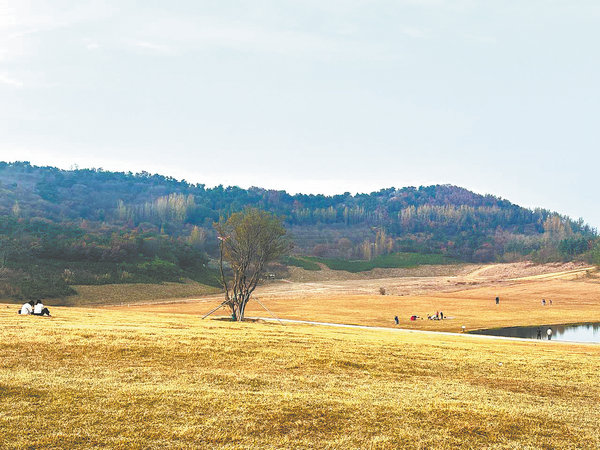
Bailu Bay in Shandong province is a popular destination known for its picturesque rural landscape and enhanced ecosystem. [Photo by ZHAO RUIXUE/CHINA DAILY]
In early winter, Bailu Bay in Wulian county, Rizhao, Shandong province, exudes a serene beauty. Egrets stretch their wings, skimming over the mirror-like water, while nearby, a dozen swans glide gracefully, leaving gentle ripples in their wake.
"See that leading swan? It has a faint gray patch on its neck. It has returned here for the fifth consecutive winter," says Liu Ming, a staff member involved in the cultural and tourism project Bailu Bay Town.
"More birds are choosing to stop over at Bailu Bay, indicating that the ecosystem here is good."
An Ran, another staff member, recalls that back in 2012, this area was a completely different scene. "Where we stand now was desolate, with barren hills and sparse vegetation."
Today, it has transformed into a model for rural vitalization, integrating ecological parks, artistic landmarks and agricultural tourism.
Faced with the challenge of 80 percent bare land, the town embarked on a massive greening effort, planting hundreds of thousands of seedlings over the past decade, including cedar and red maple. This effort has boosted forest coverage to the current 70 percent.
"The saplings we planted were only as thick as a finger, but now they stand tall and lush," says An.
Restoring the water ecosystem was equally crucial.
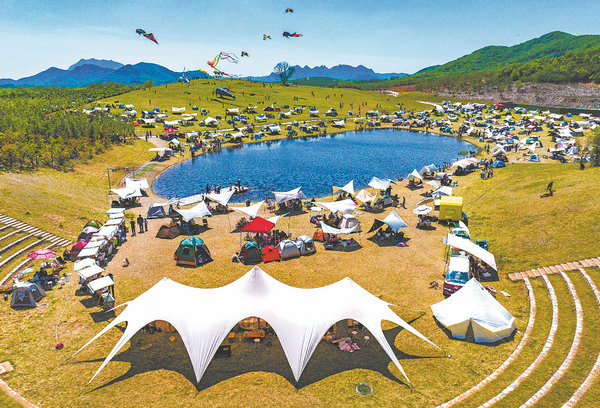
Bailu Bay in Shandong province is a popular destination known for its picturesque rural landscape and enhanced ecosystem. [Photo by ZHAO RUIXUE/CHINA DAILY]
Dredging the Chaobai River, which flows through the bay, reinforcing banks with vegetation, and reviving wetlands have reestablished a healthy ecosystem teeming with water, grass, fish and birds.
"The bay has become a thriving habitat, attracting over 80 bird species. The number of overwintering swans alone increased to 80 last year," says Liu.
This pristine ecological canvas has provided a stage for art to empower the countryside. The Zaishui Art Museum, resting on clear water, connects art galleries with culinary workshops, and has become a famous landmark that attracts tourists.
At the Cocoa "drinks library", the aroma of coffee mingles softly with music, immersing visitors in a unique reading experience. In the Train Park, a retired, green-covered train has been repurposed into a restaurant, offering guests a nostalgic dining experience with pastoral views.
"We integrate art into the fields, making beauty part of daily life," says An.
"Internationally renowned architects have created 12 art museums with distinct styles. These architectural artworks attract about 500,000 visits annually."
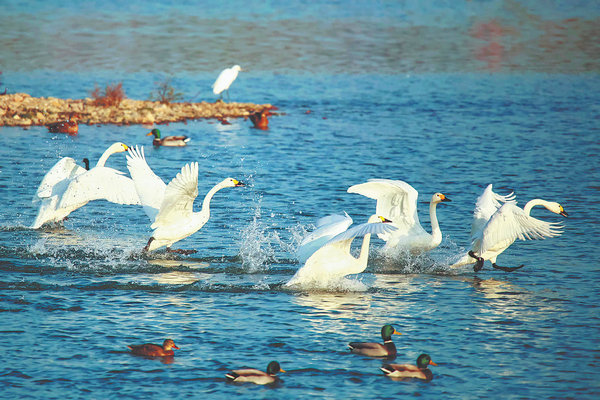
Bailu Bay is a thriving habitat for birds. [Photo by ZHAO RUIXUE/CHINA DAILY]
In addition to art facilities, the town has developed an agriculture-themed tourism belt that includes facilities such as a ranch, tea and sweet potato agricultural complexes, and picking bases for blueberries and cherries.
In the town, visitors can admire world-class architecture, experience rural life, participate in farming and savor local delicacies.
"The ultimate goal of rural vitalization is to benefit the villagers," says An.
In a bakery in the town, Chen Yan, from Chenjiagou village, deftly operates a wood-fired oven.
"I used to make 3,000 yuan ($426) a month at a curtain factory. Now, as a baker, my salary has more than doubled," says Chen.
There are now more than 200 farmers working in the town.
"We prioritize hiring locals and provide training. From cleaners to homestay managers, gardeners to bakers, everyone can find a suitable role if they're willing to learn," An says, highlighting how this approach has empowered villagers to shift from traditional farming to skilled professions.
The town has also explored a model of coordinated development with the collective economy of surrounding villages.
"By using funds to join the operation of the town, our village receives an annual dividend," says Xu Yongxue, Party secretary of Dazhuang village.
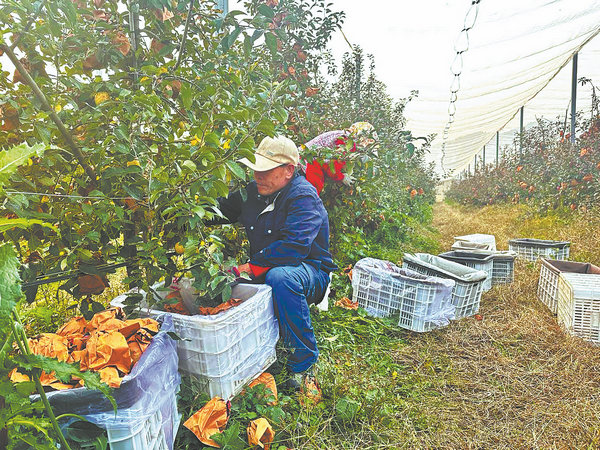
Visitors can enjoy various activities in orchards and the Train Park. [Photo by ZHAO RUIXUE/CHINA DAILY]
With income from leasing 20 hectares of land, the village has a collective annual income of 300,000 yuan. This income finances canteens for the elderly and road improvements in the village.
"Our village used to be poor, making it hard to do anything. For example, we had planned to improve the roads, but we didn't have the money," Xu says.
"But now, with steady income, we can do more for our villagers."
The Bailu Bay project collaborates with seven surrounding villages. By hosting art festivals, photo exhibitions, and intangible cultural heritage workshops, the town draws visitors to neighboring villages.
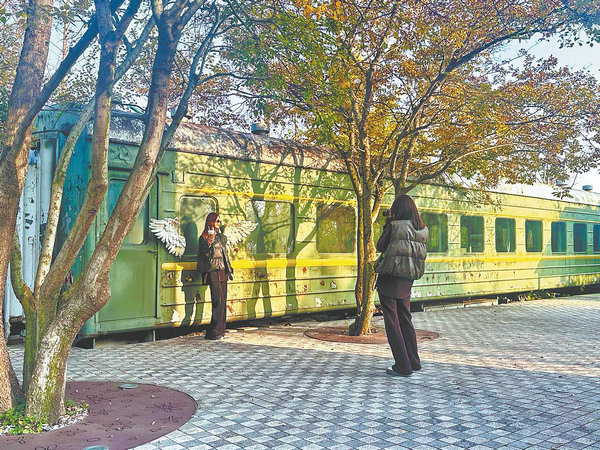
Visitors can enjoy various activities in orchards and the Train Park. [Photo by ZHAO RUIXUE/CHINA DAILY]
Zhangjiazhuang village, by the Chaobai River, has leveraged the brand, transforming empty houses into artists' studios and bookstores, and gradually evolving into a village that attracts art enthusiasts and study groups.
Over the past three years, the town has received over 3 million tourist visits. It has also attracted many young people to develop businesses.
"From barren hills to a popular area that features a healthy ecosystem, this proves that ecological investment is not a cost, but a rewarding strategic investment," says An.
Like the Bailu Bay project, which has driven the development of seven villages, Shandong as a whole has developed 2,070 such integrated development areas in recent years, according to the Shandong Provincial Department of Agriculture and Rural Affairs.
These regions establish collaborative mechanisms among geographically connected and economically complementary villages, functioning as cohesive units characterized by unified planning, interconnected industries, shared infrastructure, and coordinated governance. They now encompass over 18,000 villages.
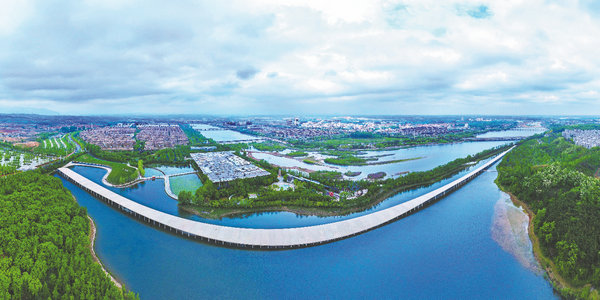
Bailu Bay in Shandong province has transformed from desolation into an ecological and cultural haven, following years of ecological restoration and development. [Photo by ZHAO RUIXUE/CHINA DAILY]
