

The Zhengjiagou site in Xuanhua district, Zhangjiakou, North China's Hebei province. [Photo by Wang Xiao/ For chinadaily.com.cn]
A discovery at the Zhengjiagou archaeology site in Hebei province is offering new insights into the expansion and influence of one of China's most important Neolithic civilizations, dating from 6,500 to 5,000 years ago.
The site, located in Xuanhua district, Zhangjiakou, is home to artifacts from the Hongshan culture, which thrived between 5,000 and 6,500 years ago.
Archaeological work at the site over the past four years has revealed nine stone mound tombs, according to Gong Zhanqing, the executive leader of the excavation at the site.
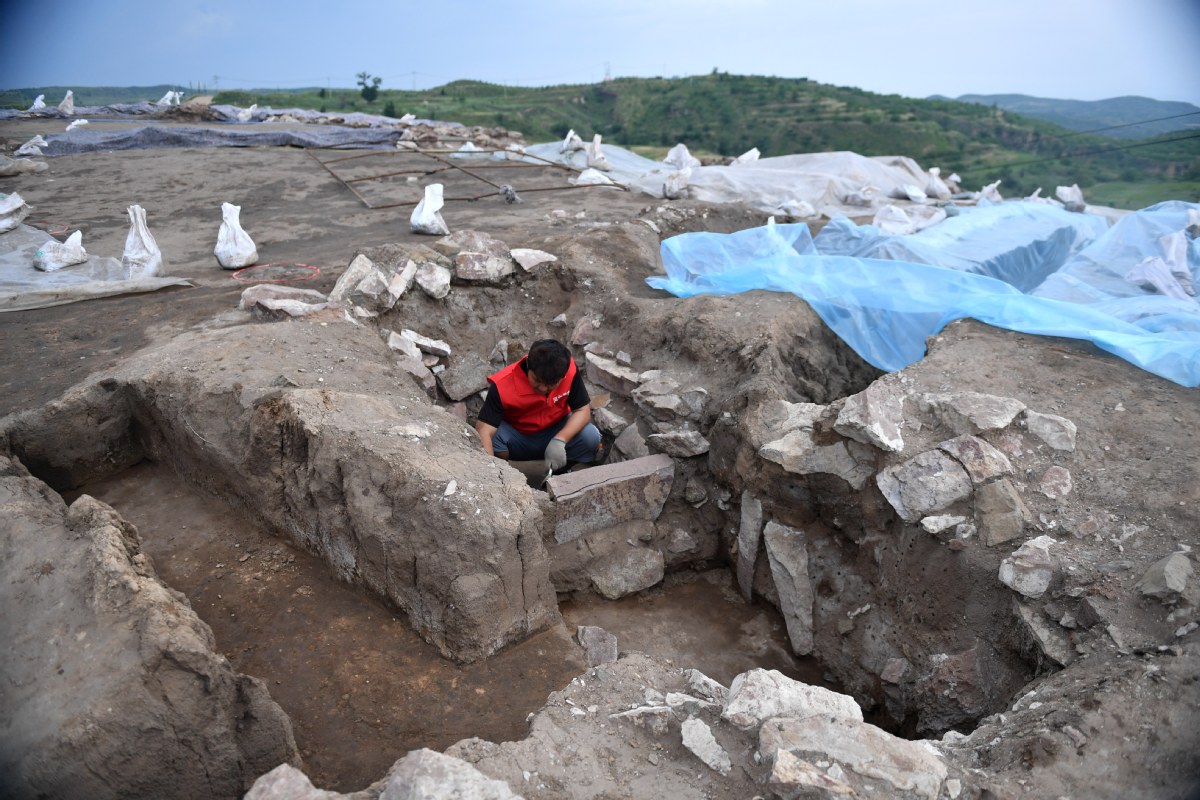
A member of the excavation team works at a stone mound tomb at the Zhengjiagou site in Xuanhua district, Zhangjiakou, North China's Hebei province. [Photo by Wang Xiao/ For chinadaily.com.cn]
One of the largest tombs, labeled Mound No 1, features a three-tiered earthen platform reinforced with stone retaining walls. The mound is clearly divided into burial and sacrificial areas.
Over 600 ritual objects, primarily made of jade, pottery, stone, bone, and shell, have been recovered.
"This discovery lengthens the duration of the Hongshan culture and greatly expands its known sphere of activity," Gong said, adding that it clearly shows a southwestward expansion from the area that is now Northeast China.
The site was one of the major points of discussion at the recent 2025 Hebei Archaeological Achievements Exchange Conference in Shijiazhuang. It was selected as one of the six most important archaeological discoveries in Hebei for 2025.
