
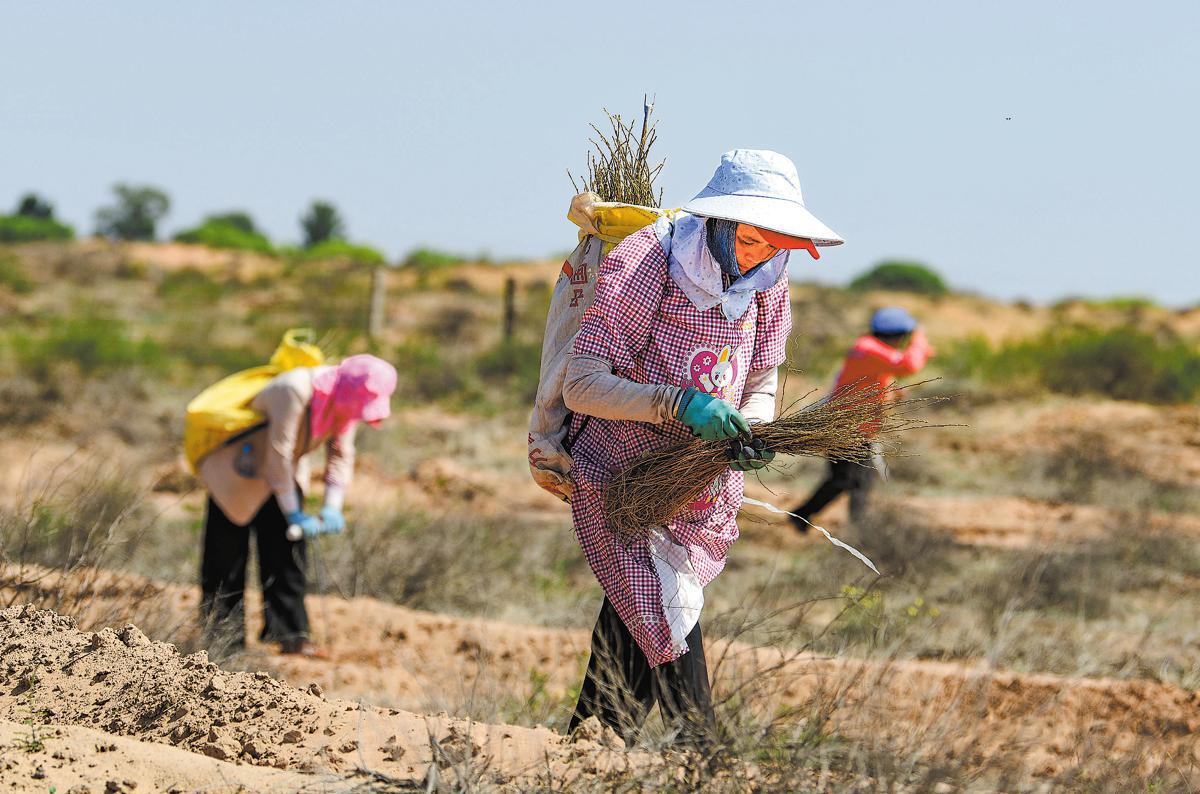
Workers plant caragana saplings in Otog Front Banner, Inner Mongolia autonomous region, in June 2023. WANG ZHENG/FOR CHINA DAILY
Editor's note: This year marks the 20th anniversary of President Xi Jinping's proposal of the concept that "lucid waters and lush mountains are invaluable assets".To mark the occasion, China Daily is publishing a series of stories on how resources such as mountains, rivers, lakes, forests and farms are being transformed into priceless gifts.
New life has been breathed into a patch of once ravaged and desertified grassland in northern China's Inner Mongolia autonomous region, thanks to a biological restoration project integrating the installation of solar panels and the planting of desert-hardy vegetation underneath.
The 700-hectare site in Darhan Muminggan Joint Banner was chosen for the project because of its vast tracts of windswept, uninhabited land with some of the highest solar radiation levels in northern China, and its relative closeness to the industrial hubs of Baotou and Hohhot, which have a high demand for clean energy.
The solar panels, which cover an area more than twice the size of New York's Central Park, do more than generate electricity; they also serve as protectors of the recovering grassland below.
For decades, northern China has tried to fight back against the sands of desertification. Drawing on the collective wisdom of experts, enterprises and farmers, Darhan Muminggan Joint Banner has adopted an innovative approach, sowing grass seeds beneath photovoltaic installations to revive degraded grasslands.
As the grasslands bounce back, related industries are emerging and expanding around them.
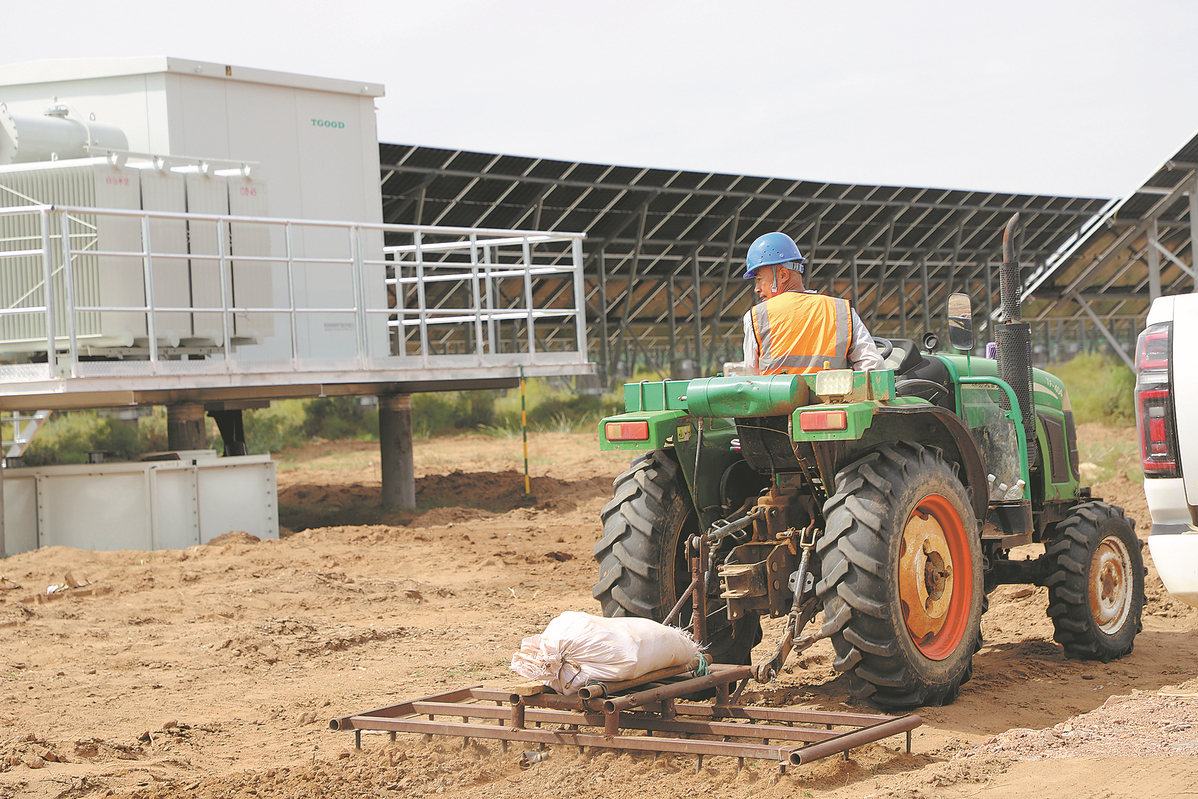
Grass seeds are sowed at a solar farm in Darhan Muminggan Joint Banner, Inner Mongolia. [Photo provided to CHINA DAILY]
Restoring greenery
Last year, the banner launched China's first pilot project integrating grassland restoration with solar power generation, using panels to physically block sand and wind, and provide shelter while generating clean energy.
Due to its unique geography, Inner Mongolia acts as a key ecological barrier for the country, so the success of the pilot project could lead to this approach being rolled out in areas with similar challenges.
Zhou Hui, director of the forest and grassland resources protection center at the banner's forestry and grassland bureau, said that from the 1980s onwards, overgrazing and climate change-induced drought had taken a heavy toll on the grassland.
High-quality pasture has been repeatedly grazed to the point where it can no longer recover, while soil erosion and shrinking surface water bodies have further accelerated the degradation, he said.
"Animal husbandry suffered severe setbacks as grass yields declined sharply," Zhou said. "As a result, herders' incomes dropped, and more than 20 percent of households fell into poverty."
The ecological decline forced many herders to leave and hindered regional development, he added.
To reverse the trend and revitalize the animal husbandry industry, the local government has mobilized enterprises and herders to join the restoration efforts. In addition to the solar shelter project, traditional restoration measures, such as artificial reseeding and rainfall enhancement, have been introduced in the area.
Thanks to the banner's 3,000 hours of sunshine each year, the concept of "power generation above, restoration below", was introduced last year.
"We conducted ecological adaptability assessments to identify shade and drought-tolerant grasses such as alfalfa and crested wheatgrass,"Zhou said. "We needed species that could thrive in the shaded microclimate beneath the panels."
To accommodate grass growth under the panels, they were set at a minimum height of 2.5 meters above the ground and with a row spacing of 6.5 meters. The height is significantly higher than the common 0.8-to 1-meter height used in typical photovoltaic projects.
"This design ensures efficient power generation while providing enough space and sunlight for the grass below," Zhou said.
Once panel installation had been completed, workers sowed the seeds. Months later, verdant growth blanketed the area beneath the panels.
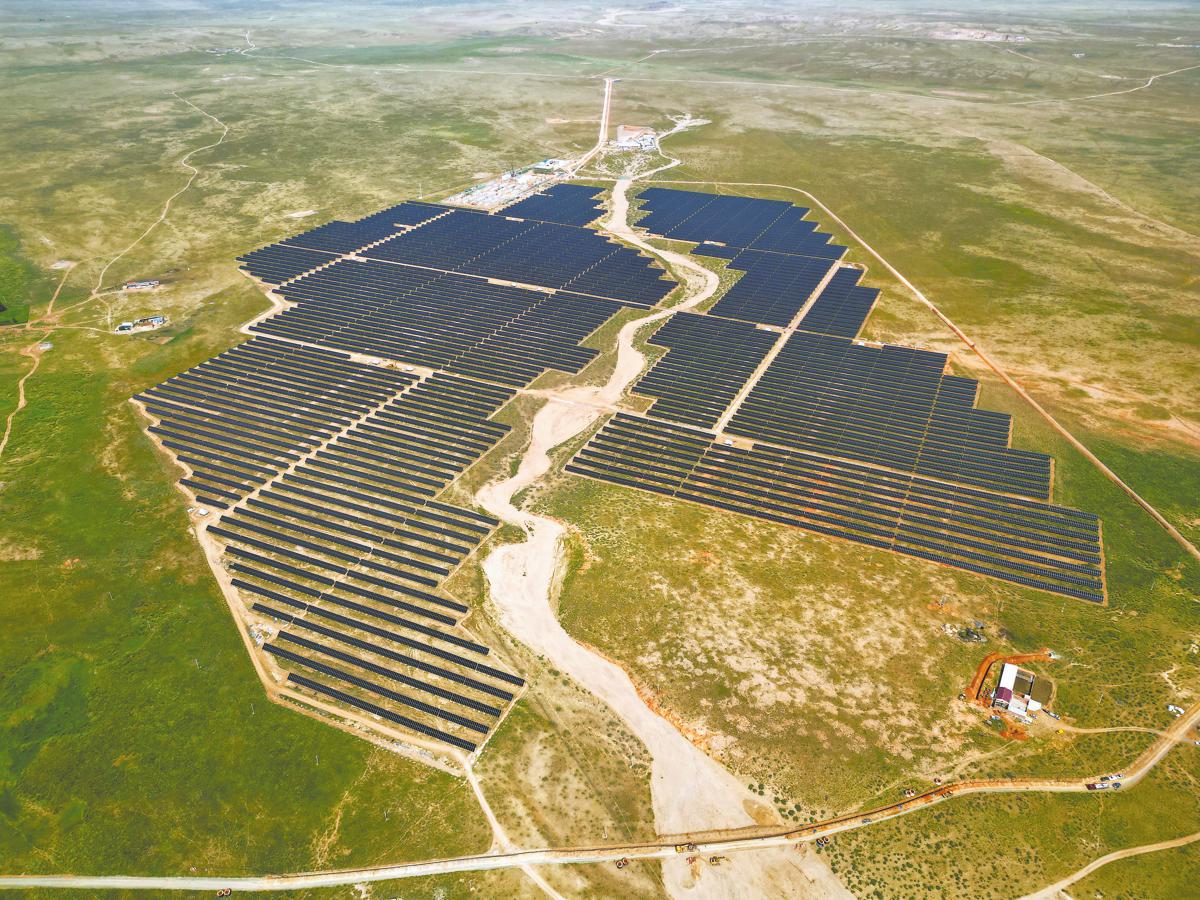
A solar farm spreads out on a grassland in Darhan Muminggan. [Photo provided to CHINA DAILY]
Grass–solar fusion
In the caragana–alfalfa intercropping demonstration area of the pilot project, vegetation cover has reached 95 percent, producing enough forage to meet nearby demand. The forage yields are comparable to those of 10,000 hectares of natural grassland.
This year, the whole banner's average vegetation coverage reached 38.97 percent, exceeding 40 percent in some areas, with an average height of 23.82 centimeters.
The photovoltaic array, which was activated earlier this year, generates around 90 million kilowatt-hours of electricity annually, according to Zhang Jinping, general manager of the photovoltaic part of the project.
Zhou said the micro-environment provided by the shade of the solar panels has reduced moisture evaporation and expanded the range of plantable grass species, greatly improving water-use efficiency and enhancing biodiversity.
"The solar panels can lower surface temperatures by 3–5 C, preventing sun-loving plants from losing excessive moisture through high-temperature transpiration while also providing a suitable habitat for shade-tolerant species," he said.
According to official data, the number of plant species in the pilot area has increased from 12 before restoration to 28. The cooler, more moist habitat has also attracted more insects and birds, indicating a significant improvement in biodiversity.
As vegetation thickens and roots stabilize the soil, wind erosion has declined, Zhou said, adding that the outcome so far has achieved the goal of "stabilizing sand with grass".
Zhang, the manager, said, "While we were installing the panels on the grassland, we consulted with experts from time to time about suitable grass seeds to plant that would ensure disturbance to the grassland was minimized."
With an installed capacity of 50 megawatts, the photovoltaic project supplies clean energy to a green substrate facility in Darhan Muminggan Joint Banner's new industrial park. The 263,000-square-meter array of photovoltaic panels is expected to save more than 39,000 metric tons of standard coal and cut carbon dioxide emissions by about 73,000 tons annually, according to Zhang.
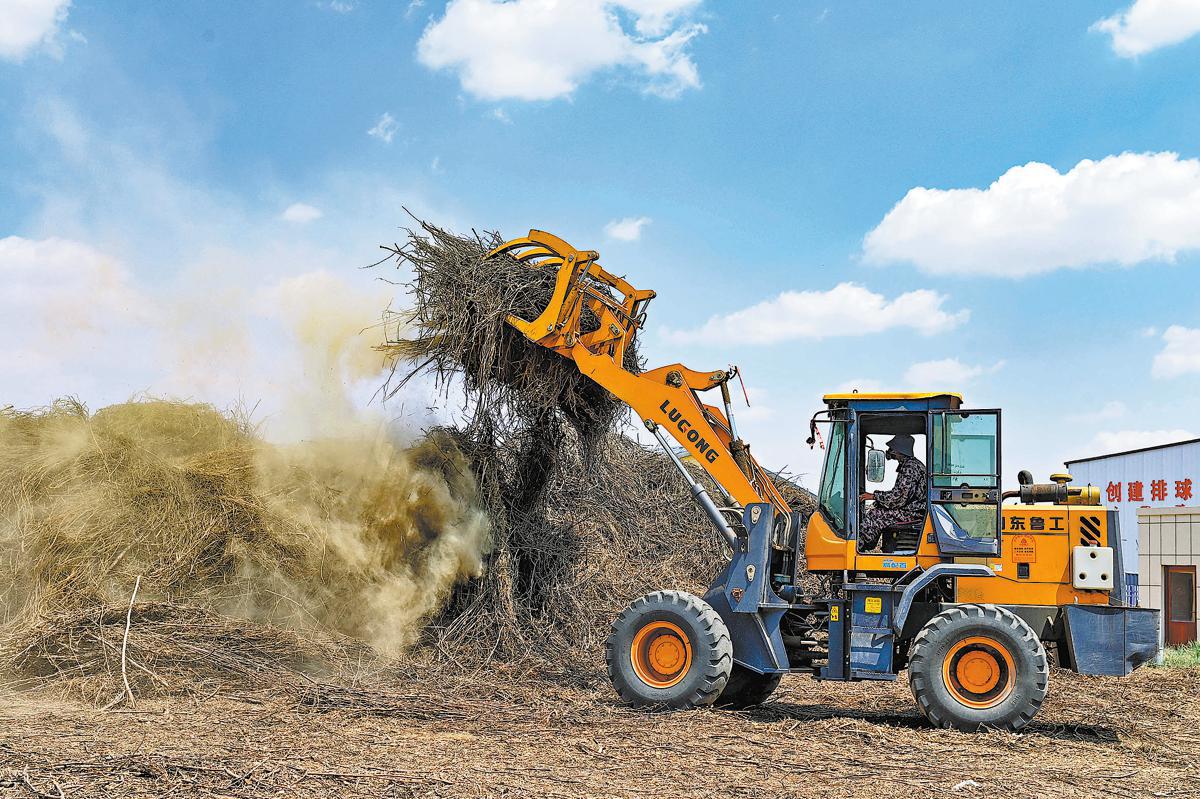
A digger mixes harvested caragana for air-drying before the plants are sent for feed production in Ordos, Inner Mongolia, in May. WANG ZHENG/FOR CHINA DAILY
Seed to feed
Beyond the grass–solar model, drought-tolerant species used in desertification control are also boosting forage supplies for herders in the Inner Mongolia autonomous region.
Caragana korshinskii, a hardy shrub widely planted across dry regions in the country, is considered a treasure in Inner Mongolia's Ulaanqab city. A local saying captures its value: "As both a forest and grass, caragana blocks the wind and stabilizes sand", and serves as a "lifesaving forage for livestock".
Since the 1990s, Ulaanqab has planted the shrub across more than 800,000 hectares. Originally intended for ecological restoration, it also provides abundant, low-cost forage that reduces production expenses for herders and husbandry companies.
Li Kaijun, head of Inner Mongolia Qingmuyuan Agriculture and Animal Husbandry Co, said, "Locally produced caragana forage contains no pesticide residue and has cut transportation costs by over 40 percent."
He added that the stable year-round supply and low price of local caragana forage help increase milk yields, speed calf growth, and improve the company's performance.
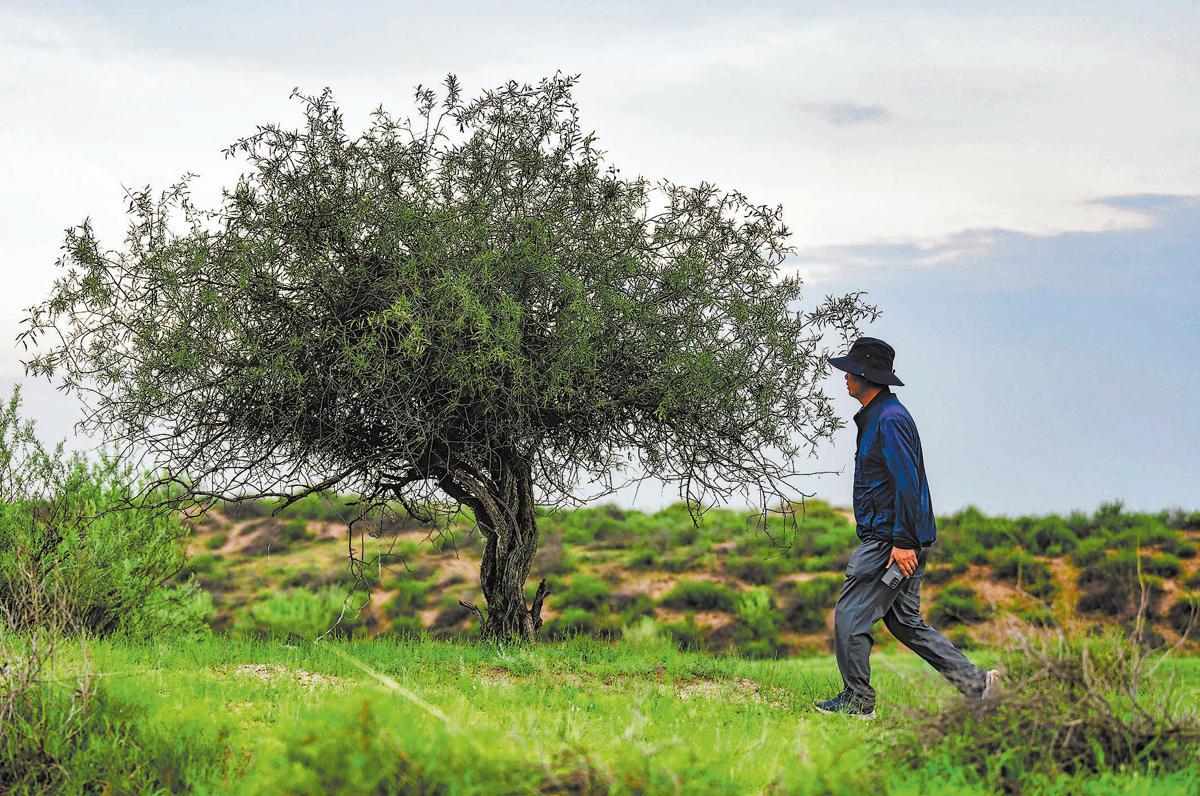
A worker walks through a caragana grassland in Otog Front Banner in July 2022. [Photo provided to CHINA DAILY]
Turning grass grown for sand control into livestock feed forms a "green chain" that strengthens both ecology and industry, Li said.
In addition to caragana, Ulaanqab's grass seed industry has grown to produce high-quality seeds of major species, including alfalfa, smooth brome and crested wheatgrass, with an annual output of 540 tons.
The region, once dependent on external seed supplies for restoration, today relies on its own production, forming a sustainable cycle.
"Take smooth brome, for instance. Its lush growth and high protein content make it both excellent for ecological restoration and a premium forage grass," said Yao Junwen, head of Huiteng Wolf Totem Agriculture and Animal Husbandry Co.
These grass species have thus become the foundation of Ulaanqab's animal husbandry industry. Their abundance and economic value have attracted feed-processing enterprises. A total of 32 caragana processing companies operate in the city, supplying markets such as Ordos in Inner Mongolia and Zhangjiakou in Hebei province.
Li said the model is a virtuous cycle, in which the shrubs are coppiced to support both harvesting and renewed growth.
"The 'coppicing for rejuvenation' method preserves ecological benefits while providing enterprises with low-cost caragana forage," he said.
Contact the writers at lishangyi@chinadaily.com.cn

