
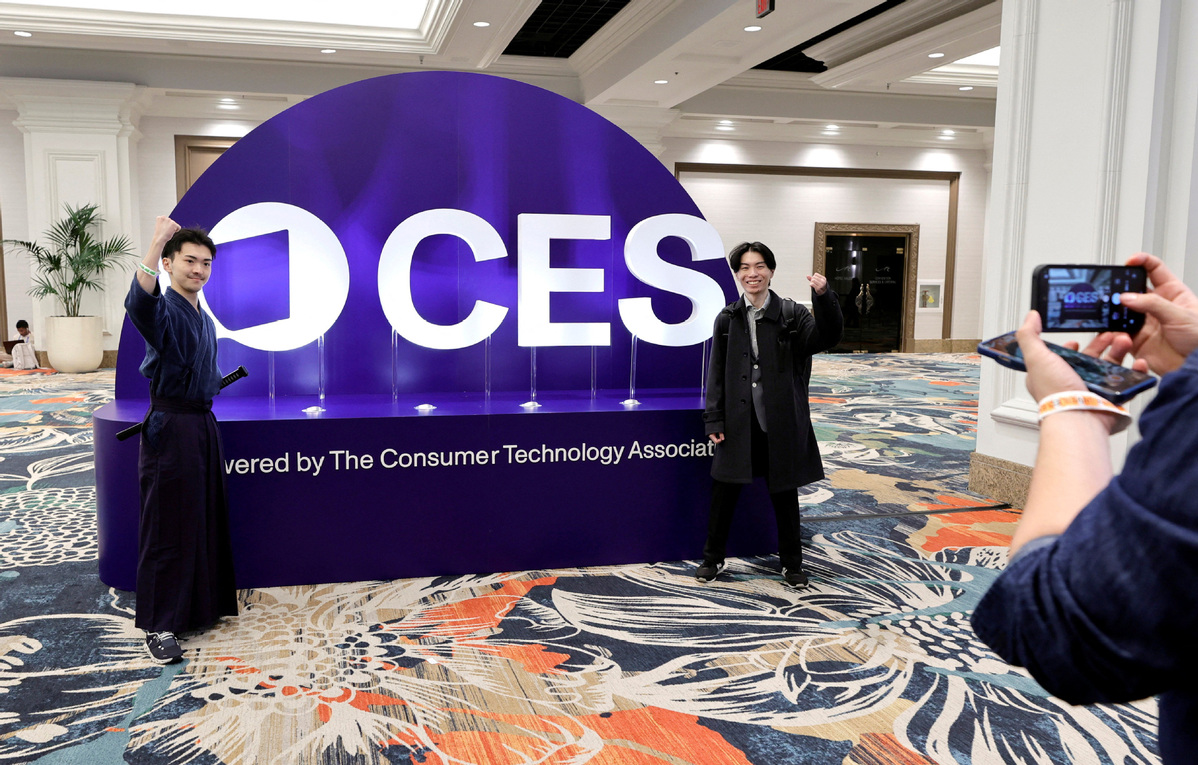
Attendees pose by a CES sign before CES Unveiled at CES 2026, an annual consumer electronics trade show, in Las Vegas, Nevada, US January 4, 2026. REUTERS/Steve Marcus
The Consumer Electronics Show 2026 being held in Las Vegas from Tuesday to Saturday shines a spotlight on cutting-edge innovations, with China's top robotics and AI tech companies once again creating a buzz. For instance, Unitree Robotics has unveiled a new lineup of next-generation humanoid robots that are designed for greater mobility and interactivity. AgiBot, another big Chinese name in the field, is showcasing a portfolio of industry-leading automated solutions for commercial and industrial applications. These demonstrations offer a glimpse into Chinese companies' ability to translate frontier artificial intelligence capabilities into useful real-world industrial applications.
China's embodied AI innovations that leverage the country's combined strengths in AI software and robotics hardware, represented by systems capable of autonomous operation in the physical world — such as autonomous vehicles, drones, industrial manipulators and microbots — are already well recognized globally.
The prowess of Chinese robotics companies is due to many factors, such as the country's huge talent pool, complete industry chain and broad manufacturing base and scale that can help bring down costs drastically, as well as the fierce domestic competition, which means only the best companies survive.
Another factor contributing to the rapid progress in the sector is top-level policy guidance. For example, the Central Economic Work Conference and the 20th Communist Party of China Central Committee's recommendations for the 15th Five-Year Plan (2026-30) both prioritize the development of AI and the expansion of "AI Plus" applications in key sectors, such as the robotics industry.
As China has become one of the fastest-rising economies in terms of innovation capability, innovation and creativity have given rise to new quality productive forces and have made life more colorful.
Indeed, the country has consistently placed innovation at the core of its overall development strategy, emphasizing a "dual-engine" approach that drives both technological and institutional innovation. This has unleashed a continuous surge of innovative vitality. The continuity and stability of policies have provided the much-needed impetus for innovation. For example, China's total R&D expenditure increased from 1.03 trillion yuan ($146.8 billion) in 2012 to 3.63 trillion yuan in 2024, firmly maintaining its position as the second-highest in the world.
According to the 2025 Global Innovation Index Report released by the World Intellectual Property Organization, China ranks 10th for innovation globally, marking the first time China has entered the global top 10, climbing a total of 25 positions since 2013. The report also reveals that China now has 24 clusters among the world's top 100 innovation clusters, the highest number globally. Notably, the Shenzhen-Hong Kong-Guangzhou cluster ascended to the top position worldwide in 2025. These innovation clusters have developed into comprehensive ecosystems, bringing together numerous enterprises, universities and research institutions, thereby facilitating the flow of talent, capital and other resources.
China's progress in seeking innovation-driven growth is a boon to the world. It will enable the country to offer more public goods to the world especially the developing countries, while significantly enhancing people's lives.
Unlike certain countries that seek to leverage technology to impose their will and exert control, China believes that technology should serve to foster global connectivity, and enable diverse cultures to share knowledge and collaborate on global challenges such as climate change.
China hopes to work with other countries to bridge development gaps and promote understanding, making sure technology plays a major role in helping build a community with a shared future for humanity.
Instead of focusing on barriers, nations should invest in research and education and engage in collaboration, fostering environments that encourage technological growth and competitiveness on a global scale, rather than relying on knee-jerk protectionism.
