
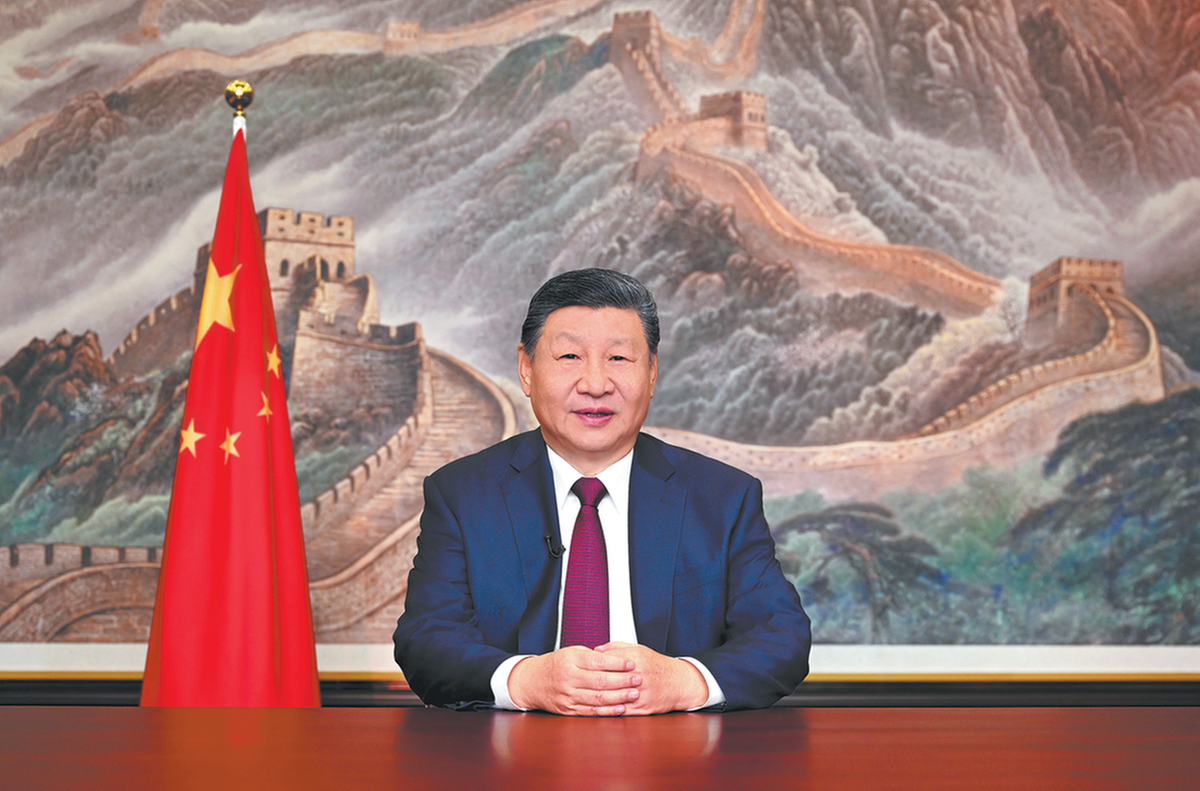
President Xi Jinping delivers his 2026 New Year message through China Media Group and the internet on Wednesday. YAN YAN/XINHUA
Global experts hailed President Xi Jinping's New Year message as an inspiring voice of optimism and stability in an increasingly complex and uncertain world, offering reassurance amid global challenges.
On Wednesday evening, Xi delivered his 2026 New Year message, summing up tangible progress in 2025 and urging solid steps to write a new chapter in the story of China's miracle.
Noting that 2026 marks the beginning of the 15th Five-Year Plan (2026-30), Xi said on New Year's Eve that a successful venture should start with a good plan, with clear goals set, and he called for more concrete efforts to promote high-quality development, further deepen reform and opening-up across the board, and deliver prosperity for all.
Experts highlighted the continuity and the focus on high-quality growth conveyed in the Chinese leader's speech.
Jack Perry, chairman of the 48 Group, a London-based organization that promotes equal and mutually beneficial trade, said, "I have been struck by the consistency and confidence with which China is approaching its next stage of development."
"China is not attempting to change direction abruptly. It is building carefully on what has already been achieved. As the 14th Five-Year Plan (2021-25) draws to a close and the 15th Five-Year Plan approaches, there is a clear focus on strengthening foundations rather than chasing short-term gains," Perry said.
In an increasingly fragmented world, China's greatest advantage may not be speed or scale, but clarity of direction, he pointed out.
"For multinational companies and global investors, predictability of direction is often more valuable than short-term incentives."
He highlighted that in China, the language of reform, innovation and shared development is backed by institutional capacity and long-term planning, which gives China its unique position in the global economy.
Tom Harper, a lecturer specializing in China's international relations at the University of East London, said that Xi's remarks reflect both continuity and change in China's path, showing that Beijing is focused on high-quality growth rather than growth at all costs.
Karori Singh, former director and emeritus fellow at the University of Rajasthan's South Asia Studies Centre in India, said Xi not only highlighted achievements of the year 2025, but also expressed satisfaction with the performance of the 14th Five-Year Plan in terms of high-quality development and modernization.
Xi underscored challenges ahead and strategies to address them, said Singh, adding that Xi's speech explained that China has moved ahead with enterprise and fortitude, and with adequate research and innovation backing it up.
In his New Year message, Xi said that over the past year China continued to embrace the world with open arms. He said that China always stands on the right side of history, and is ready to work with all countries to advance world peace and development.
Jack Midgley, an adjunct associate professor in the Security Studies Program at Georgetown University in Washington, said that Xi's New Year message struck a positive tone regarding China's future in a peaceful world.
Charbel Barakat, a media commentator and head of the international news department at Kuwait's Al Jarida newspaper, emphasized China's role as a stabilizing global force.
China's accelerated development of new quality productive forces, as outlined in its latest five-year plan, represents a shared opportunity for the Global South, he said. "By offering technology, investment and knowhow without political conditions, China is injecting new momentum into global growth and industrialization efforts in developing nations."
In today's volatile and polarized international landscape, characterized by unilateral and zero-sum policies, Barakat emphasized that China's commitment to multilateralism, win-win cooperation and internationally lawful solutions reinforces its role as a stabilizing force.
"For the Global South, China's approach offers an alternative model of major-power behavior — one that emphasizes sovereignty, inclusiveness and development over coercion and ideological confrontation — thereby strengthening solidarity and creating broader space for cooperation in an increasingly divided world," he said.
Wang Mingjie in London and Yang Ran contributed to this story.
