
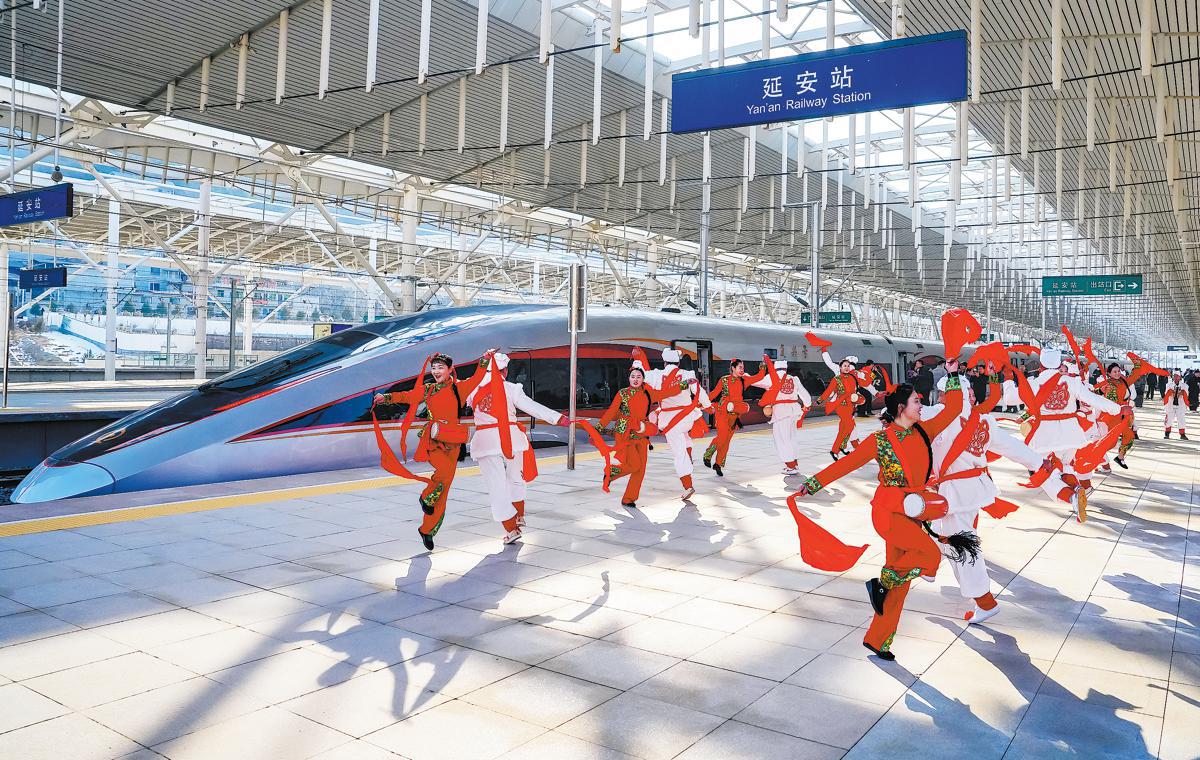
Dancers perform an Ansai waist drum dance on Friday at Yan’an Railway Station to welcome Train C9312, the inaugural service from Xi’an North Railway Station. The route in Northwestern China’s Shaanxi province stretches 299 kilometers with a designed top speed of 350 km/h, making it the fastest railway currently traversing the Loess Plateau.Liu Yijiang/For China Daily"
With the opening of the Xi'an-Yan'an high-speed railway in Northwestern China on Friday, the country's high-speed rail network has surpassed 50,000 kilometers. This marks a major milestone in China's railway development and reinforces its position as the world's largest high-speed rail operator.
China's high-speed rail now serves 97 percent of cities with populations above 500,000, and the network holds the world's largest operating mileage, surpassing the combined total of all other countries, according to China State Railway Group, the national railway operator.
The new line, which cuts travel time between the two cities from over two hours to about one, brings both historical regions and modern communities closer, highlighting the transformative power of high-speed rail.
The 299-kilometer line runs north from Xi'an, the capital of Shaanxi province, to Yan'an, a city famed as the base of the Communist Party of China leadership for around 13 years from 1935 to 1948.
Traversing Shaanxi's Loess Plateau, the new line links towns and cities that are part of China's revolutionary base areas, with 10 stations including Fuping South, Tongchuan and Luochuan.
The line not only shortens travel times, but also connects the region more closely to the rest of the country, reinforcing its role in China's high-speed rail network.
At stations such as Fuping South, Tongchuan, Luochuan and Yan'an, locals were seen enjoying the sunshine at the station squares, where snack stalls have quickly sprung up.
Many residents said the new stations have already become local landmarks and lively community hubs, offering fresh spaces for leisure and socializing. These scenes illustrate how the high-speed rail line is reshaping daily life along its route.
"When I was a child in the 1960s and 1970s, traveling from Fuping to Xi'an was a full-day ordeal," said Lu Zengren, a resident of Yao village, Fuping county.
"We would leave at 2 or 3 am, carrying big bags on our backs, with some buns for the journey. By the time we reached Xi'an, it was already evening — about 15 hours in total. Now, with high-speed rail, the same trip takes just 20 minutes."
Nesrine Karmani, a student from Tunisia, took the maiden ride from Yan'an to Xi'an on Friday.
It was also her first high-speed train trip, and Karmani spoke highly of her experience.
"I took the regular speed train to Yan'an before, and the bullet train cut in half the travel time," she said.
"The high-speed train is so fast and comfortable. The environment is better as well," she said, adding that she plans to take more advantage of China's high-speed railway network to travel during weekends.
Lu and Karmani are among millions of people whose daily lives have been transformed by high-speed rail, experiencing not just faster travel but also greater convenience and connectivity along the route.
Within city clusters, major cities within a 500-km radius can now be reached in one to two hours, while cities within 1,000 km are connected in four hours, allowing same-day round trips. Even journeys of up to 2,000 km can be completed in eight hours, letting travelers depart in the morning and return by evening.
For example, the Beijing-Shanghai high-speed railway covers about 1,318 km in roughly four-and-a-half hours; the Beijing-Guangzhou line, spanning 2,298 km, can be traveled in around eight hours; and the Beijing-Tianjin intercity line, just 120 km, allows commuters to reach the neighboring city in about 30 minutes.
Such connectivity strengthens the flow of people, information and capital between cities, facilitates resource integration and accelerates regional development. The network has also generated a "same-city effect", spurred the growth of urban clusters, and created multiple economic corridors linked by high-speed rail lines, the company said.
"High-speed rail has not only transformed the way Chinese people travel, but has also reshaped the relationship between space and time," said Yu Jian, director of the comprehensive planning division at the planning research institute of the China Railway Economic and Planning Research Institute.
"These lines are part of a national network, not stand-alone routes. Only by operating the network as a whole and strengthening the links between lines can high-speed rail reach its full potential," he added.
luowangshu@chinadaily.com.cn
