
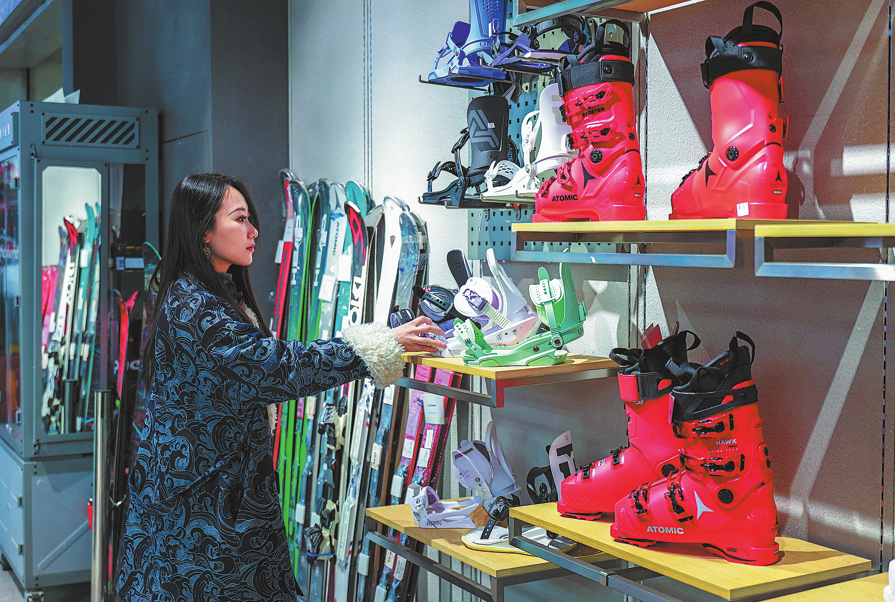
A consumer checks out ski gear at a store in Hohhot, Inner Mongolia autonomous region, on Dec 7. DING GENHOU/FOR CHINA DAILY
An earlier-than-usual winter in parts of northern China is giving the country's ice and snow industry a timely boost, helping ski resorts open sooner, lifting ski traffic and translating into stronger-than-expected sales for equipment makers at the start of the new season.
"The overall start of this snow season is clearly better than last year," said Xiong Wei, vice-general manager of Pegasus Sports Co Ltd, which manufactures ski boots, bindings and snowboards. "Colder weather came earlier, and that has driven demand from both ski resorts and consumers."
Xiong said that this year, their business is expected to outperform last season, supported by rising participation from beginners and young ski enthusiasts, particularly the extended snow holiday in Xinjiang Uygur and Inner Mongolia autonomous regions and northeastern China provinces for primary and middle school students.
Plans to grant primary and secondary school students a five-day snow holiday in early December, are potentially being extended to nine days when combined with adjusted weekends.
"The youth market is particularly strong," Xiong said. "Junior products are selling out quickly, and many retailers are already restocking. We expect demand to remain high through January and the Spring Festival."
After years of producing ski equipment for export markets, the company launched its own domestic brand, Chanrich, in 2020 and has since benefited from growing recognition among homegrown ski labels.
"Consumers today are much more willing to choose domestic brands, especially those from outside the first-tier cities," he said.
"They value practicality and cost performance, and local brands now have a clear edge there."
A key product this season is the company's self-developed fast-wear binding technology, designed to make ski gear easier and safer to use. "Lowering the entry threshold is critical," Xiong said. "If beginners can put the equipment on quickly and feel secure, they are more likely to try skiing and stick with it."
The improving outlook of manufacturers reflects broader growth across the industry. The 2024-2025 China Ski Industry White Paper by Wu Bin, founder and CEO of Beijing Snowpal Enterprise Management Co Ltd, shows that during the 2024-25 snow season, 22 new ski resorts were built and put into operation across China, including six indoor facilities and 16 outdoor resorts. By the end of the season, the total number of ski resorts open to the public reached 748, comprising 66 indoor and 682 outdoor venues, up 29 from the previous year.
From May 1, 2024 to April 30, 2025, domestic ski resorts recorded 26.05 million skier visits, a year-on-year increase of 12.9 percent from 23.08 million. The data highlight the sustained momentum of winter sports in China following the Beijing Winter Olympics, which helped expand skiing and skating beyond traditional northern regions.
Policy support continues to underpin the sector. At a recent forum where the China Ice and Snow Industry Development Research Report (2025) was released, Bai Yufei, a professor at Beijing Sport University, said the earlier onset of winter in northern China is creating favorable conditions for the 2025-26 snow season. He added that supportive national policies are providing strong backing for the ice and snow economy.
Last November, the State Council issued guidelines aimed at promoting the high-quality development of ice and snow sports, setting targets for the industry to reach 1.2 trillion yuan ($170.4 billion) by 2027 and 1.5 trillion yuan by 2030.
According to Li Li, general manager of Asia Data Group, the industry's expansion is also reflected in rising enterprise activity, with the number of ice — and snow-related cultural enterprises reaching 3,984 by August this year, up 5.84 percent from 2024.
wangzhuoqiong@chinadaily.com.cn
