
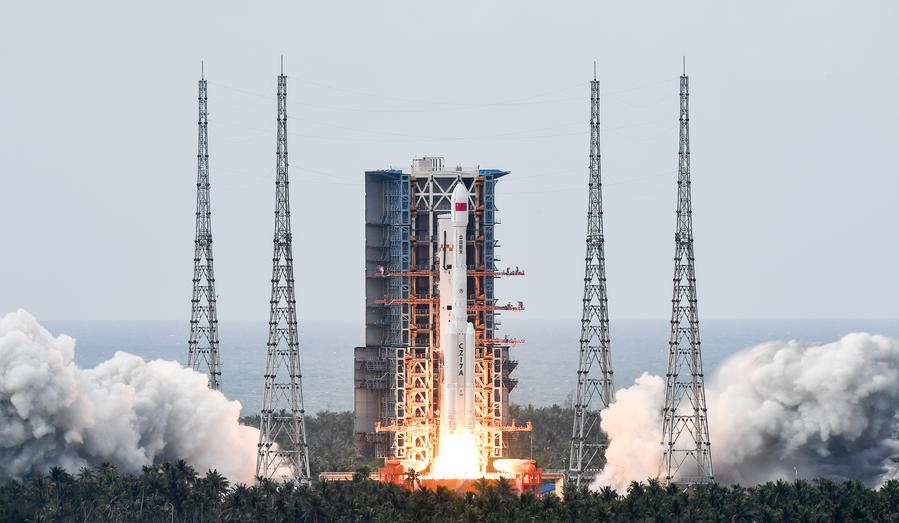
A modified Long March-7 carrier rocket carrying the Yaogan-45 satellite blasts off from the Wenchang Spacecraft Launch Site in South China's Hainan province, Sept 9, 2025. The satellite was launched at 10 am (Beijing Time) and has entered the preset orbit successfully. [Photo/Xinhua]
Hainan province is intensifying efforts to build a comprehensive aerospace industrial cluster at Wenchang International Aerospace City, focusing on satellite launches, satellite manufacturing and data chain development.
Cao Shuyu, mayor of Wenchang, said the city will accelerate the development of a full commercial aerospace chain. Major projects, including a space-themed park, are being planned to position Wenchang as the "Capital of Aerospace Tourism".
In August, the Hainan provincial government issued a three-year plan (2025-27) to develop a modern industrial system with local characteristics and advantages. The plan highlights aerospace as a key sector, outlining measures to foster a full commercial aerospace industry chain and establish Wenchang as a major scientific innovation base for aerospace.
To enhance launch capabilities, Hainan is upgrading its launch site for commercial aerospace and accelerating second-phase construction and supporting facilities. The second phase of the Hainan commercial aerospace launch site began construction in January this year.
Hainan International Commercial Aerospace Launch Co said it plans to double its number of launch pads from two to four, and push forward rocket-recovery technology.
Yang Tianliang, chairman of the company, said: "By end-2026, we will have launch pads No 3 and No 4, along with a new technical area and telemetry station. Once completed, the facility will be able to handle more than 60 launches annually, with each pad supporting launch missions every 10 days, or even weekly."
Wenchang in Hainan offers geographical and policy advantages, experts said. Its latitude boosts payload capacity by 10-15 percent, while its coastal location eases sea transport and provides safe landing zones for reusable rockets.
Rocket recovery is seen as key to cost reductions. With first-stage manufacturing accounting for more than 70 percent of launch expense, Yang said the company is building a sea-recovery vessel soon to support a "launch-recover-reuse" model and enable recovery missions for domestic rocket makers.
Minsheng Securities said 2026 will be a critical year for the debut and validation of new-generation reusable rockets, both from private and State-owned enterprises, potentially marking a true turning point for commercial rocket development.
International cooperation is also expanding. Wenchang said it is partnering with the national deep space exploration lab on four new centers for payload integration, deep-space research, industrial coordination and international exchange.
The city has also teamed up with Tsinghua University and other institutions on joint research and space-station support.
On top of cultivating the aerospace industry, Hainan is also stepping up its push to build competitive future-oriented industries, such as seed production and deep-sea exploration. The island province is also scaling up and strengthening its tropical high-efficiency agriculture and cultivating a number of specialized industrial clusters such as tourism and modern service sectors, according to the Hainan provincial government's three-year plan.
Contact the writers at masi@chinadaily.com.cn
