
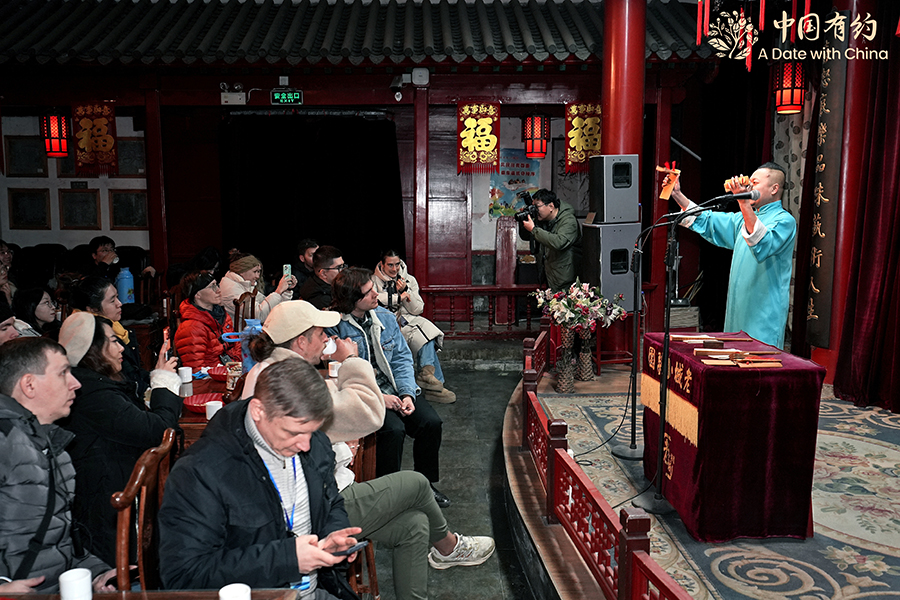
Participants of the 2025 "A Date with China – Charming Tianjin" international media tour visit a crosstalk teahouse in Tianjin on Dec 16, 2025. [Photo/chinadaily.com.cn]
Situated on the banks of the Hai River, Tianjin, while known as a major international port city, has been steadily cultivating an identity as one of the premier hubs for technological innovation in China. However, although Tianjin remains on the cutting edge of innovation and boasts a thriving research environment — ranking as the 15th leading city in the world in terms of research output in 2024— Tianjin has not lost touch with the traditions and culture that made the city stand out long before its turn as an innovation center.
As a participant in the 2025 "A Date with China – Charming Tianjin" international media tour, I was able to experience this duality firsthand.
My date with Tianjin began with a very special crash course in Pingju Opera at the Hongqi Theater. As part of a China Daily livestream, I took on the very appropriate role of the "clown" in the Pingju classic Du Shiniang. I was made up, outfitted in a costume, and coached in the movements and singing of the character I was playing by experts who have studied Pingju Opera for decades.
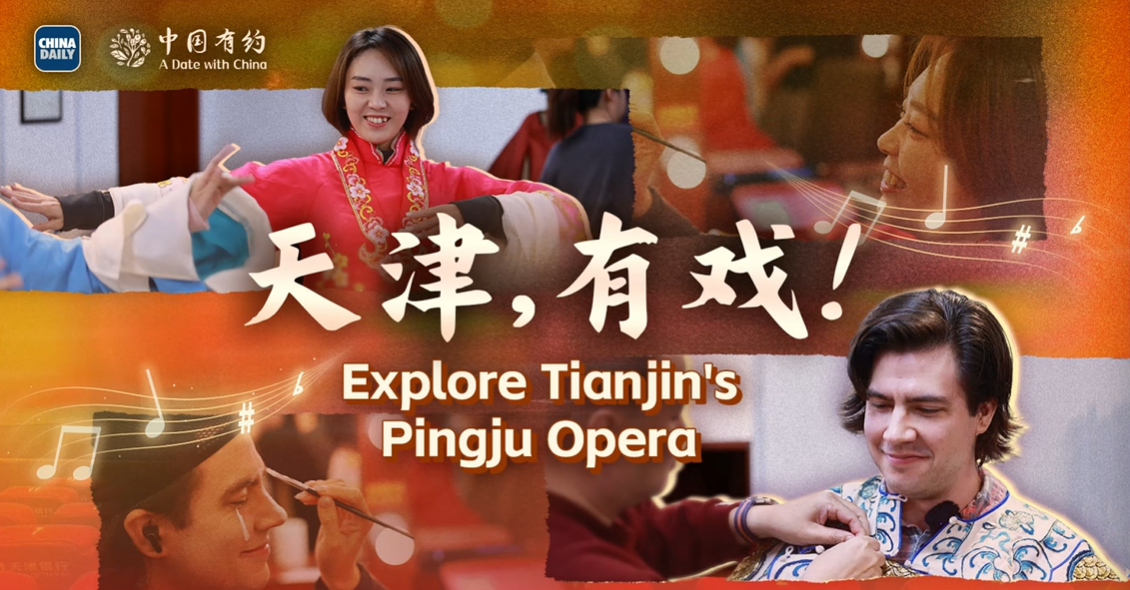
Click on the pic to watch livestream Behind the curtain: Explore Tianjin's Pingju Opera
For a first time effort, it was still quite poor, but I appreciate the efforts of the Hongqi Theater staff for doing their best to coach a modicum of grace from my clumsy form.
In subsequent days, I was able to visit the Circular Economy Exhibition Hall of the Tianjin Ziya Economic and Technological Development Zone to learn about China's green development philosophy and model for enhancing resource-use efficiency to protect the environment while also ensuring sustainable economic development.
We visited the Lenovo Innovation Industrial Park where the company's latest AI infused products were demonstrated, and also stopped to explore AI intelligent home health management robots by Baima Planet.
To get acquainted with Chinese intangible cultural heritage and folk customs, we walked along Tianjin's Ancient Culture Street, visited the clay figurine museum of the Zhang family, a shadow puppet theater, and Guangdong Guild Hall where we admired the beauty of Chinese classical architecture and opera.
This is by no means an exhaustive list, just some of the highlights.
The structure of the tour was a masterstroke by the organizers — showcasing Tianjin as a model for moving forward without abandoning the past — alternating between experiences in the technological innovations that are driving economic development and experiences in the traditions and culture of the city.
My main takeaway from the tour is this: the future is inevitable. There is no escape hatch on the path that the collective "we" are heading down. There's simply too much momentum, too much investment, and too much riding — from an economic standpoint — on technological advancement and its integration into every facet of our daily lives.
Given this harsh reality, in an age of the major, technology-driven societal upheaval being led by rapid advancements in AI, it's more important than ever that these traditions be continued and protected. After all, a millennium from now, will anyone tell tales of the AI-generated cat videos their ancestors watched on the subway ride to work? Not likely.
But, just days ago, I watched a shadow puppetry performance of Journey to the West — a story that has been told for hundreds of years in a medium that itself is thousands of years old.
Lest we forget, as one of the earliest forms of visual storytelling, shadow puppetry was a major technological advancement in its day. While new forms of entertainment have since come along and captured our imaginations and destroyed our attention spans, the old ways have earned their place in history as vehicles for Chinese values and cultural identity.
China boasts 5,000 years of civilization, but what would that matter if the links to that history were allowed to fade away? What if there were no more inheritors of the ancient arts? I shudder to think. However, Tianjin gives me hope that tragedy will be avoided.
The writer is a foreign expert of China Daily Website.
