
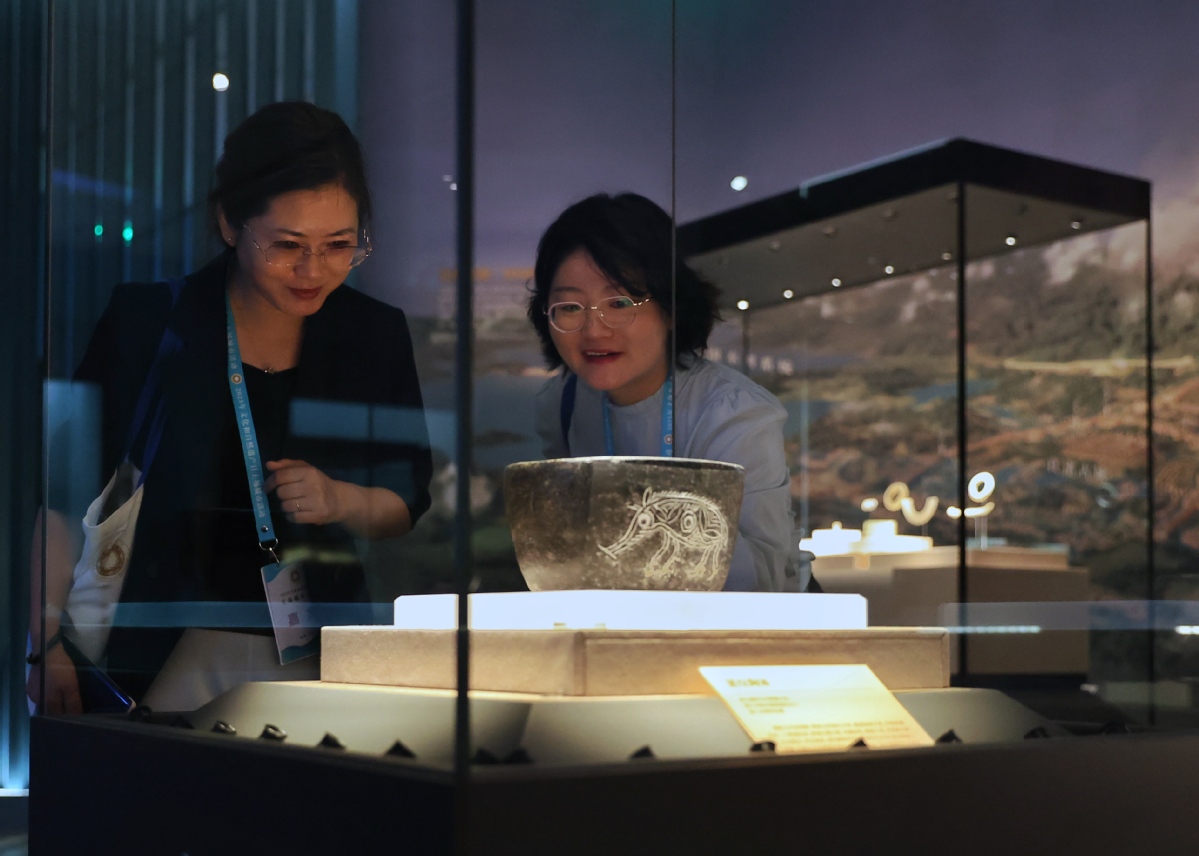
Visitors admire a pig-patterned pottery bowl unearthed from the ancient Hemudu site in Yuyao, Zhejiang province, on display at the exhibition opening on June 14, 2025. [Photo by JIANG DONG/chinadaily.com.cn]
The mighty Yangtze River, long regarded as the cradle of Chinese civilization, now takes center stage at the Changsha Museum.
As part of the celebrations for this year's Cultural and Natural Heritage Day that highlights the country's efforts to preserve and rejuvenate China's cultural relics, the Exhibition of the Yangtze River and the Chinese Civilization opened on June 14.
With over 200 sets of rare cultural relics on display, this exhibition traces the evolution of Chinese civilization along the Yangtze River — from prehistoric settlements to imperial grandeur, and into modern connectivity.
Jointly hosted by the National Cultural Heritage Administration and the Hunan government, the exhibition displays an unprecedented collaboration of 51 major cultural institutions, including the Palace Museum and the National Museum of China.

A visitor looks at clay figurines from the Jin Dynasty (266-420), unearthed in Changsha, on display at the exhibition. [Photo by JIANG DONG/chinadaily.com.cn]
Divided into three thematic chapters — Vital Origins, Brilliant Convergence and Magnificent Momentum — the exhibition spans 11 sections that metaphorically represent the 11 provincial-level regions through which the Yangtze flows.
The Vital Origins explores early human activities and the shared genetic roots of Chinese civilization, with highlights such as jade artifacts from the Neolithic archaeological site of Liangzhu in Zhejiang province, painted pottery from the Shijiahe site dating back about 5,900 years in Hubei province, and early city structures from the Baodun site about 4,500-3,700 years ago in Sichuan province.
The Brilliant Convergence showcases how the Yangtze contributed to the development of crafts, governance and philosophy, featuring relics from the ancient sites of Panlongcheng in Hubei and Sanxingdui in Sichuan, and exquisite bronzeware from Yunnan and Sichuan.
The Magnificent Momentum delves into the river's influence from the Song Dynasty (960-1279) onward, highlighting advancements in politics, education, trade and cultural exchange — from the Yuelu Academy and Jiangnan textile industry to ancient imperial examination scripts and theatrical paintings.
Beyond artifacts, the exhibition reimagines how geography and history intertwine, integrating symbolic visuals and interactive technologies. The museum's central atrium — with its grand dome and layered platforms — has been transformed into a narrative space where visitors metaphorically "travel upstream" along the river's cultural course.
