
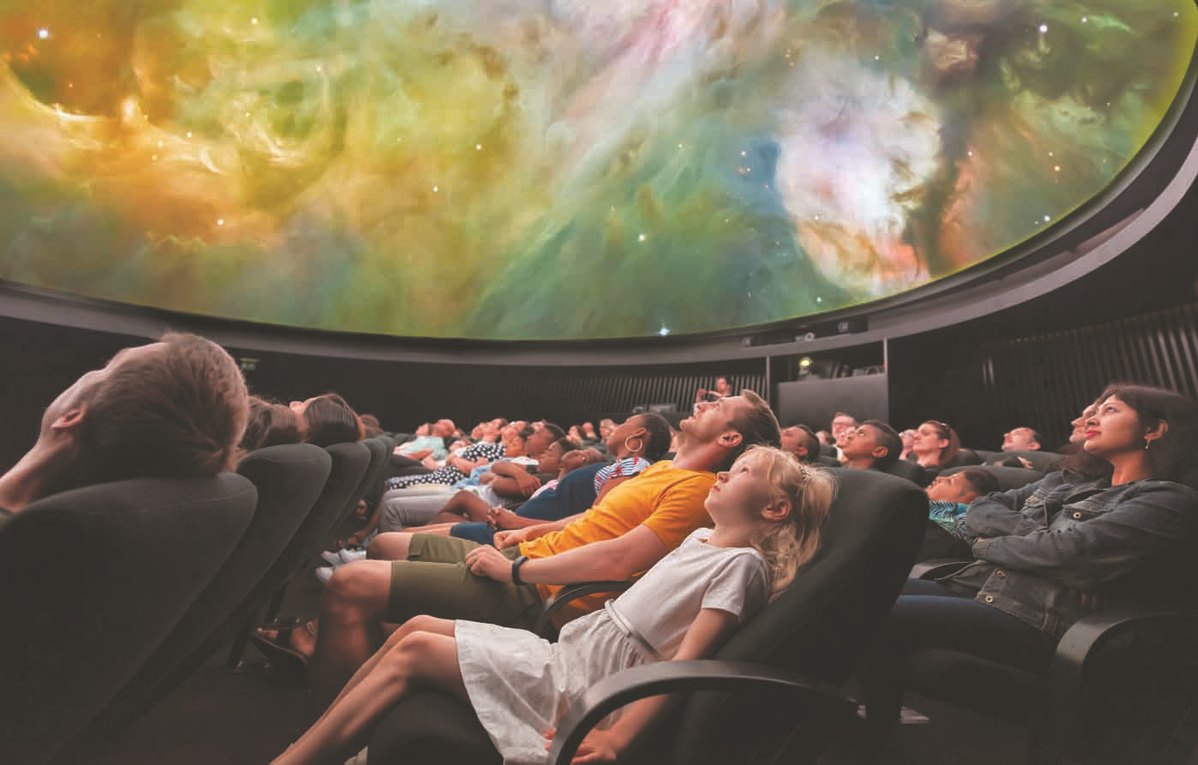
Visitors watch the planetarium show at the Royal Observatory Greenwich. A special show about ancient and modern Chinese astronomy will be given on Dec 16. CHINA DAILY
While the progress of China's Tiangong space station continues to fascinate fans of all things lunar and planetary around the world, anyone wanting to find out more about the past, present, and future of China's involvement with the stars can make the slightly easier journey to Greenwich in London to stay up to date.
On Dec 16, the latest event in the Chinese astronomy program at the Royal Observatory Greenwich takes place, giving visitors a chance to learn all about China's connection with the heavens, from way back in history to what is yet to come.
Tania de Sales Marques, a senior astronomy manager at the observatory, is originally from Macao, China's special administrative region, and she told China Daily that when the venue was looking to expand its programming and audience reach, China was an obvious choice.
"Part of our community strategy is to run events that would appeal to audiences who might not necessarily usually come to us, so first of all we did the astronomy of Islam, which was really successful, and we decided we wanted to develop it further," she said.
"We looked around at local communities that have a rich history of astronomy — ancient and modern — and with me in the team and my background and professional connections, it just made sense to do something about China.
"People are really interested in learning about different ways of looking at the stars, and also learning about the long and rich history of observations, some of which are very accurate, and even though they're hundreds of years old, still guide astronomers today."
With a history of astronomical study and observation dating back to Gan De and Shi Shen in the 4th century BC, China has a huge heritage of celestial observation, which, as Marques put it, "connects pieces of a puzzle that help with modern understanding".
According to the Britannica website, supernova remnant the Crab Nebula, which is particularly clearly visible in winter, was discovered by British astronomer John Bevis in the 1700s. But centuries earlier, Chinese observers were aware of it.
"We use modern things like the Hubble telescope to observe it today, but we know that ancient Chinese astronomers observed it in 1054, when they saw a star come up in the sky for a short time, then disappear.
"They called it the Guest Star, and astronomers have since checked calculations and realized that the Chinese astronomers had observed the supernova explosion that led to the formation of the Crab Nebula."

An illustration of Chinese constellations. CHINA DAILY
In years gone by, astronomers held positions of great responsibility, as their ability to read the heavens and make predictions contributed to the power and authority of emperors.
The way that the heavens are still significant in Chinese culture for dates, such as the Lunar New Year, and choosing auspicious days for events like weddings, Marques said, showed that there was still a cultural affinity to the lights of the night sky.
Although the observatory has done shows in Mandarin and Cantonese as part of a separate community program, the upcoming Chinese show will be delivered in English, for maximum possible appeal.
"It's for everyone who is interested in learning about astronomy from different cultures and angles, so we hope we can continue to grow it for more and more people," she explained.
Anna Gammon-Ross is a senior planetarium astronomer at Greenwich and presents the Chinese astronomy show. She told China Daily that even after years of studying the stars, she was still learning new things from the Chinese shows that she helps put together.
"What is most fascinating is how much more complex the Chinese approach is than the Western approach we use today," she said. "The sheer number of asterisms, how they work together — everything has a meaning, makes you think about the sky in a different way.
"The contemporary Western view is that we see the stars in 88 constellations, but the Chinese have hundreds, some of which are absolutely tiny, then within that, they group asterisms together to make bigger groups.
"The amount of detail they've gone into to group stars together is so much more than we do now, so when I'm preparing for another talk, after I've done one of the Chinese shows, I know I have so many more things that I can talk about, which makes the other shows richer.
"We focus on those ancient constellations, and the way that they still influence the timing of festivals today, but it's great to have the modern context too — we talk about the current missions to the moon, where China has become the first country to land on the far side, and also the Mars mission plans."
Gammon-Ross admitted that the show has sometimes been "tricky to market", but said all the audience feedback has always been very positive.
"The biggest conversation I had after the last show was with a non-Chinese family who had come along because they were interested in the ancient culture and in hearing about space in a different way," she said, stressing that the most important message to get across was that the show was for anyone with an open mind and a sense of wonder.
"The planetarium show isn't hardcore science — you don't need to know the physics, you can look at nice things and learn something," she said. "The vast majority of people who come along definitely aren't experts, but it's a subject that draws people in. You would really struggle to find someone who wasn't interested in space at all."
