

Leopold Martin Chen Lind (third from left) takes a selfie as he revels in his victory in the Belt and Road Youth English Speaking Competition. Just behind him are Zhang Aijun (center), a member of the Standing Committee of the CPC Jiangsu Provincial Committee and head of the publicity department, and Qu Yingpu, publisher and editor-in-chief of China Daily. ZOU HONG/CHINA DAILY
Two public speaking competitions brought together young people from around the world, and they faced off in finals during the week, Meng Wenjie reports.
The power of public speaking is evident in the stories of young people such as Zhou Yuxi, 21, a student at Hong Kong Polytechnic University. For Zhou, public speaking is a platform to advocate for the issues and groups she deeply cares about.
In a speech she delivered in the national finals of the China Daily"21st Century Cup" National English Speaking Competition, she talked of growing awareness among women, exemplified by a decision the German women's gymnastics team made at the Tokyo Olympic Games held in 2021. In opting to switch from traditional half-body suits that reveal the female figure to bodysuits that cover the thighs and extend to the ankles, they created quite a stir.
In her speech, Zhou said: "As time goes by, evolution happens, on her, on them. From thousands of years ago, women silently accepted the role of 'caring for the family' or 'passing on the lineage', to the first feminist movement (that) broke out in France 200 years ago, to the awakening of women's consciousness worldwide, to today's many outstanding women in all walks of life."
After the competition, Zhou expressed her gratitude for being born in a safe and relatively gender-equal country like China. However, she recognized the struggle of women worldwide and their need for a global voice. She aspires to be that voice for them.
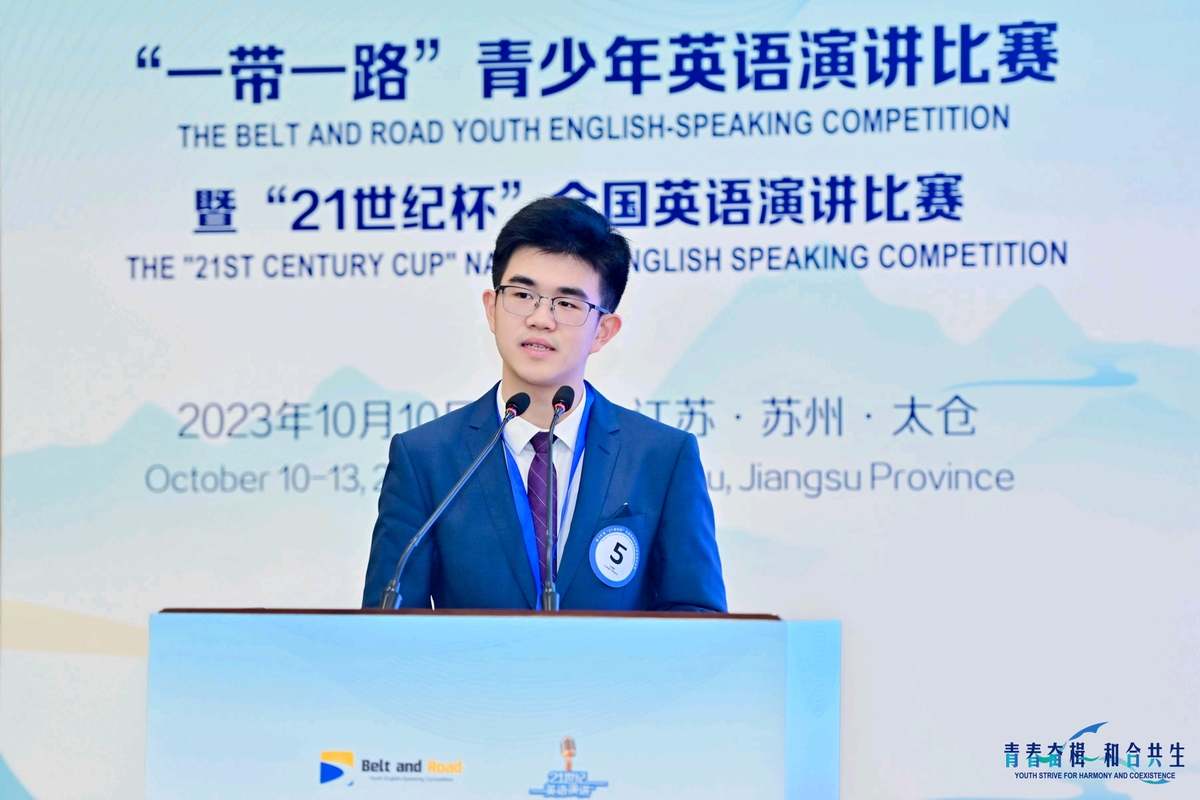
Liu Baoxiang
"I may not be able to contribute to groundbreaking advances in fields such as medicine or physics, but as a language learner I can wield language as a potent tool to aid those in need."
The competition combined two events: the Belt and Road Youth English Speaking Competition and the "21st Century Cup" National English Speaking Competition. The national grand finals were held in Taicang, Jiangsu province, from Tuesday to Friday.
Liu Baoxiang of Peking University won in the 28th "21st Century Cup" National English Speaking Competition's college group. Yin Yue of Central South University in Changsha, Hunan province, won in the youth group. And Leopold Martin Chen Lind, a German who is studying at Tsinghua University in Beijing, won the fifth Belt and Road Youth English Speaking Competition.
Tian Yihan, 19, a sophomore at China University of Political Science and Law in Beijing, who qualified for the final round of the "21st Century Cup" competition, fondly recalled her elementary school years when her English teachers often showed students videos of top contestants in the competition.
"It was during those moments that I developed a dream of some day stepping onto this stage myself."
Tian said she was pleasantly surprised by the attention the audience gave to her speech. "It was a powerful experience for me. I find it awesome to have such a platform where I can freely express and disseminate my ideas and opinions."
The primary goal of the "21st Century Cup" National English Speaking Competition, established in 1996, is to give young people the opportunity to have their voices heard on the global stage.
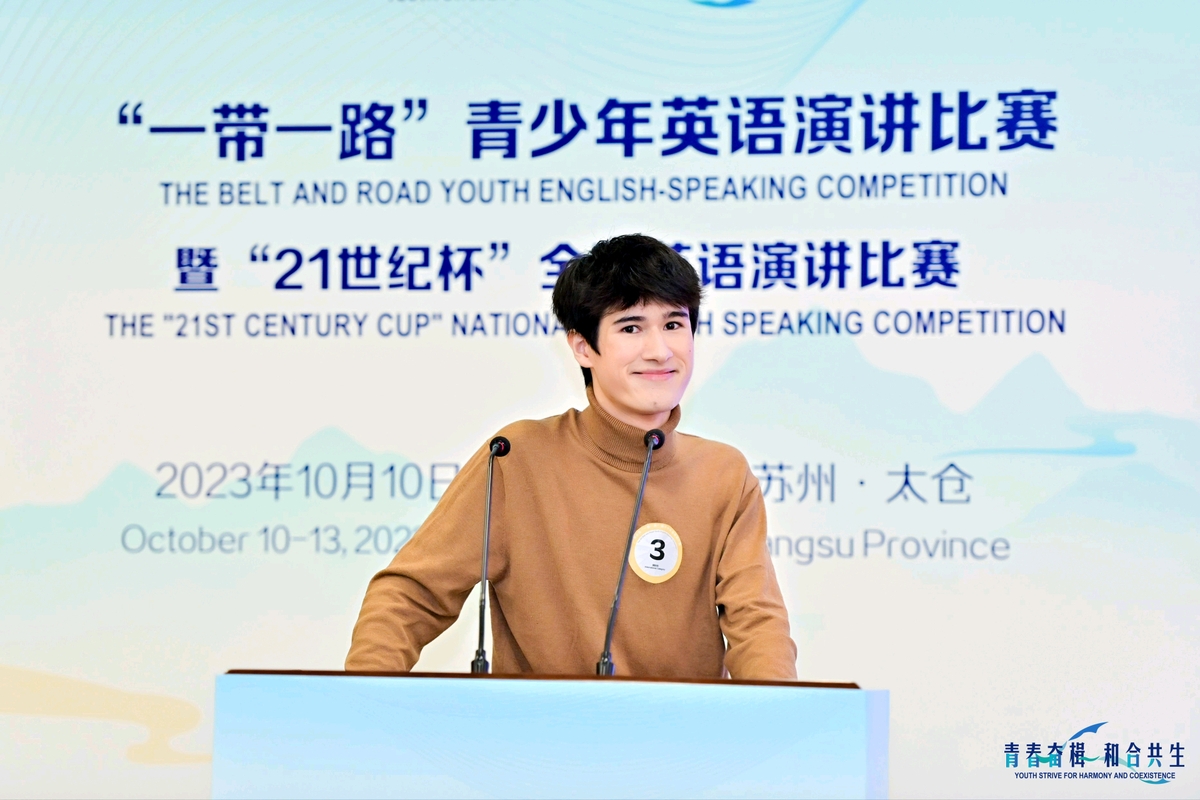
Leopold Martin Chen Lind
"The '21st Century Cup' provides a platform for youth of all ages and nationalities to share their thoughts," said Yin, 24, the youth group champion. "The topics of the contest always revolve around social issues and global matters, aiming to inspire participants to boldly express their opinions and encourage critical thinking."
Zhang Qirui, 20, in his third year at Huazhong Agricultural University in Wuhan, Hubei province, told of promoting Chinese hybrid rice in Nigeria as part of the Belt and Road Initiative.
He faced challenges when local farmers rejected his "advanced methods" and said that "farmland should remain in its natural state as a gift from God". Zhang said he was shocked by what he called their "primitive" views, but his supervisor offered a critical perspective: "They are not lagging behind. They are just different."
Through respectful intercultural dialogue, Zhang and his team eventually reached a consensus with the Nigerians on farming concepts.
China, renowned for its bridge-building skills, is now connecting with the rest of the world and helping produce prosperity and mutual development, Zhang said.
Bridge building is something the"21st Century Cup" has been doing for years. And four years ago its organizers established the Belt and Road Youth English Speaking Competition. This year's event featured more than 30 participants from five continents competing for six spots in the finals.
One of them was Tawanda Mupini, 26, from Zimbabwe, who has lived in China for seven years and is studying medicine at Fudan University in Shanghai.

Yin Yue
In his speech he talked about the benefits of the BRI for young Zimbabwean farmers, agriculture having become a significant source of employment and income for many young people in his country, he said.
"I believe that public speaking is an effective means to convey and express ideas to others, facilitating communication among people from different countries, civilizations, and cultures."
During the competition, Eloise Claire Cameron-Smith, 22, an Australian studying electronics engineering at Auckland University of Technology in New Zealand, said she found joy in experiencing new cultures and breaking down barriers.
In her speech, she said the modern world is like "a place where people live divided by large glass walls, able to see in but never communicate and never truly understand".
The BRI is eliminating such impediments and is forging "new pathways of connectivity, cooperation and commerce across continents", she said.
Connections and communication were recurring themes in both competitions.
"I think the competition is a melting pot of ideas, which creates moments of cultural bonding where you not only understand the cultures of others but also reflect on your own culture through these exchanges," Lind said.
Contact the writer at mengwenjie@i21st.cn
