
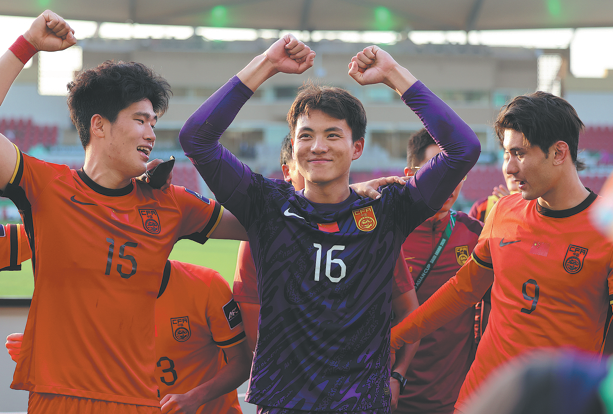
China's goalkeeper Li Hao (center) celebrates with teammates after winning the quarterfinal against Uzbekistan at the 2026 AFC U23 Asian Cup on Jan 17 in Jeddah, Saudi Arabia. WANG HAIZHOU/XINHUA
Twenty-two years after last appearing in an Asian Cup final, Chinese soccer returned to the continent's biggest stage — not through the senior national team, but via a youthful U23 squad carrying long-unrealized hopes.
The ending was not a fairy tale, yet the journey offered a rare and powerful reminder of what Chinese soccer can still aspire to achieve.
In Saturday's AFC U23 Asian Cup final in Saudi Arabia, China's U23 men's team fell 4-0 to Japan. Team China's Spanish head coach, Antonio Puche, acknowledged the gap, describing Japan as "on a different level", and calling the score line "harsh". But he was unequivocal in his praise for his players.
"I'm very proud of my players," Puche said. "Losing naturally brings disappointment, but we have to stay balanced."
"We have never been in such a situation," he said of the final, "but the players showed great spirit right up to the final whistle."
China entered the final unbeaten and without conceding a single goal. The defeat sealed a runner-up finish, yet it also capped a breakthrough campaign that rewrote history. Team China progressed beyond the group stage of the U23 Asian Cup for the first time, battled through successive knockout rounds, and reached the final, a result that few had dared to imagine only weeks earlier.
Each hard-fought match answered skepticism with resilience, surprising fans back home and rekindling optimism in a soccer landscape long starved of uplifting moments.
While the U23s were making waves on the international stage, change was also unfolding at the senior level.
Newly appointed men's national team head coach Shao Jiayi has been leading a revamped China squad through an intensive winter training camp in Dubai, United Arab Emirates. Following a demanding "two sessions per day" training regimen, the team has focused on building physical endurance while improving tactical cohesion.
In March, Shao will lead China to Australia for the FIFA Series 2026, where they will face Australia, Cameroon, and Curacao. The tournament will mark his first official competitive outing since taking charge of the national team, and it has drawn close attention from both fans and observers eager to see the direction the rebuild is going in.
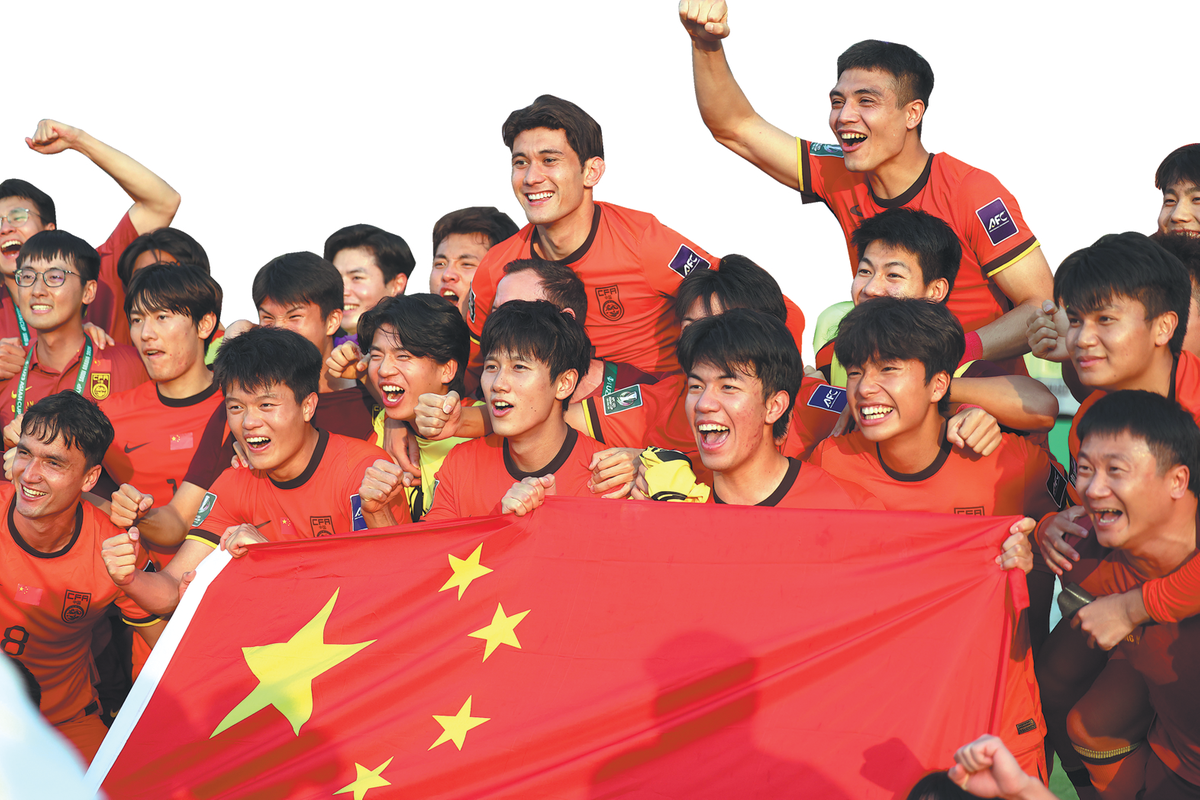
Chinese players pose with the national flag after reaching the U23 Asian Cup semifinals on Jan 17. WANG HAIZHOU/XINHUA
These parallel developments have given Chinese soccer a rare sense of momentum at the start of a new year. Expectations for a return to the World Cup and Olympics have quietly risen, while enthusiasm for the sport has also surged at the grassroots level.
Following the breakout success of the "Suchao" — the 2025 Jiangsu Football City League — multiple provinces including Guangdong, Zhejiang, and Shandong have begun rolling out city football leagues for 2026, signaling the arrival of a nationwide, mass-participation soccer movement.
Rising star
At the heart of China's U23 Asian Cup run was 22-year-old goalkeeper Li Hao, who emerged as one of the tournament's standout performers. Appearing in every match, he conceded only four goals — all in the final against Japan — after keeping clean sheets in his first five games.
According to statistics from the AFC's official website, Li made 33 saves across six matches, ranking among the highest totals in the competition. His consistent excellence between the posts formed the backbone of China's defensive stability and was instrumental in the team's historic progression to the final.
Li's defining moment came in the quarterfinal clash against Uzbekistan. Over 120 minutes of regulation and extra time, he produced a series of spectacular saves, denying one-on-one chances, long-range strikes, and shots from tight angles near the byline. In the penalty shootout, he blocked a decisive attempt with one hand, sealing China's progression and earning Man of the Match honors without dispute.
As the final whistle blew, Li's teammates lifted him into the air. The sunset over Jeddah bathed the young goalkeeper in golden light, freezing a famous moment that will long linger in Chinese soccer fans' memories.
"I've actually dreamed of moments like this many times — wearing the national team jersey and being thrown into the air by my teammates," Li told Xinhua News Agency afterward. "I always believed this day would come. Thinking back on all the hardship and effort, I feel it was all worth it."
Behind the heroics lay meticulous preparation. Before every crucial save, Li would discreetly glance at a small note taped to his water bottle. He explained that the note offers guidance in decisive moments and is usually brought out only when needed.
Despite his growing fame, Li consistently credited the collective team effort over individual brilliance.
"The most important people are the 10 teammates standing in front of me, including those who came on as substitutes. They run tirelessly on the pitch and work even harder than I do," he said. Even as his highlight reels flooded social media, the modest goalkeeper insisted: "I feel a bit embarrassed. I was just doing my job."
Li's rise has been closely tied to the guidance of Shao.
The goalkeeper, who previously trained in Atletico Madrid's youth academy, secured the starting role at Qingdao West Coast Football Club in the Chinese Super League last season, largely due to Shao's recommendation during his time with the club.
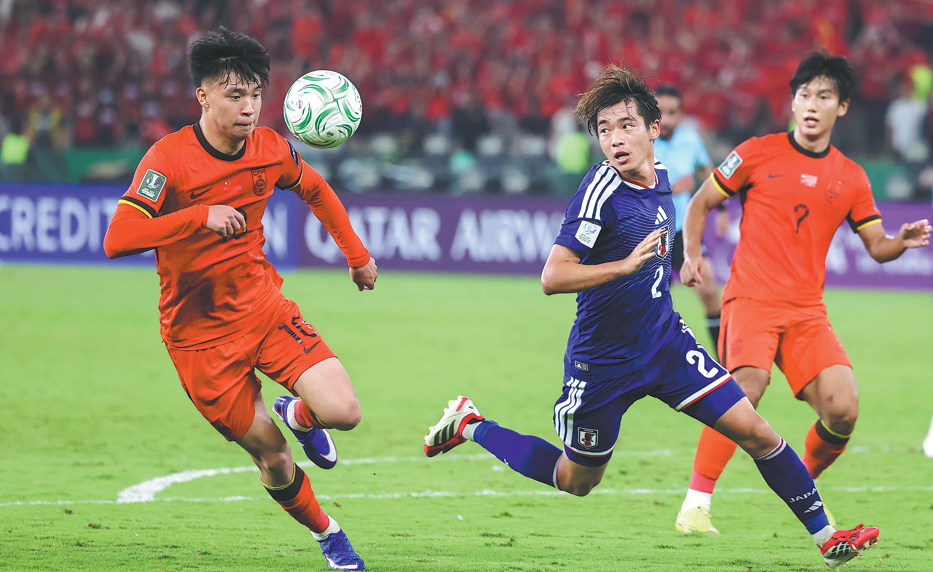
Wang Yudong (left) of China vies with Rei Umeki (center) of Japan during the U23 Asian Cup final in Jeddah on Saturday. WANG HAIZHOU/XINHUA
Li said Shao has long been a mentor. "When I first started playing in the CSL, I couldn't keep up with the tempo at all," he recalled. "Coach Shao and goalkeeping coach Yang Zhi helped me adjust step by step and guided my improvement."
"Coach Shao always told me to set my goals higher and believe firmly in my pursuit. Without that encouragement, I might not have made it out of my low point. He gave me immense trust and helped me regain my confidence."
Now that Shao has taken charge of the senior national team, Li hopes to soon don the senior team jersey.
Although this U23 Asian Cup was not directly tied to Olympic qualification, the achievement has laid a solid foundation for China's push to qualify for the 2028 Los Angeles Olympics.
At the 2028 U23 Asian Cup, only the top two finishers will earn Olympic berths, with seeding determined by results from the previous three editions. Thanks to this year's performance, China is set to shed its fourth-seed status, potentially benefiting from a more favorable group draw.
Looking ahead, several players — including Wang Yudong and Kuai Jiwen — will remain eligible for the next cycle.
Combined with prospects such as Liu Chengyu and Li Xinxiang, who narrowly missed out this time, this battle-tested generation appears better prepared to face future challenges, even if Asia's Olympic quota is reduced to two places.
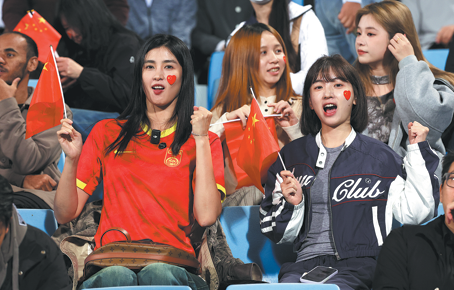
Former Team China goalkeeper Zhao Lina (left) cheers for the Chinese team during its opening match against Iraq on Jan 8. WU ZHIZHAO/FOR CHINA DAILY
New start
The momentum extends beyond the youth ranks.
On Jan 1, the latest senior national team training squad was officially announced, with Shao assembling the team for his first camp in Zhaoqing, Guangdong province, before heading to Dubai for a two-week overseas training stint.
At his first media appearance as head coach, the 45-year-old former national team midfielder admitted he felt both excitement and pressure.
"Excitement, because coaching the national team is the ultimate dream of every coach; pressure, because of the heavy responsibility on my shoulders," he said.
"Since the announcement, the urgency of unfinished tasks has never left me. Becoming head coach is only the beginning. Leading the team to show fighting spirit and results that satisfy the Chinese people — and fulfilling a long-held national soccer dream — is our core goal."
A veteran of the 2002 FIFA World Cup, Shao later built a distinguished club career in Germany, making 168 appearances. After retiring in 2015, he transitioned into coaching, working with China's U18 and U20 teams before guiding Qingdao West Coast through consecutive successful relegation battles in the CSL.
China's most recent World Cup qualifying run ended in an early exit from the third round of Asian qualifiers, extending a drought that has lasted since the team's lone World Cup appearance in 2002. As global attention turns to this summer's World Cup, China has shifted its focus toward 2030.
Facing the challenges confronting Chinese soccer, Shao has emphasized patience, humility, and a renewed focus on fundamentals. He has also pledged to continue learning and refining his ideas, calling for greater understanding and support as the team rebuilds.
"Although there is still a gap between us and the world's strongest teams, soccer is a team sport,"Shao said. "As long as we unite our collective strength, we can move forward steadily."
Discussing winter training, Shao stressed that physical conditioning remains the immediate priority. "We will test our work through matches and adjust our plans dynamically," he said. "For the national team, no match can be taken lightly — every game carries the expectations of the fans and the future of the team."
On the goal of World Cup qualification, he said: "Reaching the World Cup is our shared ambition. I can't promise qualification, but we will move forward step by step through solid training and high-quality matches, giving everything we have to pursue that goal."
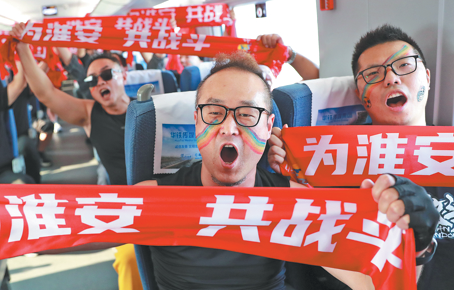
Fans of the Huai'an team practice chants and slogans on a soccer-dedicated high-speed train during the 2025 Jiangsu Football City League on Sept 20. XU CHANGZHENG/XINHUA
Nationwide boom
While a return to the World Cup may still be some distance away, enthusiasm for the sport at home is already surging. Last year, the Suchao staged 85 matches, drawing more than 2.43 million stadium spectators, and generating over 2.2 billion online views. The league also emerged as a powerful engine for the integrated development of sports, culture, tourism, and commerce.
That momentum is now spreading nationwide. Competitions such as the "Yuechao" league in Guangdong and the "Zhechao" league in Zhejiang have been formally placed on the calendar, with city football leagues increasingly becoming a standard feature across provinces.
In 2026, the Suchao will further refine player selection rules, strengthen players' identification with the cities they represent, and enhance its role in nurturing youth soccer.
Progress is already visible on the ground. The Zhejiang City Football League qualifiers have officially begun, with players selected through grassroots competitions organized by prefecture-level cities. The subsequent city championship phase is scheduled to run from mid-April to late July.
Guangdong plans to operate its city football league alongside the provincial competition, with the Yuechao expected to make its debut within the year. At the same time, the inaugural Northeast China City Football League will kick off in May, jointly organized by Liaoning, Jilin, and Heilongjiang provinces and the Inner Mongolia autonomous region, injecting new vitality into soccer across the region.
Data from the Chinese Football Association underscores this surge. In 2025, social soccer participation recorded growth across the board: city leagues were held in 16 provinces, regions, and municipalities, with 980,000 amateur players nationwide — up 95 percent year-on-year. A total of 4,324 amateur tournaments and 144,000 matches were staged, marking increases of 88 percent and 140 percent respectively.
CFA president Song Kai has described social soccer competitions represented by the Suchao as the "harbingers of spring" for the revitalization of Chinese soccer. He noted that many regions have established coordination mechanisms led by provincial authorities, incorporating soccer development into performance assessments.
Social soccer, he added, is increasingly serving as a new platform for advancing local cultural and economic development.
