
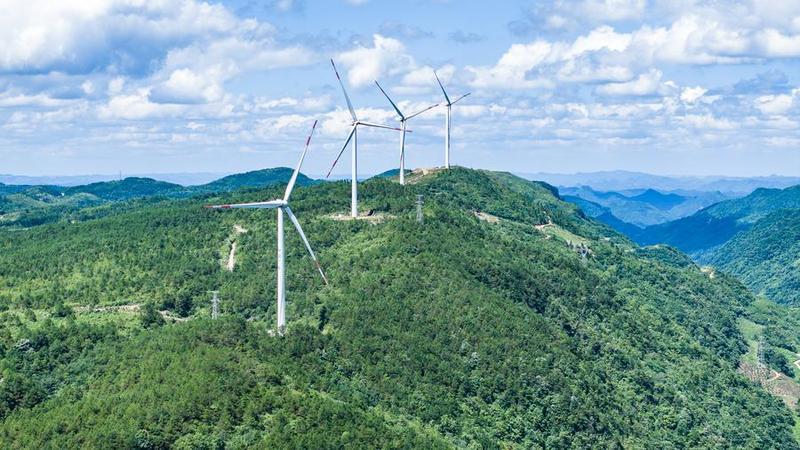
An aerial drone photo taken on July 4, 2025 shows wind turbines in Longli county, Southwest China's Guizhou province. [Photo/Xinhua]
China's industrial base is undergoing a shift toward greener, more digital and more diversified development, a transformation that is creating fresh investment opportunities for global capital as the country steps up its two-way opening-up efforts.
These changes are also reshaping how Chinese companies expand overseas, enabling them to integrate more deeply into the industrial ecosystems of their target markets, business and political leaders said at the inaugural Global Business Summit held during the Asian Financial Forum in Hong Kong on Tuesday.
Wu Wei, executive vice-mayor of Shanghai, said the city is accelerating the construction of a modern industrial system to add new impetus to economic growth.
While advancing the digital and green upgrading of traditional industries, Shanghai will also step up the development of integrated circuits, artificial intelligence and biomedicine as well as six emerging pillar industries, including next-generation electronic information, advanced materials, and new energy, Wu said.
North China's Shanxi province, one of the country's major energy bases, is pushing large-scale development of wind and solar power as part of its low-carbon transition, with new and clean energy now accounting for about 55 percent of installed power capacity, said Tang Zhiping, vice-governor of Shanxi.
Tang said he hopes the Hong Kong Special Administrative Region will continue to leverage its role as a "super connector" and "super value-adder" to help Shanxi strengthen links with global markets and attract more international capital, technology and talent to the province.
The recommendations for formulating the country's 15th Five-Year Plan (2026-30) underscore high-quality development and technological self-reliance, said Paul Chan Mo-po, financial secretary of the HKSAR government.
He added that the HKSAR is leveraging its financial sector to support the development of technology and industry, as its world-class financial services and international connectivity have strengthened the city's overall value proposition.
Chinese companies' push abroad has entered "a new phase", one no longer defined by the scale of outbound investment or export growth but by "quality, brand-building, technological capability, supply-chain resilience and long-term international presence", said Lim Lork Piseth, secretary of state at Cambodia's Ministry of Commerce.
In 2025, Chinese investment accounted for more than half of the Southeast Asian nation's total foreign direct investment inflows, covering sectors such as energy, agricultural processing and digital industries, Lim said. "These figures reflect the successful integration of Chinese enterprises into Cambodia's industrial ecosystem."
A similar pattern is also seen in the Middle East.
In the United Arab Emirates, more than 14,500 economic licenses have been issued to Chinese businesses across sectors ranging from logistics and infrastructure to advanced manufacturing and commerce, said Younis Al Khoori, undersecretary of the UAE Ministry of Finance.
Besides green and smart development, Chinese firms are placing greater emphasis on localized research, development and production.
Li Donghui, vice-chairman of China's leading automaker Geely, said in the face of growing fragmentation in globalization, the company is leveraging the local strengths and operating assets of its international brands such as Volvo and Polestar in overseas markets.
