
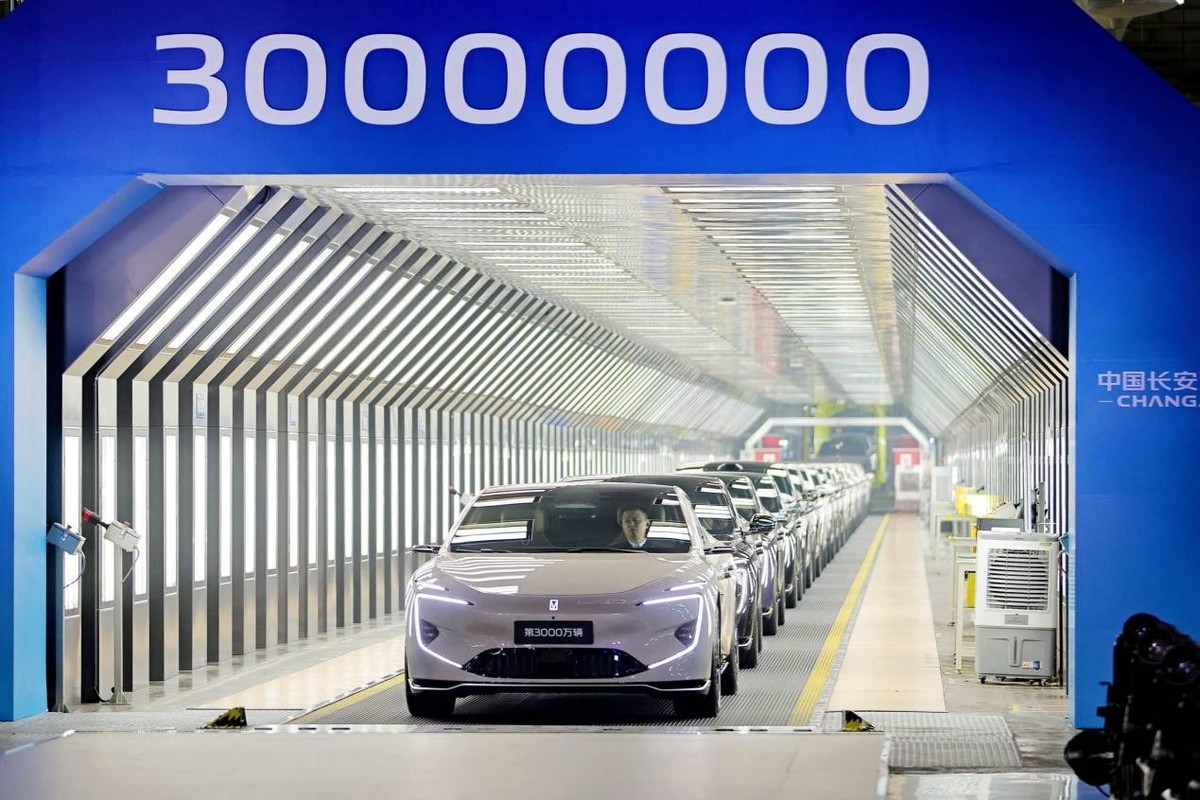
An Avatr 12 sedan rolls off the production line in Chongqing on Dec 10, 2025. [Photo provided to chinadaily.com.cn]
China Changan Automobile has produced its 30 millionth Chinese-brand vehicle, becoming the country's fastest automaker to reach the milestone as local manufacturers accelerate their transition toward electric and intelligent cars.
The landmark unit — an Avatr 12 — rolled off the line on Wednesday.
It took the Chongqing-based carmaker 30 years to reach its first 10 million vehicles in 2014, seven years to double that figure and another four and a half years to reach 30 million, highlighting the rapid scale-up of China's auto industry.
The company said the achievement stems from sustained investment in research and development and a long-established forward-engineering system.
It spends about 5 percent of annual revenue on R&D and has built a global network spanning six countries and 10 locations, supported by more than 24,000 engineers and over 200 labs covering areas such as EV powertrains, autonomous driving and NVH.
The carmaker has filed more than 14,000 patents over the past three years and holds China's first ASIL-D functional safety process certification.
Looking ahead, the company aims to sell 5 million vehicles by 2030, with new-energy models accounting for more than 60 percent and overseas markets more than 30 percent.
Its NEV strategy revolves around three brands: Avatr for the premium smart NEV segment, Deepal for younger buyers and Qiyuan for mainstream families.
The carmaker expects its NEV sales to exceed 1 million units in 2025. The company is also advancing technologies such as its battery system, SDA vehicle architecture and large multimodal AI models for perception and decision-making.
It is developing end-to-end autonomous-driving capabilities and is exploring longer-term projects, including humanoid robots scheduled for mass production in 2028 and a commercial flight-car concept targeted for 2030.
China Changan is expanding its global operating system to support rising overseas demand, strengthening local R&D, production, logistics and service capabilities while incorporating ESG requirements into its international footprint.
Founded through a military-to-civilian transition in 1984, the company entered the passenger car market in 2003 and in 2017 launched a strategic shift toward becoming an intelligent, low-carbon mobility technology company.
The manufacturer intends to deepen its presence in next-generation batteries, power semiconductors, digital energy systems and recycling-related businesses by 2030.
