
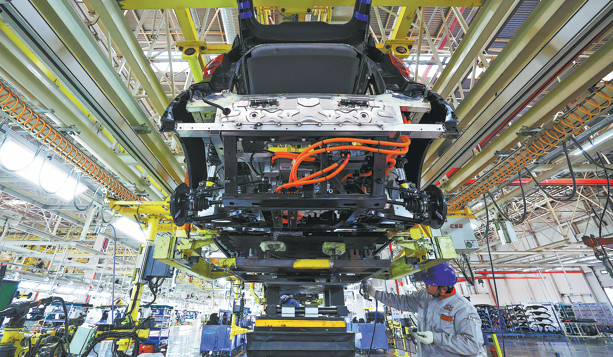
An employee works on an EV assembly line in Shijiazhuang, Hebei province, on Jan 8. LIANG ZIDONG/XINHUA
As China makes rapid advances in new energy vehicles and intelligent connected technologies, the country is gradually shifting from being a follower of international automotive standards to an active contributor in global standard-setting in related fields, industry experts said.
"The Chinese automotive industry has entered a new stage of development, creating an urgent need to formulate and apply international standards in related fields, while strengthening international cooperation on standardization," said An Tiecheng, chairman of the China Automotive Technology and Research Center (CATARC), a major science and technology research body in the automotive industry.
"The rising internationalization of automotive standards will help Chinese automakers better integrate into the evolving global automotive landscape," An added.
The remarks came after China's first domestically branded new energy testing sedan recently completed a successful landing in Antarctica, marking a major breakthrough in the global adaptability and application of advanced common technologies for Chinese NEVs.
To address the continent's extreme conditions — including ultralow temperatures, strong winds, blizzards and intense ultraviolet radiation — CATARC's engineering institute established an "Antarctic system" covering more than 30 development and verification items across five key dimensions: driving reliability, functional safety, comfort experience, intelligent electronic control, and thermal management.
"Antarctica is a natural testing ground for evaluating how various types of equipment perform under extreme environmental conditions," a CATARC expert said. "The test is expected to strongly support the development and iterative upgrading of domestically produced NEVs' adaptability to complex climates."
In fact, Chinese standards are gaining strength through breakthroughs in core technologies.
To address long-standing bottlenecks in the industry, CATARC has completed the domestic substitution of electronic control simulation test benches and developed China's first industrial-grade simulation software for NEV research and design. It has also achieved tangible progress in foundational areas such as the first domestically developed crash-test dummies and testing for automotive-grade chips.
Progress in technology development has been matched by steady advances in standard-setting.
To date, the national research body has led the release of 14 international standards, promoted the formulation of more than 800 automotive standards, and established the China Automotive Standards Internationalization Center in Geneva — believed to be a significant step in the country's deeper participation in global automotive rulemaking.
The development of Chinese standards has also helped promote global exchanges and cooperation in automotive technologies.
"As Chinese electric vehicles gain increasing popularity in overseas markets, many trading partners have expressed interest in adopting Chinese standards," said Guo Chenguang, a senior official at the State Administration for Market Regulation.
To date, 35 Chinese automotive standards have been adopted globally, covering areas such as safety, battery systems and charging equipment, he added.
"In this regard, we will further strengthen international engagement to support China's automotive industry in moving from product exports to value exports, providing systematic safeguards for Chinese automakers as they go global," An of CATARC said.
lijiaying@chinadaily.com.cn
