

The 27th Harbin Ice and Snow World opened in Harbin, Heilongjiang province, on Dec 17. ZHANG SHU/FOR CHINA DAILY
With the opening of the 27th Harbin Ice and Snow World on Dec 17 in Heilongjiang province in Northeast China, the nation's winter tourism and sports entered their peak season.
"As of Dec 18, the day after the opening of the Harbin Ice and Snow World, searches for 'snow tours' and 'Harbin' have surged on our platform," said Qi Chunguang, vice-president of travel portal Tuniu.
The area of the winter theme park has been expanded by 1.2 million square meters this year, with the total volume of ice and snow used reaching 400,000 cubic meters — a record high in the history of the annual event, China Central Television reported.
Before the opening of the "winter fairyland" in Harbin, snow and ice enthusiasts had already been eagerly anticipating the event.
LY.com (Tongcheng Travel) said that as of 9 am on Dec 15, searches for "Harbin Ice and Snow World" had skyrocketed fivefold compared with the same period the previous day. It added that Harbin has maintained the top spot among winter tourism destinations on its platform since December.
"My daughter likes to pout prettily at me and ask me to take her to the Harbin Ice and Snow World. We went to the 'snow fairyland' about eight years ago when she was very young, and we plan a family trip to Harbin again during the New Year holiday," said Wang Lin, 45, a Beijing resident.
Qi, from the Tuniu portal, noted a growing trend in winter tourism this year. "Based on our data, people living in central, eastern and southern provinces, including Jiangsu, Guangdong and Hubei, show a stronger passion for winter tourism. So far, 70 percent of winter tour bookings on our platform have been made by tourists from these regions," he said.
"The most popular winter destinations in recent months include Zhangjiakou in Hebei province, northeastern provinces such as Jilin, and Altay in the Xinjiang Uygur autonomous region. About half of group tour participants in recent months have chosen Liaoning, Jilin and Heilongjiang as their destinations," Qi added.
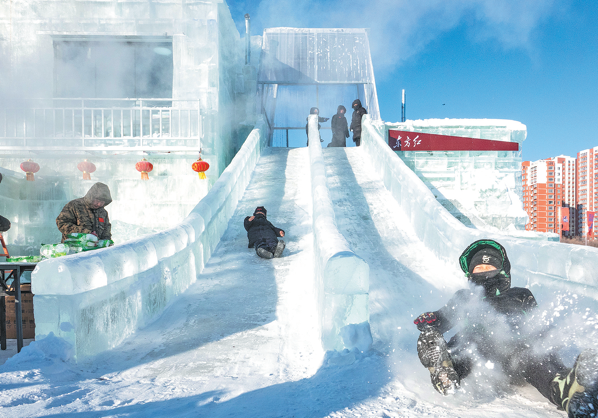
Children race down ice slides in Hailaar of Hulunbuir, Inner Mongolia autonomous region, on Dec 21. LYU HAOJUN/FOR CHINA DAILY
Growing ice and snow economy
The popularity of Harbin and its "snow and ice fairyland" is emblematic of China's burgeoning winter tourism and sports sector.
"The growth of winter-related consumption is closely linked to economic development, the upgrading of tourism consumption, and government policies. When per capita GDP reaches $10,000 and people's basic needs are met, they naturally pursue spiritual needs such as sports and tourism," said Zhang Jinshan, a researcher at the Tourism Planning and Development Research Institute of Beijing Union University.
"China has the world's largest domestic tourism consumption market, and winter tourism is an important segment. The government has therefore taken active measures to expand winter-related consumption to boost domestic demand," he said.
Figures from the Harbin government show that the 26th Harbin Ice and Snow World, which ran from Dec 21, 2024, to Feb 26 this year, received about 3.56 million visits. Harbin received about 90.36 million tourist visits during the winter season from late 2024 to early 2025, generating about 137.2 billion yuan ($19.49 billion) in tourism revenue, marking year-on-year increases of 9.7 percent and 16.6 percent, respectively.
Qi said winter tourism and sports have blossomed on all fronts. "Outdoor ski resorts in northern and northeastern provinces are becoming increasingly sophisticated, while indoor ski parks and winter theme parks in warmer regions such as Chongqing and Shenzhen have also grown in number. The winter tourism industry has not only met people's demand for sports, sightseeing and snow-viewing experiences, but has also boosted consumption in accommodation, transportation and winter gear."
A recent report by Asiadg.com and Beijing Sport University showed that China's winter-related consumption during the winter season from late 2024 to early 2025 totaled about 187.5 billion yuan. The nation's winter-related industry expanded from 270 billion yuan in 2015 to 980 billion yuan in 2024, and the report estimates it will exceed 1 trillion yuan for the first time this year, predicting that it will reach 1.5 trillion yuan by 2030.
The report also noted that consumption at ski resorts nationwide reached more than 78.6 billion yuan during the previous winter season.
"My husband and I are big fans of winter sports. We initially simply loved winter and snow and visited many snow destinations at home and abroad between 2015 and 2018, such as Jilin province in Northeast China and Russia. Later, we began trying winter sports such as skiing and soon fell in love with them," said Wang Tiantian, 32, who is now in Chengdu, Sichuan province.
She said that she and her husband regularly visit the Xinjiang Uygur autonomous region in winter and usually stay for about a week skiing. "We sometimes go to indoor ski resorts in Chengdu during summer when we feel the itch to ski," she said, adding that they value the quality of snow and services more than ticket prices.
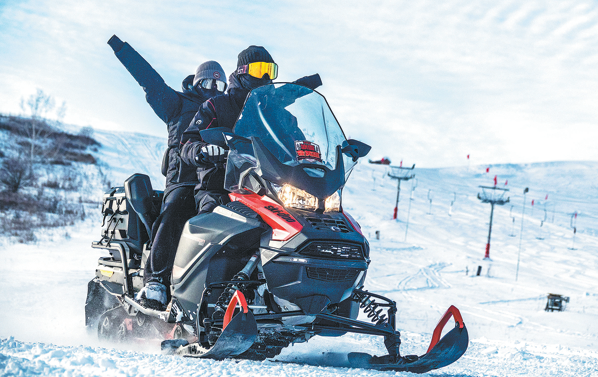
Tourists ride a snowmobile at a scenic area in Yakeshi, Inner Mongolia, on Dec 22. LYU HAOJUN/FOR CHINA DAILY
Indoor as well as outdoor
Ma Rui, marketing director of Wuhan Chengjian Bonski, an indoor ski park affiliated with Bonski — a company that operates ski domes and provides ski training and education — said she has noticed the rising popularity of winter sports such as skiing in recent years, with outdoor and indoor ski parks complementing each other and driving the growth of winter tourism and sports.
"Indoor ski parks break the limits of time and space, offering people year-round access to winter sports and lowering the threshold for participation," she said.
Cheng Xiaoming, general manager of Wu Shang Bonski, said demand for high-quality and convenient winter tourism and sports experiences has strengthened this year.
"We usually see large numbers of tourists on weekends and public holidays. Indoor ski parks are also popular in summer, when people seek out-of-season snow experiences during scorching weather," he said, adding that domestic winter sports — especially skiing — have grown rapidly since the successful conclusion of the Beijing 2022 Winter Olympics. People's consumption preferences have gradually shifted from "checking off a bucket list item" to "deeper learning", with winter sports increasingly becoming a social activity.
Discussing the development of China's winter tourism and sports, Zhang Jinshan said that China has a long history of winter sports and tourism. "Altay in the Xinjiang Uygur autonomous region is recognized as the origin of winter sports," he said.
Zhang noted that winter sports and tourism experienced rapid growth after 2000, alongside improvements in the economy and people's livelihoods, and that the Beijing 2022 Winter Olympics marked a milestone in the sector's development.
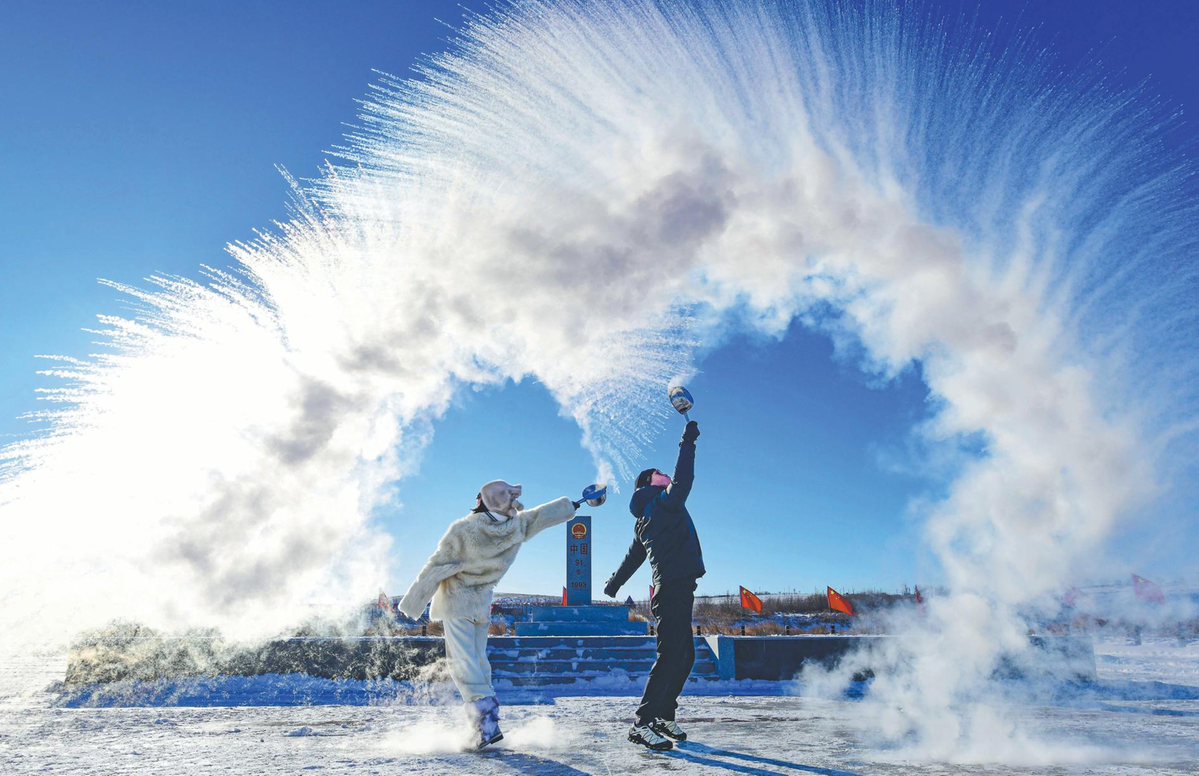
Tourists enjoy the instant freezing of water at a scenic area in Ergune, Inner Mongolia, on Dec 23. WANG ZHENG/FOR CHINA DAILY
Policy support
Noting the growing desire and spending power for winter tourism and sports, as well as the sector's vast potential, governments at various levels have taken steps to promote the industry's development.
This winter, several provinces have successively announced "snow vacations" for primary and secondary school students.
Altay in the Xinjiang Uygur autonomous region announced its first "snow vacation" from Dec 1 to Dec 5 for students under compulsory education, while the regional capital Urumqi rolled out a nine-day snow vacation from Nov 29 to Dec 7.
Students under compulsory education in Jilin province in Northeast China also enjoyed their first five-day "snow vacation" starting Dec 3.
During the snow vacations, diversified entertainment and educational tour products were offered at discounted prices. In Jilin, for example, 171 A-rated winter scenic spots and 39 qualified ski resorts and skating venues were opened free of charge to primary and secondary school students, with discounted tickets available for their parents.
The province also encouraged employees to take paid leave to accompany their children during the snow vacation, and required schools not to organize teaching activities or assign homework during the break.
Figures from the Jilin provincial government show that the province's first snow vacation benefited 1.63 million students from 2,379 schools and invigorated the local tourism market. Data from China UnionPay Merchant Services Payment Inc showed that during the five-day snow vacation, major ski resorts across the province saw tourist numbers surge, while the 171 A-rated scenic spots recorded year-on-year increases of 83 percent in visitor numbers and 53 percent in tourism revenue.
In addition to regions with natural advantages for winter tourism and sports, several eastern provinces with milder climates have also stepped up efforts to tap into the winter economy.
Zhejiang province issued a notice in May 2025 encouraging counties and cities such as Lin'an, Tonglu and Anji to develop into winter tourism destinations. The provincial government said it would provide strong support for eligible localities applying to become national-level skiing and leisure resorts, and encouraged the development of winter gear and apparel industries.
In November 2024, the State Council, China's Cabinet, issued guidelines on boosting the ice and snow economy, setting targets of 1.2 trillion yuan by 2027 and 1.5 trillion yuan by 2030.
The guidelines outlined measures including encouraging children and youth participation in winter sports, improving infrastructure and services, fostering leading brands and enterprises, and deepening international cooperation in the winter economy.
Zhang Jinshan said China's winter industry still has significant growth potential given the country's current economic scale and population. "The ice and snow industry is still in a rapid development stage and will continue to expand as more people participate in winter tourism and sports," he said.
chengsi@chinadaily.com.cn
