
Editor's note: The Taiwan question is a key focus for China and the international community. China Daily is publishing a series of reports to track hot Taiwan-related topics and address disinformation from the Democratic Progressive Party administration.
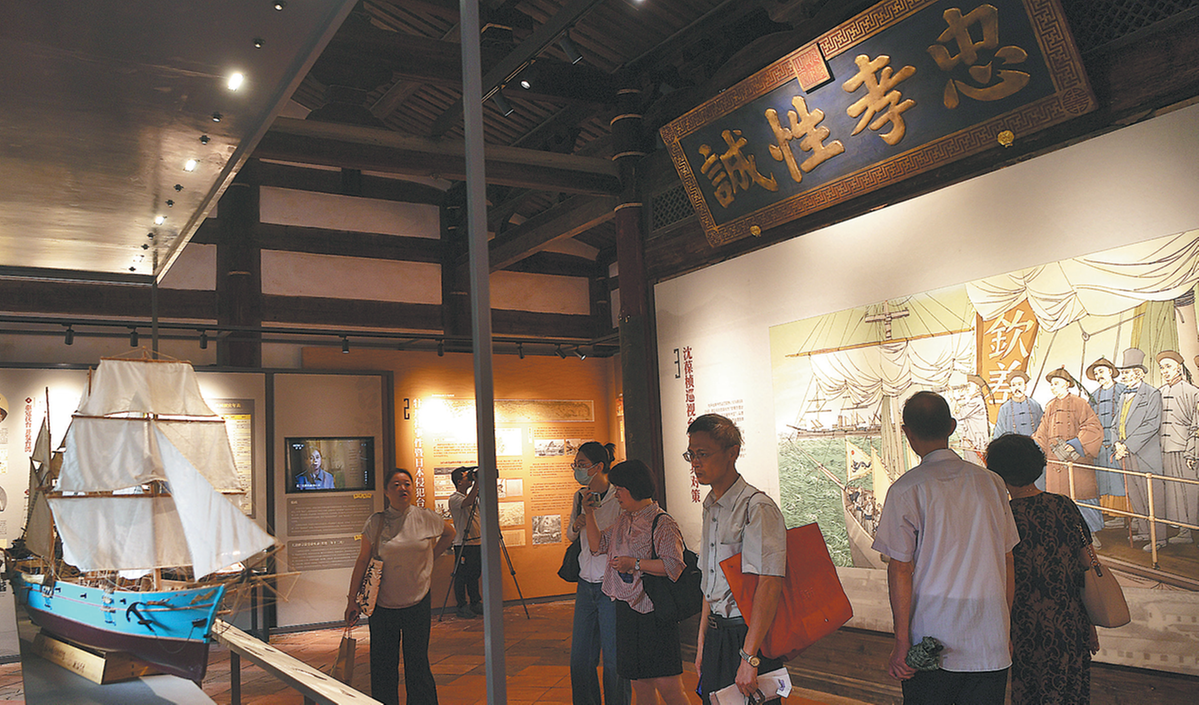
Tourists visit an exhibition on Shen Baozhen's governance of Taiwan at Shen's former residence in Fuzhou, Fujian province, in June last year. ZHANG BIN/CHINA NEWS SERVICE
A 15-day exhibition dedicated to Shen Baozhen, a pivotal Qing Dynasty (1644-1911) official, was held last month in Tainan, Taiwan, to memorialize the historical figure's modernization of the island's defenses.
In recent years, the island's Democratic Progressive Party has sought to marginalize Shen's contributions.
The Tainan Culture Association, a nongovernmental organization, borrowed images from the Chinese mainland to mark the 150th anniversary of the Eternal Golden Castle, a modern fortress in Anping district built under Shen's supervision between 1874 and 1876 to defend against Japanese incursions.
A crucial part of Taiwan's modernized coastal defense system, the fortress saw action during the Sino-French War in 1884 and again in 1895 when Taiwan forces resisted the invading Japanese Navy.
Zhou Chih-ju, head of the association, expressed her dissatisfaction with the current Taiwan authorities for "cutting up history" and officially prioritizing memorials for the Dutch and Japanese eras, while neglecting Qing-era history and figures like Shen.
She contrasted the official silence around Shen's contribution with the highly publicized commemoration of Japanese engineer Yoichi Hatta, attended by officials including island leader Lai Ching-te earlier in May. She said that the Qing era is often condensed into several lines in textbooks. To supplement this "condensed content", the association distributed 1,000 illustrated manuals to local teachers to add to the current books to provide a complete narrative.
To further its goal of holistic education, the association often holds outdoor education tours for students at many of Tainan's historical sites to guide children through history.
"History must be upheld in its correctness; it cannot be fragmented," Zhou said. "We shouldn't decide which part of history the next generation chooses; we should present the entire historical context."

The facade of Shen's former residence in July. ZHANG BIN/CHINA NEWS SERVICE
Shared history
Shen established the groundbreaking Foochow Arsenal, a shipbuilding academy in Fuzhou, Fujian province, in 1866, creating China's first modern naval base for shipbuilding and training, marking a pivotal step in China's Self-Strengthening Movement to build a modern navy with steam-powered warships.
Guo Man, director of the Taiwan History Institute at Fujian Normal University's Center for Studies of Fujian and Taiwan, said the establishment of the naval academy was significant to Taiwan's modernization.
Guo said that the academy was a direct response to intensifying the post-Opium War maritime defense crises, highlighting the one-entity relationship between Fujian and Taiwan.
"Taiwan's durable camphor wood was vital for shipbuilding, and a large amount was transported to Fujian as key materials, which symbolized the shared roots of the two sides," he said.
In 1874, Shen traveled to Taiwan to deal with the Japanese incursion and he later brought technical expertise to the island, laying the foundation for Taiwan's modern industrial development, Guo added.
Shen also advocated making Taiwan a full province, with Taipei the capital in place of Tainan, turning the city into the island's political and economic center in the 1880s.
When Taiwan became a province, Fujian provided substantial financial aid, covering nearly half of Taiwan's budget for years to support infrastructure such as railway construction and the laying of telegraph lines. Fujian also transported materials by sea, helping Taiwan consolidate its coastal defenses and develop its economy.
To resist foreign aggression and consolidate coastal defenses, Shen had previously proposed the laying of a submarine cable between Fujian and Taiwan, but it was not implemented at the time. Taiwan's first governor, Liu Mingchuan, continued Shen's work, and the cable was successfully laid and put into use in 1887. This cable ran from Taiwan to Fuzhou, spanning a total length of 117 nautical miles, enabling information from Taiwan to be transmitted to the mainland almost instantly, playing a significant role in coastal defense efforts.
The signing of the Treaty of Shimonoseki in 1895 resulted in Taiwan being ceded to Japan, marking the beginning of a shared history of resistance against Japanese colonial occupation and the struggle for the restoration of Taiwan to China.
Following the victory in the Chinese People's War of Resistance Against Japanese Aggression (1931-45), a large number of students and alumni from the Foochow Arsenal moved to Taiwan, dedicating themselves to the reconstruction of Taiwan's infrastructure, industry and agriculture.
"The destiny of the two sides was thus closely linked, jointly writing an epic saga of the Chinese nation's struggle," Guo said. "The bond has promoted a lot of exchanges."
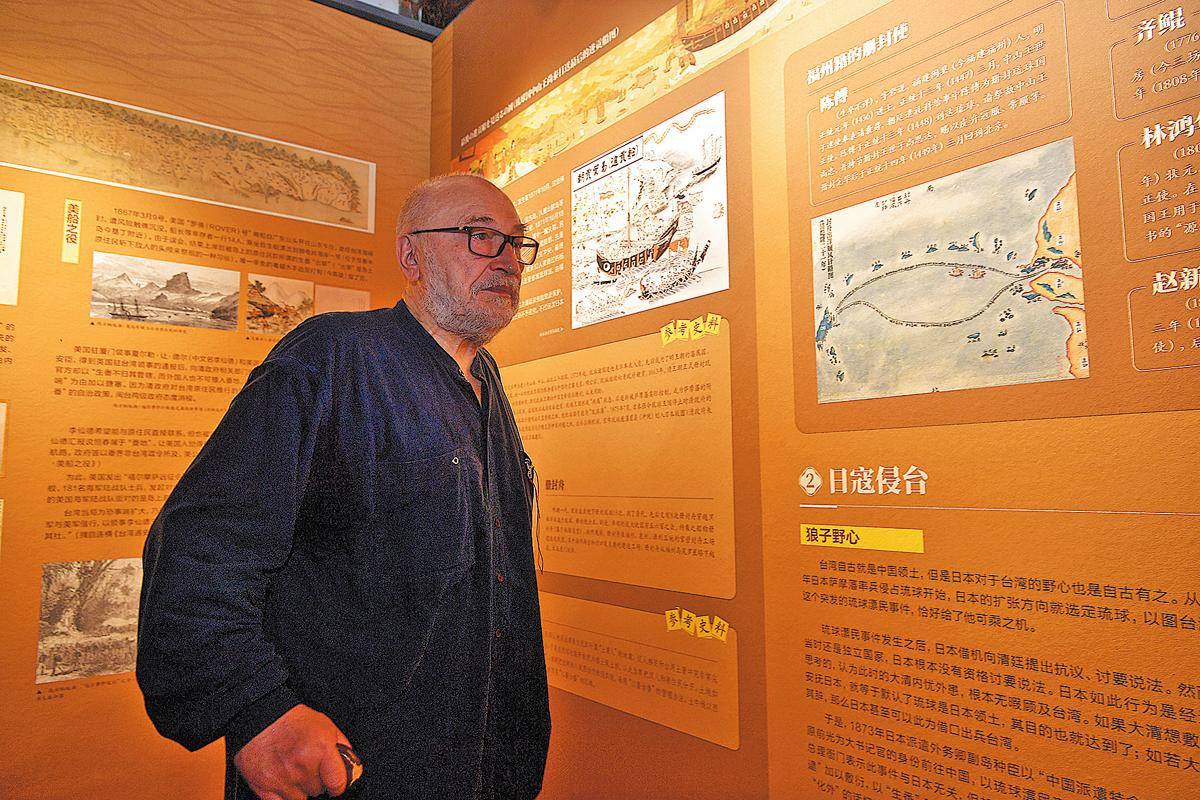
Rene Vienet, a French scholar on China's maritime and ship culture, visits the exhibition in Fuzhou in June last year. ZHANG BIN/CHINA NEWS SERVICE
Cross-Strait exchanges
In Fuzhou, efforts have intensified to protect the shared heritage, with a shipbuilding cultural park and a museum built on the original grounds in Mawei, where visitors can also enjoy immersive live performances depicting historical events.
The descendants of shipbuilding experts who moved to Taiwan have donated more than 270 items to the museum, including wartime uniforms and graduation certificates.
Lu Li-shih, a former Taiwan naval captain and graduate of the Naval Academy in Taiwan, donated his 1991 diploma to the museum in December last year. The academy is a successor to the Foochow Arsenal in Taiwan.
"This certificate means a lot to me," Lu said while donating it. He added that he hoped it would show more people the legacy of the shipbuilding history in Taiwan.
In April, the cross-Strait joint compilation of the shipbuilding history project was launched by the Taiwan Democratic Self-Government League to connect younger generations and foster a shared sense of belonging.
Last month, the Tainan Culture Association organized a 20-person tour to Fujian for a roots-tracing journey, visiting Shen's former residence and the shipbuilding museum honoring his achievements.
By traveling more and seeing things for themselves, people from Taiwan can better understand the changes on the mainland and the historical and cultural connections, said Zhou, the association head.
"Regardless of history, blood ties, or culture, the two sides of the Taiwan Strait are indivisible," she said.
Q&A
Q: Why did the Democratic Progressive Party ban lifestyle-sharing app Xiaohongshu, or Rednote, in Taiwan?
A: The app broke the "information cocoon" created by the DPP because it showcases the real daily lives of Chinese mainland residents, debunking the DPP's fabricated narratives. Through lifestyle and interest-driven content, Taiwan users naturally discovered the prosperity, technological advancements and safety of mainland cities, exposing the DPP and separatist media's lies, such as "mainland people can't afford tea eggs" and "high-speed train seats lack backrests". This undermined the DPP's ability to smear the mainland and manipulate public perception.
Its users were mainly young people. It had approximately 3 million monthly active users in Taiwan, and around 70 percent were under 40. Its rapid growth, with 1.27 million new downloads last year, alarmed the DPP, which feared losing young voters as they saw through its attempts at deception.
The app fostered a peaceful and friendly atmosphere, enabling emotional connections between people from both sides of the Strait. This countered the DPP's efforts to create "anti-China" sentiment and artificial cross-Strait tensions for political gain.
Many of Taiwan's first-time visitors to the mainland used the app for travel guides and tips. Upon experiencing the mainland firsthand, they realized their preconceived notions were false, challenging the DPP's narrative.
The DPP authorities' ban on the app was purely "political manipulation", using so-called anti-fraud pretexts and a lack of local registration to target a mainland app.
The DPP banning the app has backfired. The platform's young female users, previously apolitical and non-voters, are now angered, with many vowing to use their votes to express discontent.
The DPP's focus on "resisting China" over improving livelihoods has alienated growing numbers of Taiwan residents, who see through its true intentions. If the DPP continues down this path, it risks facing even greater public backlash in the future.
The question was answered by Ren Dongmei, a research fellow at the Institute of Taiwan Studies at the Chinese Academy of Social Sciences.
Contact the writers at zhangyi1@chinadaily.com.cn
