
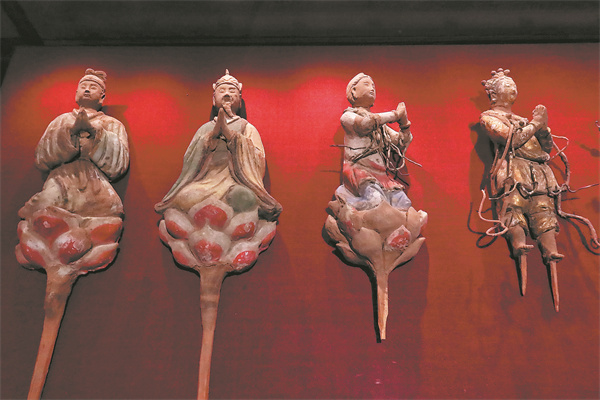
Some fragments of suspended sculptures from Xiaoxitian are on display.[Photo provided by Jiang Dong/China Daily]
Many people dub this temple on the Loess Plateau "the Sistine Chapel of the East".Well, it is probably an updated 3D version.
While those angels created by Michelangelo, vivid as they are, do not really fly along the chapel's ceiling, the deities in this temple of Shanxi province literally do sway in the wind.
Xiaoxitian (Minor Western Heaven) Temple in Xixian county in the southwest of Shanxi is also called Qianfo'an (A Temple of a Thousand Buddhas). In its main hall, 1,978 Buddhist statues jointly portray an ideal world in pilgrims' hearts. Perhaps, within a mere 169-square-meter space, they can see a universe.
The phenomenally popular video game Black Myth: Wukong, in which the temple was used for key scenes, brought overwhelming popularity to the 400-year-old site on the mountain. Now, the first thematic museum exhibition to comprehensively review relics of Xiaoxitian has opened in Beijing.
Awaken the Future: Treasures and Suspended Sculptures of Xiaoxitian Temple opened last week at the National Museum of Classic Books, affiliated with the National Library of China, and will run through May 8. In the exhibition, 84 cultural relics from the site are on display.
Suspended sculptures are indisputably the signature treasures of Xiaoxitian, and are also a representative example of cultural heritage from the Ming Dynasty (1368-1644) in Shanxi.
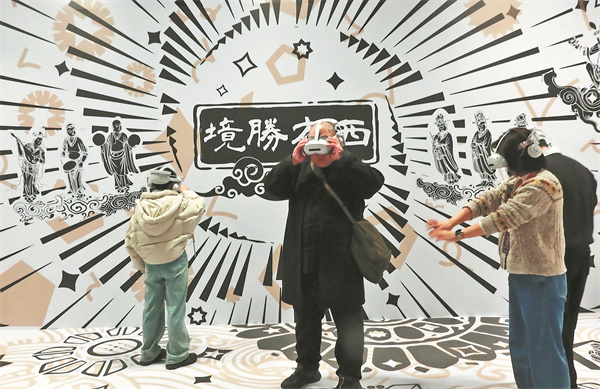
Visitors to the exhibition use virtual reality technology to have immersive experiences while viewing cultural relics in Xiaoxitian.[Photo provided by Jiang Dong/China Daily]
This unique and intricate Chinese form of three-dimensional sculptural art is primarily found in ancient religious architecture. Unlike statues that are usually found attached to walls or standing on the ground, suspended sculptures are crafted to appear as if they are "floating" in midair, often attached to ceilings, beams, or upper sections of halls.
Perhaps that is why suspended sculptures are typically used to depict divine figures and mythical scenes that are close to "heaven".
"Suspended sculptures in Xiaoxitian hold significant value in the areas of architecture, sculpture, painted decorations, religious art, and folk culture," says An Hai, curator of the exhibition and deputy director of the Shanxi provincial institute for protection and research of ancient architecture, painted sculptures and murals.
"The perspective and dynamic arrangements create a sense of depth and movement, and enhance the spiritual and visual impact of the space," An says. "The sculptures are ostentatious, but they are organized and highly detailed.
"The full hall of suspended sculptures brings Buddhist cosmology into a visible form," he explains. "It's thus a precious cultural heritage where belief, artistic expression, and craftsmanship are highly integrated."
The sculptures are skillfully attached to the wall with iron wires, which reflects the rapid development of iron-processing technology in the Ming era that helped create a boom period for suspended sculptures.
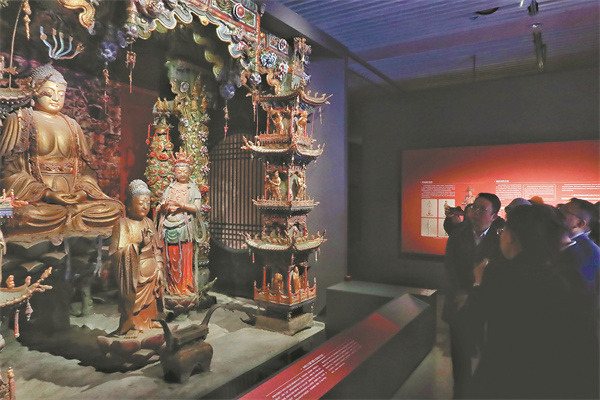
Visitors admire a replica of the Buddhist altar from the main hall of Xiaoxitian in the gallery of the National Museum of Classic Books in Beijing.[Photo provided to China Daily]
Visitors to the exhibition can appreciate the technique by looking at fragments of statues that have been replaced in previous renovations of the temple, as these fragments have been placed at ground level.
The construction of Xiaoxitian began in 1629 and was led by a monk from Wutai Mountain, a Buddhist holy place in Shanxi. Most Buddhist temples have one or three Buddha statues on their main altar, but there are five in Xiaoxitian, reflecting the builders' exceptional understanding of Zen.
Of course, it is impossible to physically move this visual wonder to Beijing in its entirety, but the exhibition's life-size replica of the Buddhist altar on display offers visitors the chance to contemplate the vastness of the universe.
But while the first pilgrims to the temple in 1644 may have marveled at this new, vividly portrayed image of heaven, the outside world had already started to descend into chaos; the Ming Dynasty fell that same year after major social upheavals, and the early years of the Qing Dynasty (1644-1911) witnessed a sustained war.
Xiaoxitian is thus widely honored as a unique episode in the popularity of Ming suspended sculptures.
In that era of dramatic change, however, those pious believers continued to seek inner peace.
A group of precious Buddhist statues from both the late Ming and early Qing dynasties that were donated by monks and pilgrims and once worshipped in Xiaoxitian are also on display in the Beijing exhibition, offering a vivid demonstration of Buddhist art from that time.
For visitors to the exhibition who have never been to Xiaoxitian, new technology is being used to showcase its majesty.
A digitalization project was launched for the exhibition that used technologies like visual algorithm modeling and AI reconstruction to digitalize the main hall at Xiaoxitian to "millimeter-level precision".
According to Wang Yun, head of the exhibition's technical team, AI high-definition enhancement technology was also applied to accurately highlight and clearly present colors that have faded over time and show details of damaged areas based on existing information.
"We have therefore established a permanent and authentic 'digital archive' of the magnificent suspended sculptures of Xiaoxitian," Wang says.

An exhibited copy of Ming Dynasty Buddhist sutra Yongle Beizang.[Photo provided to China Daily]
This archive also enables visitors to wear VR glasses for an immersive experience of the temple, clearly seeing into the dark and inaccessible corners of the original site in the virtual world.
Sculptures are not the only items on display. The exhibition also features selected volumes from Yongle Beizang, or "Yongle Northern Canon", from the collection of Xiaoxitian.
As an officially commissioned Buddhist canon from the Ming Dynasty, its calligraphy, engraving, and binding reflect the artistic characteristics of the Ming royal court and are important artifacts for studying the history of ancient Chinese book printing, according to Wei Chong, deputy director of the National Library of China.
Xiaoxitian's collection of Yongle Beizang was originally bestowed upon another temple in Xixian county in 1598 and was later housed in the Banyun Pavilion at Xiaoxitian. Currently, there are 673 cases containing 6,737 volumes in excellent condition.
"With high-quality paper and ink, as well as meticulous proofreading, this edition in Xiaoxitian, although not a complete set, is a rarely seen, precious relic of China," Wei says.
The name of the exhibition, Awaken the Future, also comes from this canon. In its original context, it means "to see into the future". But this title means more than its original context found in Zen.
"So is our protection of cultural relics," curator An explains. "Our work today will benefit the future we haven't seen."
