
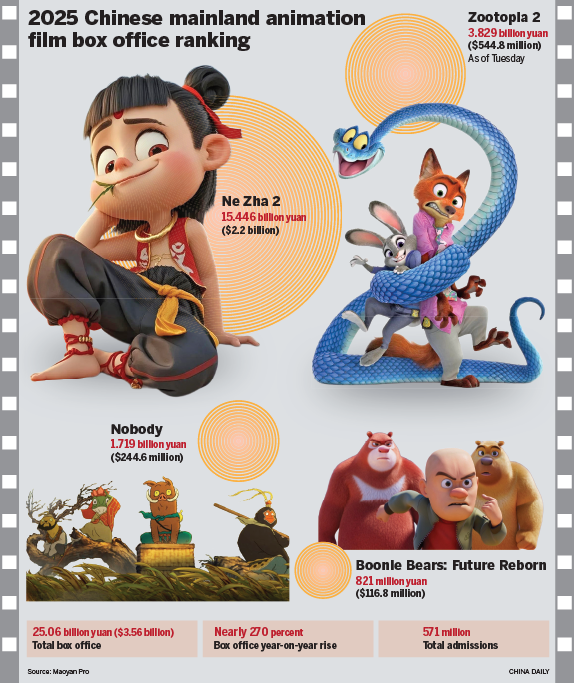
Once believed to be merely a children's favorite, animated films have "grown up", becoming the most commercially successful genre in China and making 2025 the highest-grossing year on record for the category.
As of Tuesday, propelled recently by Disney's blockbuster Zootopia 2, the box office revenue of animated movies in China has reached 25.06 billion yuan ($3.56 billion), nearly 270 percent higher than in 2024, according to industry tracker Maoyan Pro.
Winning over Chinese theatergoers for various reasons — including the new character Gary De'Snake, deliberately released during the Chinese zodiac's Year of the Snake — the sequel to Zootopia, which was a hit in 2016, has grossed over 3.8 billion yuan since its premiere on Nov 26. The figure has surpassed its North American earnings of $283 million, making China the film's most lucrative market worldwide.
Zhi Feina, a film researcher at the Chinese National Academy of Arts, said the overwhelming popularity of Zootopia 2 demonstrates the dynamic and huge potential of China's movie market, proving that appealing content — regardless of its cultural background — can always find a large fan base in the country.
Currently, the biggest contributor to this year's animation box office bonanza is still Ne Zha 2, the runaway hit sequel to the 2019 film Ne Zha, which set the previous record for the genre. Having earned over 15.4 billion yuan on the Chinese mainland, Ne Zha 2 alone has accounted for 30 percent of this year's total box office — including all live-action movies.
The first Ne Zha film was released in 2019 and earned 5 billion yuan, making that year the highest-grossing ever for animated films, until Ne Zha 2 set the new record.
Following Ne Zha 2 and Zootopia 2, the third highest-grossing animated film this year is Nobody, a feature-length spinoff of one episode from the 2023 animated series Yao-Chinese Folktales, produced by Shanghai Animation Film Studio — a pioneer since the late 1950s in introducing unique Chinese animation aesthetics to the world. By reflecting the career stress and dreams of ordinary people, the movie has struck a chord with young audiences, earning 1.719 billion yuan.
The fourth highest-grossing animated movie is Boonie Bears: Future Reborn, the 11th installment of the long-running Boonie Bears franchise, which was launched in 2012. Centering on the titular bear siblings' new adventure in a futuristic world, the film earned 821 million yuan.
Other animated hits include The Legend of Hei 2, centering on a cat demon capable of shape-shifting into a young boy, and Curious Tales of a Temple, adapted from Qing Dynasty (1644-1911) novelist Pu Songling's masterpiece Liaozhai Zhiyi (Strange Tales from a Chinese Studio). The overall ticket revenue from animation has accounted for 49 percent of this year's total box office, according to Maoyan.
Shen Wei, a concept artist for the Ne Zha franchise, said the rise of Chinese animation is built on the progress that domestic animators have made in recent years. "In the past, animated works were thought to attract only young audiences, especially children. But with advances in both storytelling and animation techniques, Chinese animation has really diversified and succeeded in drawing a wider audience," Shen said.
Yuan Yun'er, a Beijing-based film critic, said the infusion of modern values into traditional culture is a key factor behind the success of Chinese animated films this year. Both Ne Zha 2 and Nobody draw inspiration from ancient classics, with the latter loosely inspired by the 16th-century novel Journey to the West.
"It's easy to stir audiences' interest when they already know the settings and characters. They feel a fresh connection when these reimagined stories reflect their own modern-day struggles and pressures," Yuan said.
xufan@chinadaily.com.cn
