
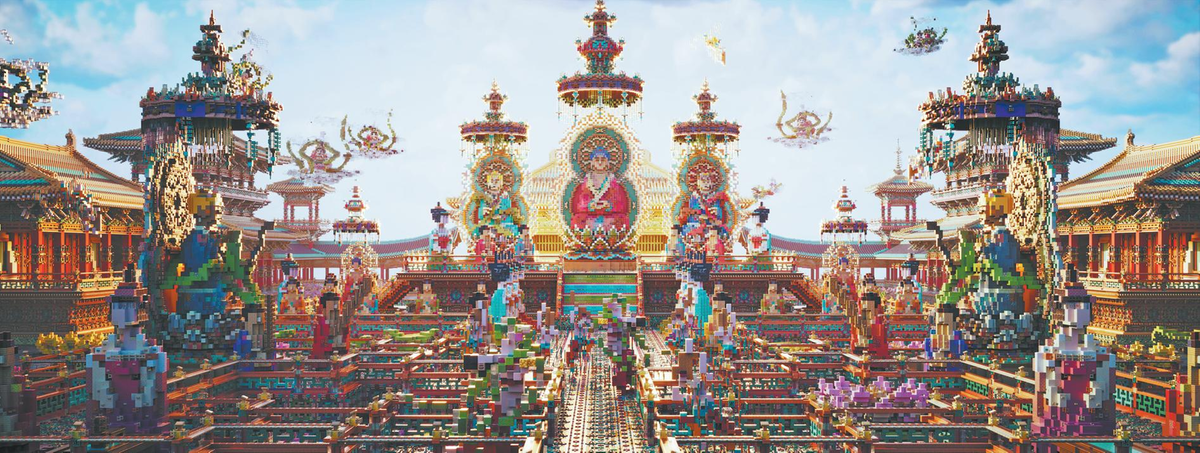
An image of the Dunhuang-themed landscape restored by Xia Caiquan in the game Minecraft shows the heavenly palace of Buddhism. CHINA DAILY
In the boundless, block-made universe of Minecraft, a popular sandbox video game, a poignant digital reconstruction has struck a deep chord across Chinese social media.
A young gamer has meticulously re-created part of the destroyed Yuanmingyuan, or Old Summer Palace, a royal garden in Beijing and a symbol of China's "century of humiliation", and has digitally repatriated the site by reuniting the looted 12 zodiac bronze animal heads in his virtual landscape.
His video, a serene fly-through of the meticulously re-created site, has been viewed millions of times.
Comment sections have been flooded with remarks about "cyber reunion" and "connecting the past and present". One top comment read,"This is the patriotic romance of the young generation."
Pixel by pixel, 24-year-old gamer Qiu Zekai, known online as Qiuxiaoniuer, spent two months resurrecting sections of the ruined palace's Xiyang Lou (Western-style mansions), including Dashuifa (the Great Fountains).
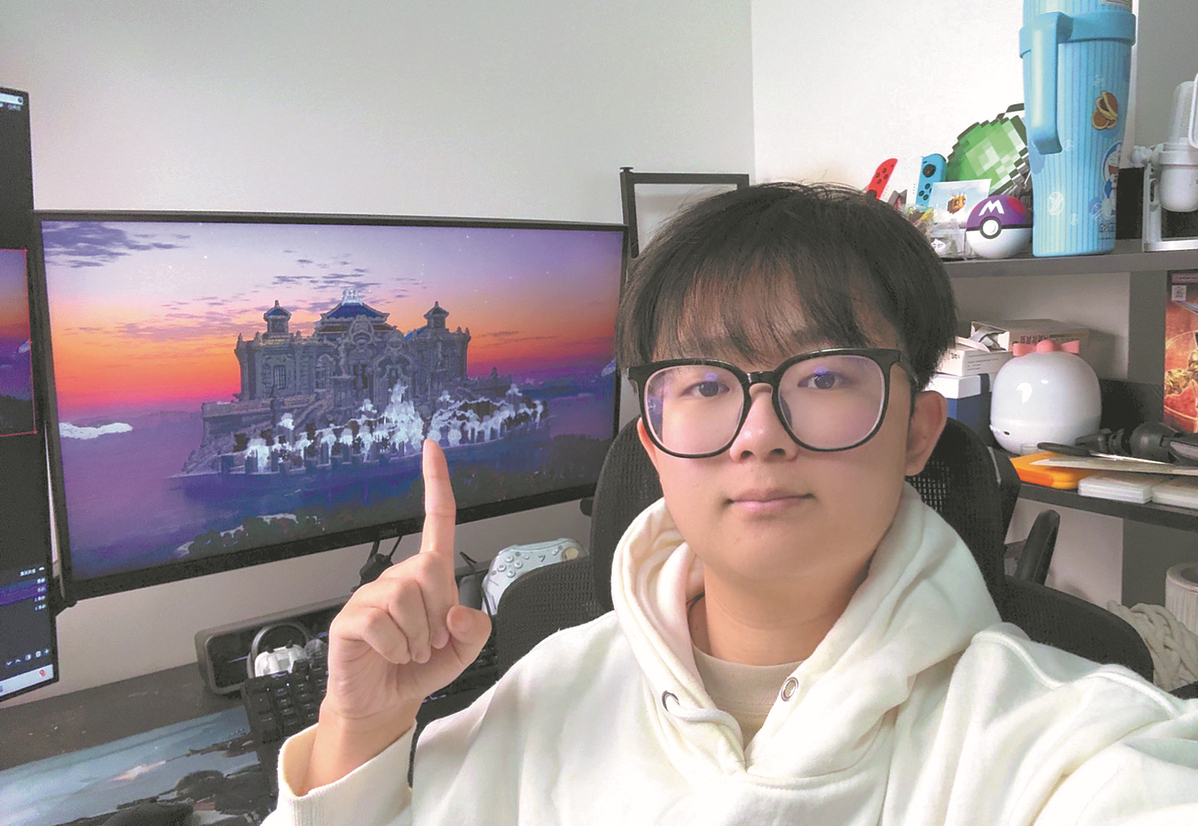
Qiu Zekai points to his work on the desktop screen. CHINA DAILY
"I wanted the regret to be compensated for in the digital world," Qiu told China Daily.
The ruins are a somber lesson in national history.
The 12 zodiac bronzes were part of a fountain at the Qing Dynasty (1644-1911) royal resort, which was burned and razed by invading Anglo-French forces in 1860 during the Second Opium War (1856-60), with numerous relics, including the bronzes, looted and lost overseas. Only seven bronze heads have been returned to date.
Qiu's creation offers a rare, interactive glimpse into its former glory, transforming pain into a proactive act of remembrance.
"I only restored a very small part. But many people said they get to know the history and the national treasure buildings through my work. It's a great honor," said Qiu, who has 3.4 million followers on the short video platform Douyin, with 200,000 of them gained through this video.
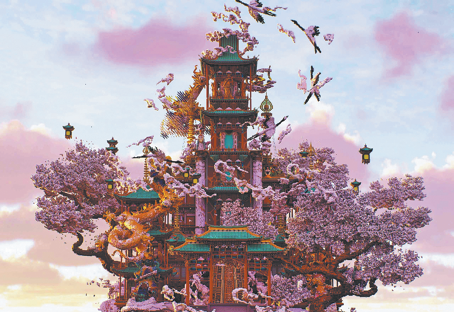
A Dunhuang style structure surrounded by blossoms created by Xia. CHINA DAILY
Relay of creativity
Qiu's project is not a stand-alone endeavor. It is the 12th leg of a spectacular Minecraft "relay" building challenge.
What began as a casual game among a small group of gamers has evolved into a viral cultural phenomenon, amassing over 300 million views and 17 million likes on Douyin alone.
This challenge is regarded as not merely a gaming activity anymore; it is also a manifestation of the younger generation's digital connection with history and an expression of cultural identity.
It showcases a generation leveraging the digital language it knows best — gaming — to connect with, interpret, and passionately safeguard its cultural heritage.
The relay was sparked in August by an influencer called "Libro, who doesn't love his liver". He invited others to sequentially build on a shared mountain map in Minecraft.
Libro began modestly, claiming he would "simply plant a blooming tree on this dirt mound". However, the result was a gigantic, stunning pink-blossomed tree.
This set the tone for what netizens would later call "intense competition". Each subsequent creator, feeling the pressure from the previous impressive work, pushed their creativity further.
The relay quickly transcended mere gaming skills, morphing into a showcase of architectural ambition deeply rooted in Chinese aesthetics.
He Jinjun works on building the Forbidden City in the game. CHINA DAILY
When the fourth relay baton passed to "Jayden, who doesn't know Chinese style" (real name He Jinjun, 23), a computer science student with a passion for classical Chinese gardens, the pressure was intense.
"Seeing the incredible works of the previous creators, the psychological pressure was really big," He recalled.
He promised his viewers only "a couple of small houses", while the reveal was a breathtaking miniature of the Forbidden City, complete with the three main halls and the Nine-Dragon Wall, all built to accurate proportions.
His week-long, high-intensity labor of love demonstrated how the game's freedom could make "players feel the elegance and grandeur of Chinese-style architecture firsthand".
To ensure authenticity, he delved into extensive historical materials, rigorously basing his creation on documented measurements. His work not only displays the rich variations in painted decorations but also clearly reveals the detailed texture and low-relief effects achieved with finer blocks.
As the relay progressed, the challenge's difficulty and creativity escalated. The scale and intricacy of the works consistently surpassed viewers' expectations.
According to Douyin sources, videos in the relay series featuring Chinese cultural architecture consistently achieved stronger viewer engagement.
Prior to the Yuanmingyuan recreation, a key turning point was the Dunhuang-themed landscape created by a 21-year-old influencer called "An Sir" (real name Xia Caiquan), which allowed a broader audience to appreciate the beauty of Chinese-style architecture within the game.
After that, content was sequentially released on Douyin, rapidly attracting attention. Most of the relay videos have garnered over a million likes, with the Dunhuang-themed video amassing an impressive 2.8 million likes.
A floating palace
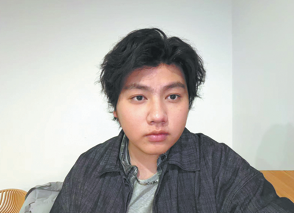
Xia Caiquan says his inspiration comes from the Mogao Grottoes. CHINA DAILY
Xia, a university senior studying polymer materials, was the eighth participant in the relay.
He initially planned "a small pavilion in the sky", but ended up constructing a floating palace twice the height of the relay's inaugural tree.
Xia said his inspiration came from the Vajrasana Pagoda in cave 428 of the Mogao Grottoes in Dunhuang, Gansu province, a UNESCO World Heritage Site adorned with vibrant murals and sculptures that whisper tales of ancient Buddhism.
"The first time I saw it, I was struck with a shock that hit my soul," Xia said. He immersed himself in research, studying the faded but ethereal lines of flying apsaras (celestial beings) and the vibrant, harmonious color schemes — predominantly red, green, and blue — characteristic of Dunhuang art.
"I was afraid my build would disappoint everyone, so I added as much detail and cultural elements as I could within my ability," he said.
The accumulated 110-hour result was an "aerial Dunhuang" palace that left viewers in awe, accumulating millions of likes.
Surprisingly, many netizens who had never been exposed to Dunhuang culture began to pay attention to the stories behind the 1,000-year-old murals because of Xia's works.
The culture and tourism department of Dunhuang awarded Xia a "Dunhuang Pass" — a ticket valid until the year 3026.
"When An Sir restored Dunhuang along the Silk Road with 10 million blocks, we witnessed the love of the younger generation for traditional culture," their post read. "We also want to express our gratitude for this protection in a romantic way: a ticket valid for 1,000 years."
"We believe that a millennium from now, Dunhuang will still be magnificent, and we believe that a millennium from now, Chinese people will still love Dunhuang," the post read.
Many netizens commented that the specially designed, oversize paper ticket could be passed down as a "family heirloom".
"I'm deeply grateful for the recognition and will continue to use the methods I am passionate about to ensure that outstanding Chinese culture is seen and appreciated by more people," said Xia.
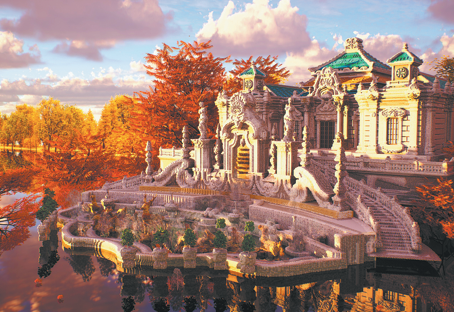
An image of the Old Summer Palace resurrected by Qiu Zekai. CHINA DAILY
Entertainment as education
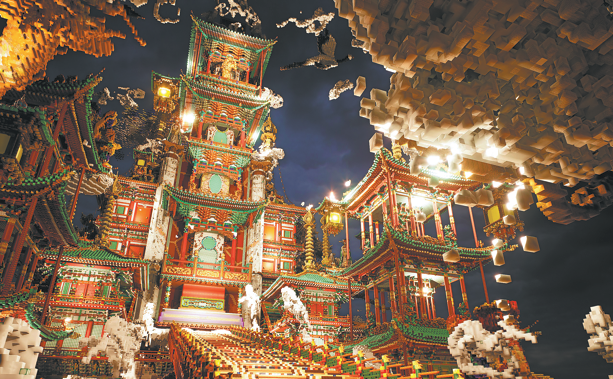
Dunhuang-themed architecture restored in the game by Xia. CHINA DAILY
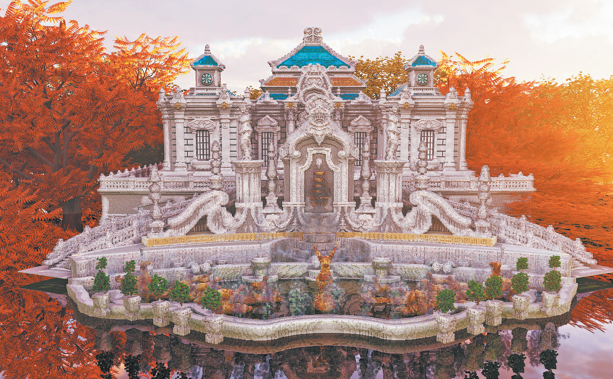
Through Qiu's work, viewers can get a glimpse of the beauty of the Old Summer Palace before it was destroyed. CHINA DAILY
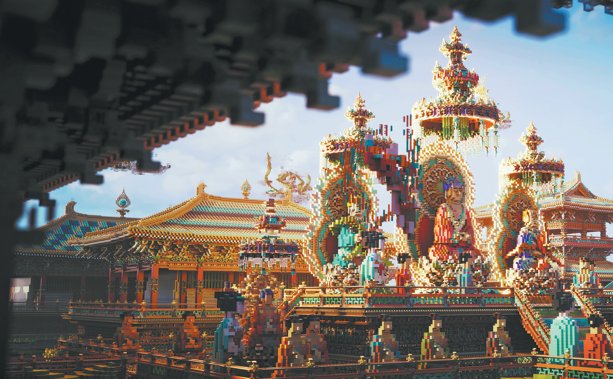
Dunhuang-themed architecture restored in the game by Xia. CHINA DAILY
This gaming relay appears to have become an efficient "router" for delivering traditional culture to the younger generation.
The talented players from diverse backgrounds and locations — Qiu lives in Chengdu, Sichuan province, Xia in Yancheng, Jiangsu province, and He in Meizhou, Guangdong province — inspire each other by reconstructing and experiencing cultural heritage in the digital space, collectively lifting the creative bar higher and higher.
Meanwhile, audiences find their own ways to connect with these block-based architectural worlds. The lively discussions in the comment sections range from architectural details to historical origins, with emotions further awakening a deep-seated sense of cultural identity.
Mainstream media have noted that this gaming relay has transcended mere entertainment to become a cultural dialogue, with the creators demonstrating that cultural heritage need not be confined to traditional forms.
The digital mediums mastered by the younger generation can breathe greater vitality into millenniums-old civilizations in this new era. Experts point to this phenomenon as a natural evolution of cultural expression for Generation Z.
"For this generation, who grew up with rich gaming experiences, the divide between real life and the gaming world isn't that large," said Cui Di, an associate professor at Fudan University's School of Journalism.
"Expressing their feelings for traditional culture through games is particularly natural and reasonable for them," he said.
Cui highlighted a key distinction between gaming and watching videos or anime. "A person's sense of agency is very strong in games, especially in open-world building games like Minecraft. Using game constructs to express emotion is a very powerful form of expression," he said.
The data supports this. According to Douyin, while the core audience for such content is under 30, the cultural depth of the relay successfully attracted non-gamers, significantly expanding its reach.
The platform's team, observing the trend, helped organize special themed chapters focusing on traditional culture, which garnered 7 million likes and 80 million plays collectively.
Comment sections have become forums for discussing architectural history, artistic styles, and shared national pride. While debates occasionally arise, the overarching sentiment is one of appreciation and discovery.
One comment read: "I never thought you could learn about traditional Chinese culture this way. It's incredibly awe-inspiring."
For the creators, the exhausting cycles of building, tweaking and rendering are fueled by this profound connection.
"That moment when a work is completed, it's as if all the nights spent awake, the revised plans, the repeatedly deliberated details all turn into sparks, lighting the way forward," Xia said.
He sees their work as a potent fusion of form and content. "It's more about the combination of both," he reflected when asked about the secret to breaking out of the gaming circle.
"It enhances cultural confidence in a way that young people can accept. You could call it 'educating through entertainment'," he said, adding they might tackle adaptations of China's four great classical novels.
Quan Jiaxin contributed to this story.

Online See more by scanning the code.
