
Editor's note: In this weekly feature China Daily gives voice to Asia and its people. The stories presented come mainly from the Asia News Network (ANN), of which China Daily is among its 20 leading titles.
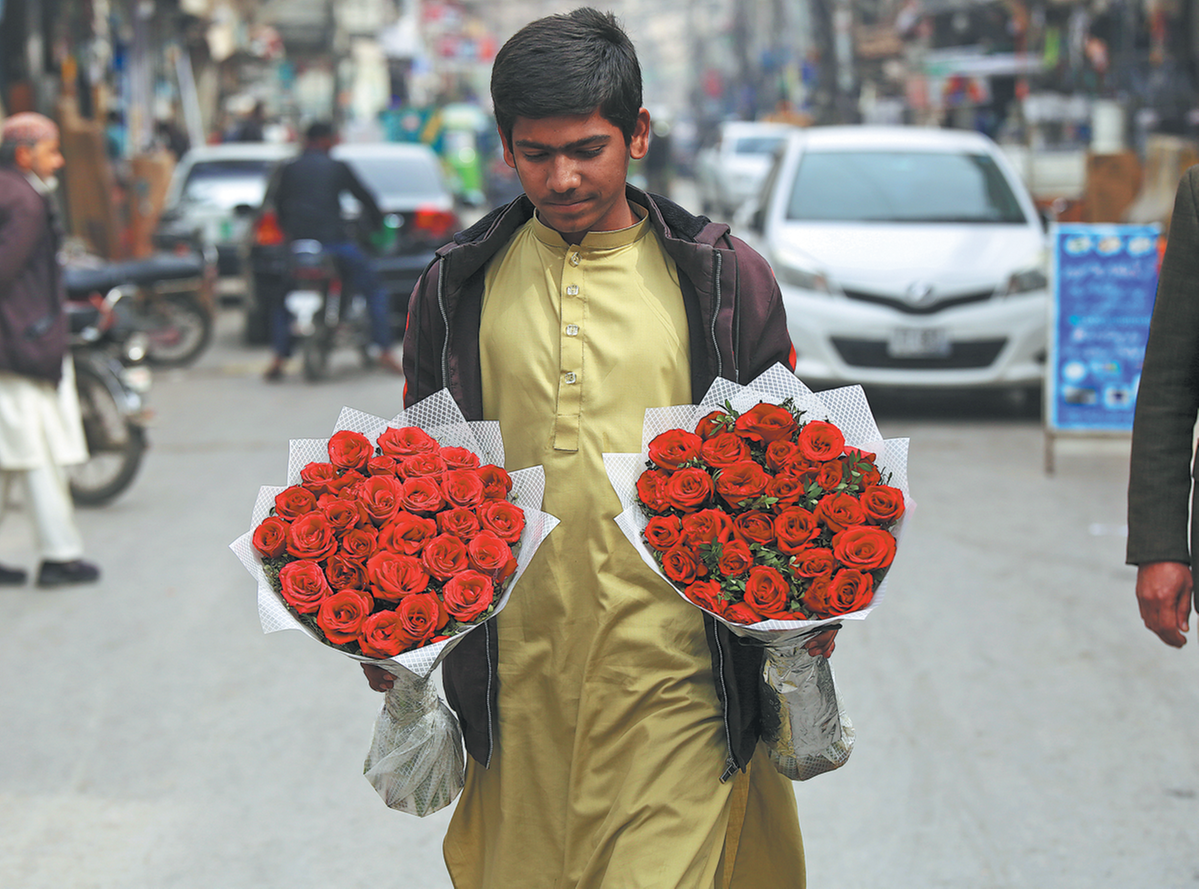
A vendor sells flowers in Peshawar, Pakistan, on Feb 14. EPA
Waseem and Ezza met in 2022 and immediately hit it off. Within a year, they were married. For most Pakistani couples, there's nothing that stands out about this story.
After all, rishtas, or marriage proposals, often happen based on rather truncated timelines. What makes Waseem and Ezza's story stand out is that it didn't start over a cup of tea in a drawing room, or a coffee date near the office. It started online -on a dating app.
Despite the presence of matchmaking and dating platforms in Pakistan for nearly a decade, dating apps are not so openly discussed in Pakistani circles.
But Waseem and Ezza are open about it. They even recommend others follow their route.
"We're sharing this story for all those people who struggle to find rishtas or get disheartened and feel they can't use different avenues," Waseem says, referring to people who look to family members, cousins or "rishta aunties" (professional matchmakers), who provide alliances based on "monetary packages".
His concern for those-struggling to find partners provides a glimpse into the long-standing and complex matchmaking process that has become part and parcel of Pakistani society.
In this route, one needs to cross the hurdle of impressing the rishta auntie before getting to meet the potential spouse.
A 2024 survey by Gallup and Gilani Pakistan showed over 80 percent of Pakistanis got married through the "arranged marriage" process, while young people were looking to expand their social circles.
For years now, rishta groups on social media have been a big part of countless rishta journeys. Statements such as "looking for someone serious only" or "only approach if ready for marriage" are commonly found on these platforms.
Before Ezza decided to sign up on Muzz, a dating and marriage app, she'd been through the standard process — families coming over, the judgement, and the rishta aunties. Yet, nothing clicked. All of this, she said, started in 2018, after she graduated from university and her parents started looking for alliances for her.
They asked for help from family and friends, and also sought professional help. Speaking about how the process of hiring a matchmaker works, Ezza said, "She would take money and show me certain kinds of rishtas." According to her, the amount of money she paid the matchmaker was directly linked to the type of alliances Ezza and her family were shown.
Those weren't the only hurdles Ezza faced. "I have just one other sibling, a sister," Ezza says. "People did not want to marry us as they assumed they would have to look after our parents too since we do not have a brother."
At one point, the constant rejections left her feeling "unlovable", and she even sought psychological counseling. It wasn't until she heard about Muzz from a colleague that she realized she had another avenue for finding a suitable alliance.
Initially, she was skeptical. She wondered who would be okay with meeting through an app. "Three years after that initial judgement, I met Waseem on the same app,"Ezza says.
For Ezza, having a platform such as Muzz allowed her the control and freedom she needed. That's not to say she didn't face rejections. The process, however, gave her more freedom.
"One benefit is you can blur your pictures, which I did," Ezza said. "If you feel like moving ahead with someone, then you can change your privacy parameters, but you need a little bit of patience."
According to her, being rejected on the app was not as bad as the alliance meetings: "The good thing is people on the app aren't coming to your house, and your family isn't involved."

A vendor sells heart-shaped balloons in Lahore, Pakistan, on Feb 14. EPA
No emotional involvement
"On the app, if someone is rejecting you, there's no emotional involvement. If it doesn't work out, you just say bye. You don't have to go through traumatic or humiliating conversations."
Nayab Nazir, Pakistan's marketing lead for Muzz, says, "When Muzz launched in Pakistan, we already knew a lot of third parties were involved in the rishta process. There were a lot of aunties, khalas (maternal aunts), mamoos (maternal uncles) that single people didn't want to involve in the rishta process because they wanted their own say. So, we already knew we had to remove the middle person."
Sara, who found her husband through Muzz earlier this year, agrees with Ezza that such apps did allow her a greater level of control.
She said, "My thinking with the traditional process was, why should I give someone the power to come and reject me." She learned about Muzz through friends and family, and she was willing to give it a try.
Although Sara and Ezza were not on Muzz for too long, they did come across a wide range of people — and they weren't all good.
According to Sara, "The app, in itself, is really good, but some people on it are quite strange, so I wanted to be picky, and I think it's good to not just trust anyone on the app. I did match with a lot of good people, but my personal values didn't align with most of them, which is why I only met two people in person."
Aliya, 38, had been looking for a match through the traditional route.
She then found that Muzz helped a divorced friend to remarry. Both the girl and the person she met on the app had children from their first marriage, she said. "They met on Muzz, got married and now they have a child."
In many ways, such apps are providing an avenue for divorced or widowed women to find their partners.
Dil Ka Rishta, one of Pakistan's most popular matchmaking apps, prioritizes safety and privacy for its users, especially women. Their recently introduced VIP Matchmaking Service, which allows users to sign up without a public profile, came after their team received feedback from women who didn't want to create public profiles.
Mir Ishaq Rehman, CEO and cofounder of Dil Ka Rishta, said, "A lot of women told us they wanted help with marriage-related decisions but did not feel comfortable putting their photos and details on a public app. We created our VIP in-person service for them."
"Instead of posting a public profile, they work privately with a consultant who understands their requirement, speaks with families and presents a shortlist that reflects what they want," he said.
DAWN, PAKISTAN
