
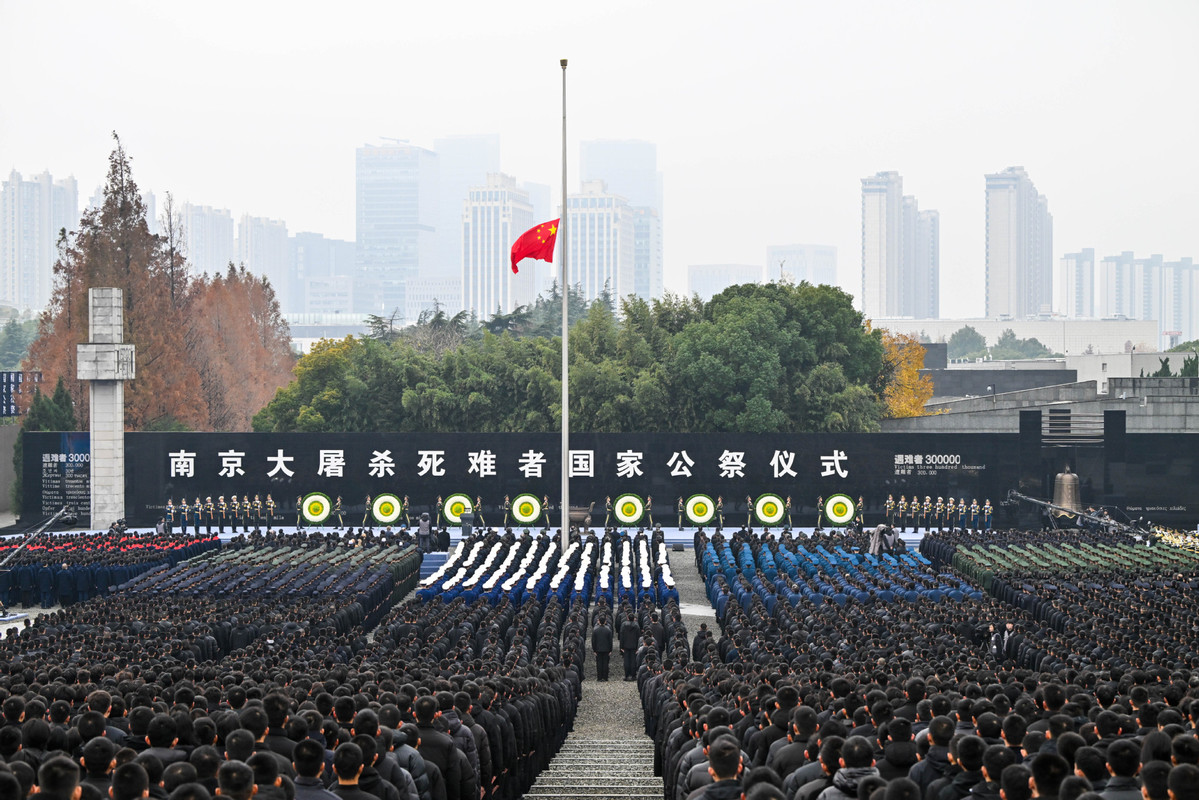
A national memorial ceremony for the Nanjing Massacre victims is held at the Memorial Hall of the Victims in Nanjing Massacre by Japanese Invaders in Nanjing, capital of east China's Jiangsu Province, Dec 13, 2025. The 12th national memorial day was observed in Nanjing on Saturday to honor about 300,000 victims killed by Japanese troops during the Nanjing Massacre, in a year that marks the 80th anniversary of the end of World War II (WWII). [Photo/Xinhua]
Liu Minsheng, 91, a survivor of the Nanjing Massacre, felt overwhelmed by emotions as he attended the solemn national memorial ceremony held on Saturday in Nanjing, Jiangsu province, to mourn the 300,000 victims of the atrocity.
His thoughts raced back to the heartbreaking chapter in history as he touched a scar on his right leg, left behind by a wound caused by the bayonet of a Japanese soldier. The scars on his heart and mind are deeper, because they capture the arduous journey from pain to resilience.
Liu was only 3 years old when Japanese invaders captured Nanjing, then the Chinese capital, on Dec 13, 1937. His parents took him and his sister to a refugee shelter, but it turned out to be anything but a safe place. One day, the shelter was attacked. The little boy's panic-stricken cries drew the attention of a Japanese soldier who raised his bayonet and stabbed the boy in the leg.
That was also the day Liu last saw his father. "The Japanese soldiers took away many young and middle-aged men, including my father. He never came back. It was initially believed that they were taken for forced labor, but later we heard that all of them were killed at the Zhongshan Wharf," Liu said.
Reflecting on the tragedy, Liu said the harm inflicted upon the Chinese people by Japanese invaders can never be forgotten. "We must remain vigilant against the resurgence of Japanese militarism. We must remember the history and cherish peace," he added.
The Japanese invaders brutally killed about 300,000 Chinese civilians and unarmed soldiers during the six-week massacre, making it one of the most barbaric episodes of World War II.
This year, eight more people who survived the 1937 slaughter passed away, leaving only 24 registered survivors still alive. Eighty-eight years have passed, but the Japanese government has yet to officially acknowledge the Nanjing Massacre.
On Saturday, China held a national memorial ceremony in Nanjing to mourn the victims of the massacre. Sirens resonated through the city as people from all walks of life observed a moment of silence in solemn remembrance of the day.
Thousands wearing dark attire gathered at the public square of the Memorial Hall of the Victims in Nanjing Massacre by Japanese Invaders, with white flowers pinned to their chests for the ceremony.
China's national flag flew at half-staff in front of the crowd, which included survivors of the massacre, local students and international friends. Eighty-eight young people from the city read out a declaration of peace, and citizen representatives struck the Bell of Peace.
Addressing the ceremony, Shi Taifeng, a member of the Political Bureau of the Communist Party of China Central Committee and head of the CPC Central Committee's Organization Department, said the gathering aimed to express the Chinese people's unwavering commitment to peaceful development, while mourning those who were brutally killed by Japanese invaders.
He called for carrying forward the great spirit of the Chinese People's War of Resistance Against Japanese Aggression (1931-45), striving to promote China's modernization and national rejuvenation, and making greater contributions to the cause of peace and progress for humanity.
In 2014, the Standing Committee of the National People's Congress, China's top legislature, officially designated Dec 13 as National Memorial Day for Nanjing Massacre Victims to keep the history firmly in mind and cherish the hard-won peace.
This year's ceremony took place amid the 80th anniversary of the victory in the Chinese People's War of Resistance Against Japanese Aggression and the World Anti-Fascist War, and against the backdrop of the strained China-Japan ties following Japanese Prime Minister Sanae Takaichi's erroneous remarks on the Taiwan question.
According to a recent global online survey conducted by China Global Television Network, 80.8 percent of the respondents said they believe the recent provocative words and actions by Japan's current leadership, which glorify militarism, have reinforced the country's image as both a troublemaker and a peace breaker.
Meanwhile, 81.6 percent said they believe Japanese politics has long been dominated by militarist and right-wing forces, and that its accelerating rightward shift poses a significant threat to global peace.
Lyu Jing, an associate professor of Chinese history at Nanjing University's School of History, said the post-WWII international order was built upon the reckoning with wars of aggression and the defense of humanitarian principles, and any attempt to deny or falsify history constitutes a direct challenge to the principles of international justice.
The global community must reach a shared understanding that Japan should face its history with a responsible attitude and fulfill its obligations to historical truth, Lyu said, adding that the international community should stop allowing Japan's continued evasion of its wartime culpability.
caodesheng@chinadaily.com.cn
