
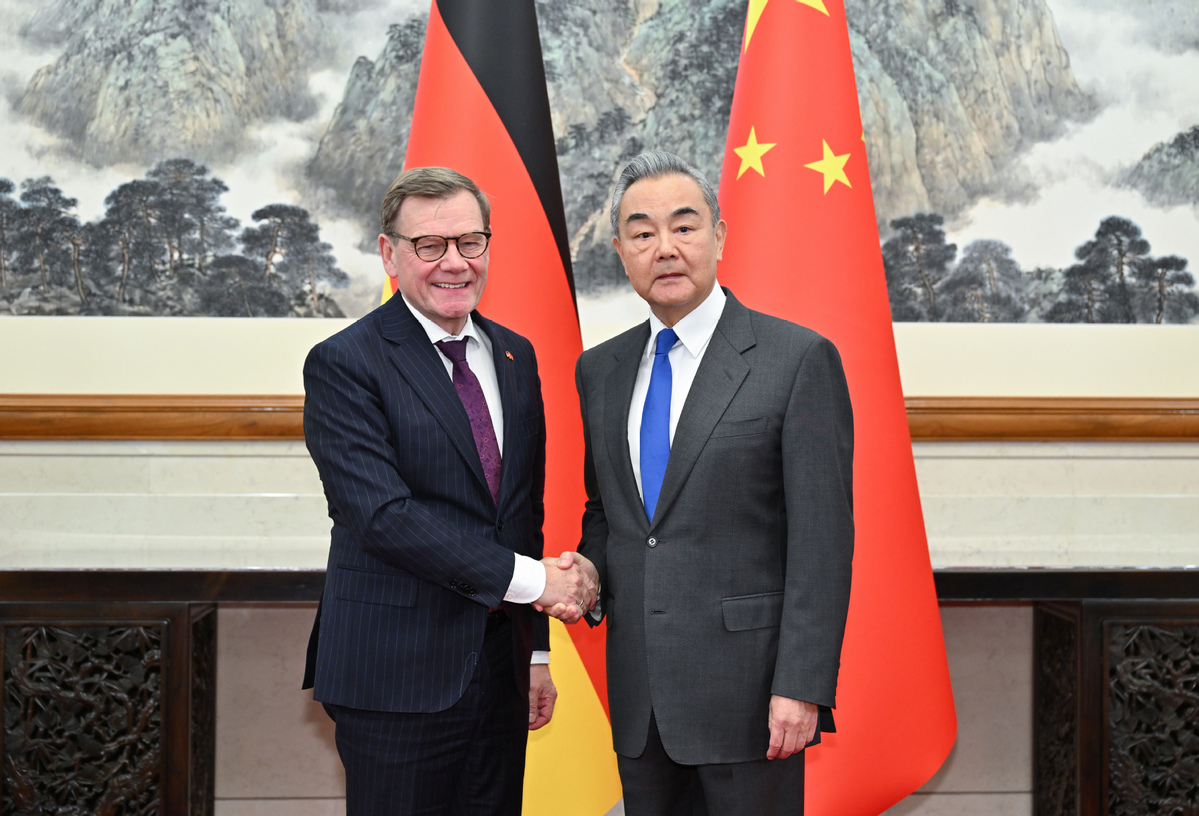
[Photo/Xinhua]
Foreign Minister Wang Yi has called for China and Germany to transcend differences in social systems, histories and cultures and to build a more mature model of positive interaction and a more stable bilateral policy framework.
Wang made the remarks when meeting with Germany's visiting Foreign Minister Johann Wadephul in Beijing on Monday.
Wadephul is making his first visit to China since the formation of Germany's new government in May. "In times of growing international tensions and geopolitical upheaval, direct, intensive exchange with China is necessary, indeed indispensable," Wadephul said in prepared remarks ahead of his visit, which was originally scheduled in October.
Wang told Wadephul that although the latter's visit had gone through several twists and turns, there is a Chinese saying: "Good things never come easy".
"Whether one comes early or late is not the point, what matters is the purpose of the visit," Wang said. He added the aim of the meeting should be to seek cooperation and enhance understanding, and not to amplify differences.
As the world undergoes rapid change and turbulence, Wang said China–Germany cooperation would benefit both countries and help address global challenges.
Wang also expressed hope that Germany would take a more objective and rational view of China, uphold the positioning of the China–Germany partnership, and see China's development as an opportunity for deeper cooperation and a driver of mutually beneficial outcomes.
Wang added that China is willing to work with Germany to maintain close high-level exchanges, strengthen strategic communication, align development strategies and advance practical cooperation, so as to provide momentum for the growth of bilateral ties.
Germany, as the European Union's largest economy, is a major force for European integration and an important cooperation partner for China, Wang noted.
It is hoped that Germany would help the EU return to a rational and pragmatic approach toward China, stay on the right course of mutually beneficial cooperation, resolve differences through dialogue, and avoid politicizing economic issues, weaponizing trade matters, or making normal cooperation about security, he said.
As supporters, advocates and practitioners of multilateralism, Wang said China and Germany should strengthen solidarity and coordination and work together to promote a more just and reasonable global governance system.
On the Taiwan question, Wang stressed that the one-China principle is the important political foundation of China–Germany relations, and that there is no room for ambiguity.
He expressed the hope that Germany would understand and support China's legitimate position and resolutely oppose and resist any "Taiwan independence" separatist activities.
Wadephul said that in a volatile and uncertain world, Germany and China must shoulder their special responsibilities, strengthen communication and coordination, and become reliable and predictable cooperation partners for each other.
Germany firmly adheres to the one-China policy, and this position will not change, he said.
Wadephul said Germany looks forward to holding a new round of intergovernmental consultations with China next year and is ready to maintain close high-level exchanges and deepen cooperation in trade and other sectors for the benefit of both peoples.
German companies in China remain confident in China and are willing to continue expanding their presence in the Chinese market, he added.
He said Germany supports the EU and China in seeking mutually beneficial outcomes through dialogue and stands ready to play a constructive role in this regard.
The two sides also exchanged views on the Ukraine crisis.
