
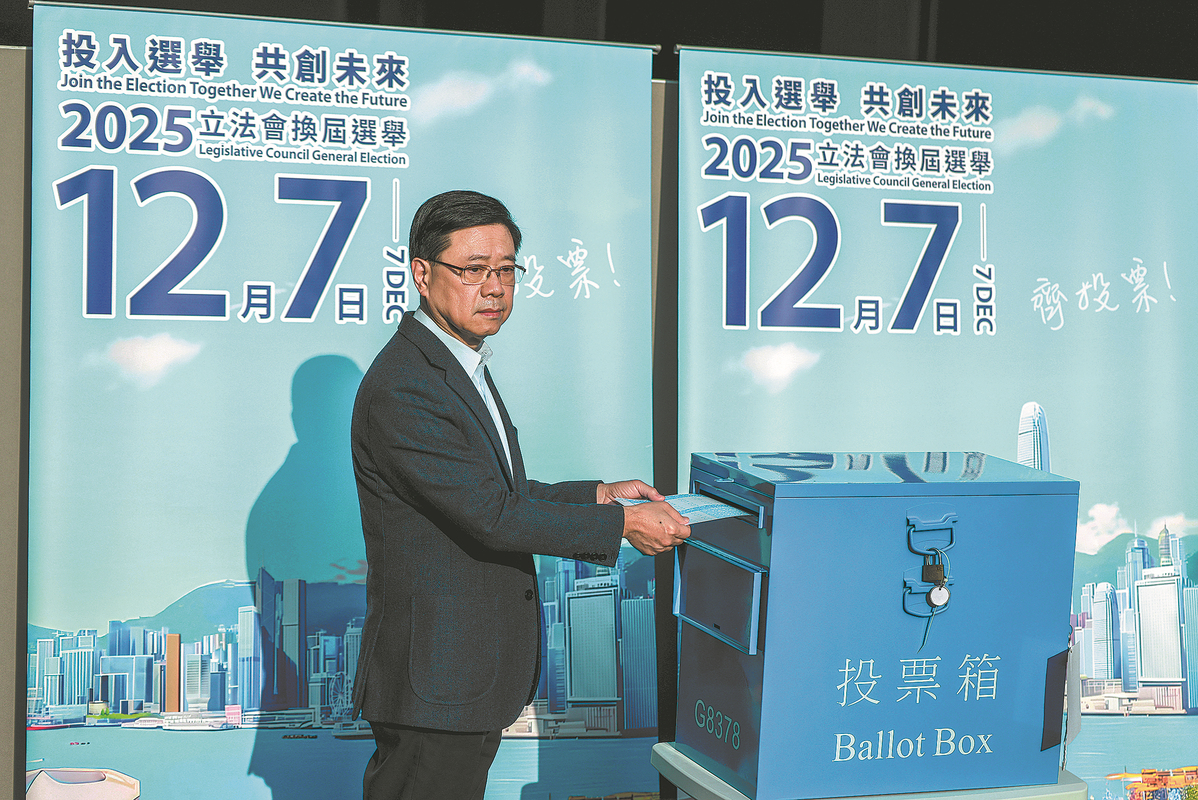
Hong Kong Chief Executive John Lee Ka-chiu casts his ballot on Sunday morning at a polling station during the voting for the election of the new term of the Legislative Council. ANDY CHONG/CHINA DAILY
Voters across the Hong Kong Special Administrative Region cast their ballots in the Legislative Council election on Sunday to pick 90 lawmakers who will serve in office for the next four years.
A total of 161 nominees are in the fray for all 90 seats — 20 seats from 10 geographical constituencies, 30 from 28 functional constituencies and 40 from the Election Committee Constituency.
The election, which is a key part of the city's revamped local governance structure, saw active participation of voters from across society. The authorities set up 612 polling stations, primarily located in schools, community facilities and government buildings.
Voting began at 7:30 am and ended at 11:30 pm, two hours longer than in previous elections. As of 5:30 pm on Sunday, the cumulative voter turnout in the geographical constituencies stood at 23.76 percent — marginally higher than the 21.02 percent recorded at the same time in the previous election — with approximately 981,777 voters having cast their ballots.
Several functional constituencies and the Election Committee segment also reported good voter participation. In the functional constituencies, the overall turnout reached 29.84 percent, while voting within the Election Committee Constituency progressed rapidly, with a high turnout of 97.07 percent.
Hong Kong Chief Executive John Lee Ka-chiu arrived at the Raimondi College polling station in the Mid-Levels area shortly after 8:30 am and cast his ballot. He called on all eligible voters in Hong Kong to cast their ballots for representatives who will "drive reform and safeguard disaster victims".
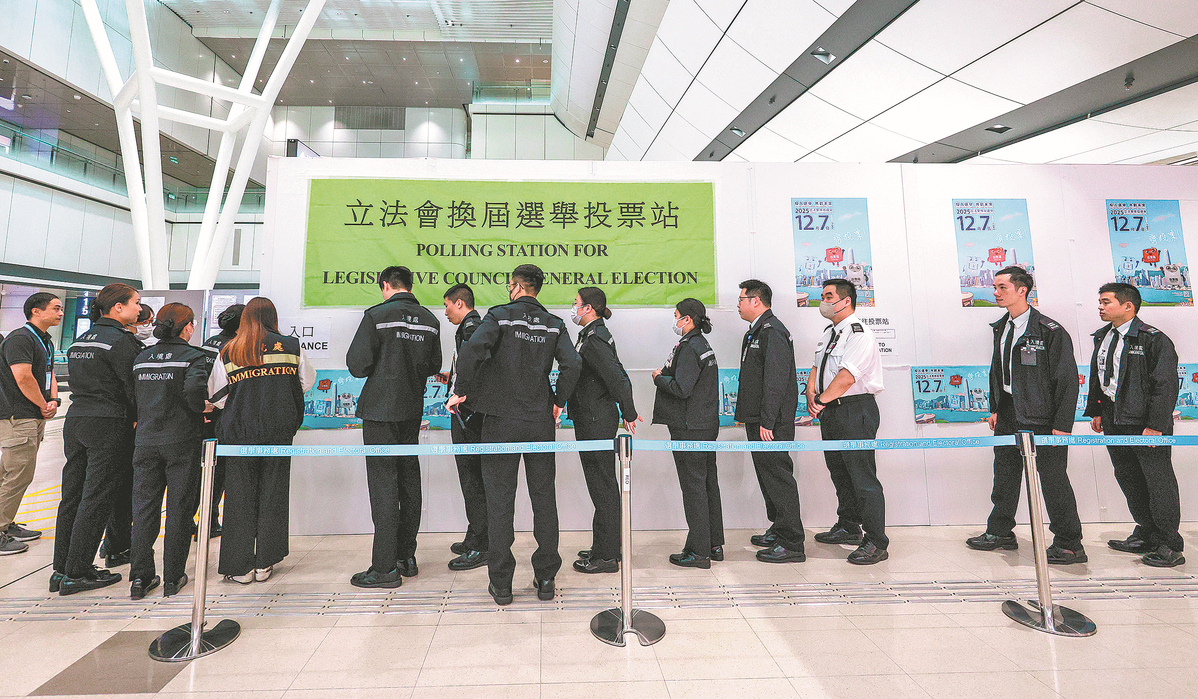
Staff members of the Immigration Department of Hong Kong Special Administrative Region line up on Sunday to enter a polling station at the Hong Kong International Airport to cast their ballots for the election of the eighth-term Legislative Council of the SAR. ANDY CHONG/CHINA DAILY
The election for the eighth-term Legislative Council is being held less than two weeks after a major fire at the Wang Fuk Court residential estate in Hong Kong's Tai Po district killed 159 people and displaced hundreds.
Lee emphasized the role that voters can play in advancing efforts to help those affected by the fire, as he described the election as a step toward making systemic improvements to plug gaps in the construction sector's practices and ensuring full support for the victims.
"The first meeting of the new Legislative Council will discuss support for the disaster victims. We will consult with lawmakers as soon as possible. Through our discussions, we aim to find the truth swiftly and expedite recovery and reconstruction efforts," he said.
Senior officials of the SAR government arrived at various polling stations to cast their ballots, and they encouraged the public to vote early.
Chief Secretary for Administration Eric Chan Kwok-ki echoed Lee when he said that the new legislature will play an important role in the SAR's governance, especially in terms of assisting disaster victims.
Archbishop of Hong Kong Andrew Chan Au-ming encouraged residents to participate in the voting process and demonstrate their support for the community. He expressed hope that the newly elected lawmakers will thoroughly scrutinize policies to help foster a safer environment for all.
"The fire tragedy has brought difficult times. However, I don't want to just concentrate on the event, but also on how we can prevent such events from happening again," Chan said.
At Law Ting Pong Secondary School and the Hong Kong Teachers' Association Lee Heng Kwei Secondary School, to which polling stations were relocated due to the fire, voters arrived early.
One voter, surnamed Yip, said she wants newly elected lawmakers to focus on various issues concerning Tai Po, including fire safety, transportation and elderly care. "Voting is our right, and it is how we can make our voices heard," she added.
Ethnic minority voters spoke positively of the electoral arrangements, noting that sufficient information and assistance were provided in multiple languages.
Ashfaqur Rahman Palash, president of the Bangladesh Association of Hong Kong, emphasized the importance of voting. "Hong Kong is also my home. … Electing the right people is crucial for my children's future and the economy," he said.
stacyshi@chinadailyhk.com
