
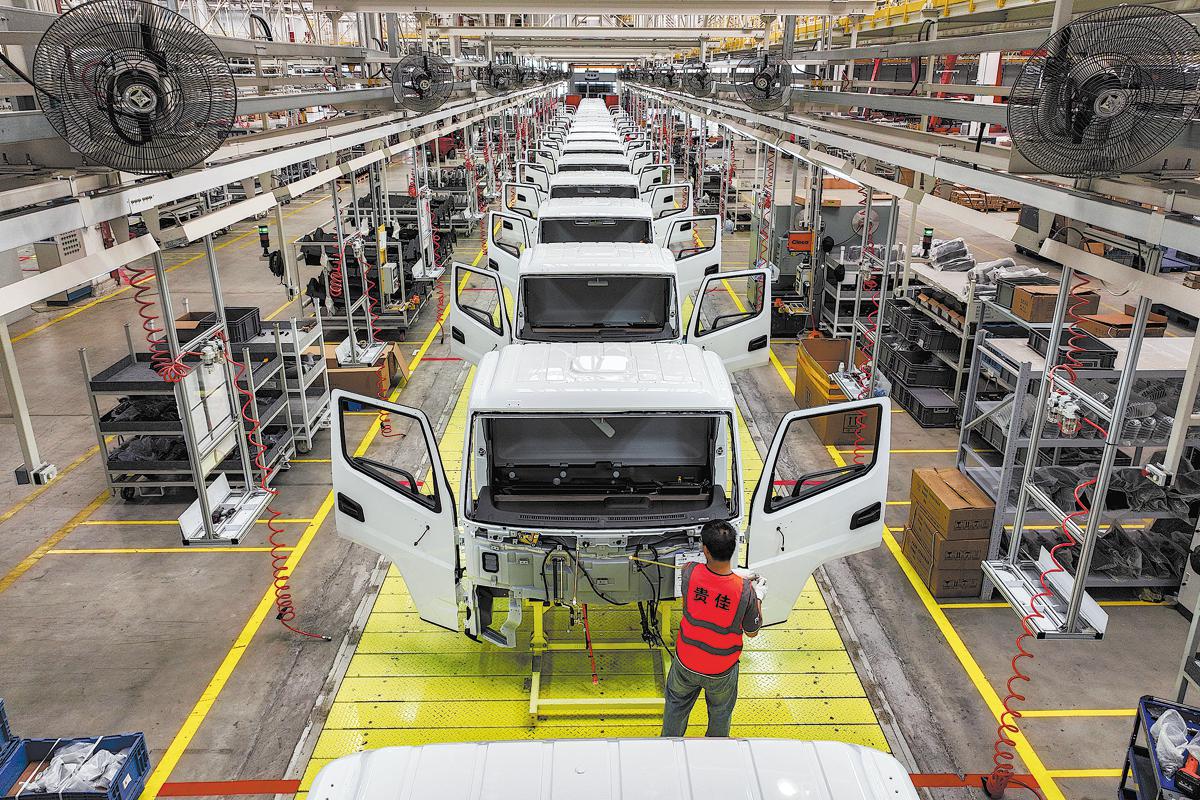
A worker assembles an electric light truck at an automobile enterprise in the Guian New Area of Guizhou province in July. QU HONGLUN / CHINA NEWS SERVICE
More electric trucks are hitting the road in China as the nation strives to achieve peak carbon dioxide emissions before 2030 and accelerate electrification of its transportation sector.
Data from a report released by the International Energy Agency in May shows that global sales of electric trucks grew for the third consecutive year in 2024, exceeding 90,000 worldwide. This global surge was largely driven by sales in China, which more than doubled between 2023 and 2024 and accounted for over 80 percent of global electric truck sales last year, the report said.
According to auto industry information service provider cvworld.cn, from January to October, China's cumulative sales of new energy heavy-duty trucks reached 157,000, surging 178.3 percent year-on-year, while its cumulative sales of new energy light trucks reached 217,000, up 60.3 percent year-on-year.
With their numbers accounting for 3 to 4 percent of the total fossil-fuel vehicles, traditional heavy-duty trucks contribute to nearly 50 percent of carbon emissions, industry estimates show.
China's strong growth in electric truck sales has been spurred by a vehicle scrappage scheme with purchase incentives, which was renewed in 2025. Lower battery prices and the introduction of tighter emission standards for trucks issued in July 2023 have also accelerated the shift, while pressure on heavy industries to reduce emissions is further translating into deployment of electric trucks.
Supercharging corridor
To facilitate wider use of electric trucks, a highway heavy-duty truck green electricity supercharging corridor was put into operation in November in Yunnan province.
The corridor, which spans four major routes with a total length of 3,350 kilometers, has 113 supercharging stations. With one supercharging station every 50 kilometers on average, the corridor forms a continuous power network capable of supporting a daily heavy-duty truck energy replenishment need of more than 400,000 kilowatt-hours.
"The four main routes of the corridor are strategically aligned with Yunnan's cross-border logistics and regional economic belts," said Xu Weidong, general manager of Yunnan Jiaotou New Energy Industry Development Co.
Serving as key arteries connecting Yunnan to inland areas such as Chongqing, Sichuan province, Guangdong province and the Guangxi Zhuang autonomous region, these routes also serve as "land gateways" linking China with South Asia and Southeast Asia, Xu added.
If all electric heavy-duty trucks along the corridor are powered by green electricity, it would reduce carbon dioxide emissions by approximately 93,900 metric tons per year and nitrogen oxide emissions by 285.6 tons annually, he said.
Compared with conventional charging that requires one to two hours per session, heavy-duty electric trucks that charge in the six-megawatt-level liquid-cooled supercharging stations deployed along the corridor can regain 200 kilometers of range with just 15 minutes of charging — four times faster than traditional solutions.
"As the first of their kind in Yunnan and one of the earliest operational megawatt-level charging networks in China, these supercharging stations mark Yunnan's entry into the 'megawatt charging era', setting new technical standards for southwestern China and redefining energy replenishment capabilities on highways," Xu said.
Yunnan is advancing the construction of distributed photovoltaic systems along highways, with the power generated prioritized for charging electric vehicles. So far, photovoltaic systems of 26 MW capacity have been completed, producing over 33.8 million kWh of electricity annually.
By 2027, the scale of such distributed photovoltaic systems will reach 300 MW, generating over 390 million kWh of electricity per year. This will ensure that nearly 100 percent of the electricity needed for charging purposes comes from green sources.
Other major application scenarios for electric trucks involve mine and port logistics, and continuous efforts are being made to encourage their wider use.
In North China's Inner Mongolia autonomous region, a fleet of 100 autonomous electric mining trucks has been put into operation at an open-pit mine since May, marking the largest-scale application of such vehicles globally.
Shu Yingqiu, the mine's manager, said the replacement of fossil-fuel vehicles with this electric fleet could help reduce diesel consumption by 15,000 tons and carbon dioxide emissions by 48,000 tons annually.
Data from the Tangshan ocean, port and shipping administration in Hebei province shows that as of November, nearly 55 percent of Tangshan Port's total vehicles — mostly trucks — ran on new energy.
The port is equipped with 236 charging piles designated for heavy-duty electric trucks, while some port enterprises have also installed photovoltaic systems on their roofs and open ground areas, generating around 8.5 million kWh of electricity annually to help recharge trucks.
wangsongsong@chinadaily.com.cn
Li Yingqing and Zhang Yu contributed to this story.
