
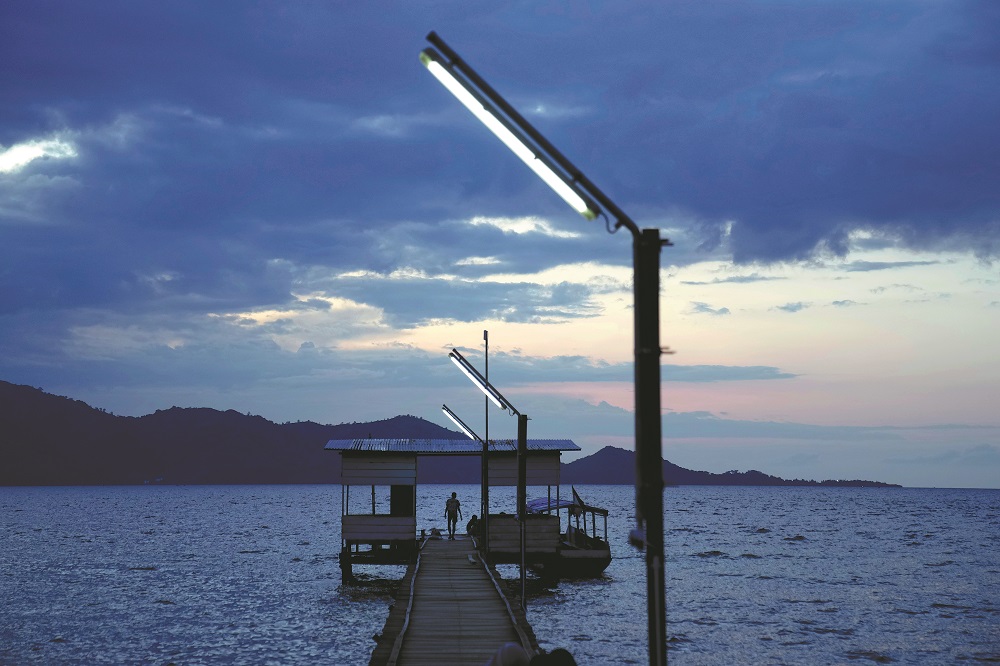
A man walks on a pier on Karampuang Island, where electricity supply relies on solar power plants, in West Sulawesi, Indonesia, on Dec 22, 2022. DITA ALANGKARA/AP
Editor's note: In this weekly feature China Daily gives voice to Asia and its people. The stories presented come mainly from the Asia News Network (ANN), of which China Daily is among its 20 leading titles.
Energy transitions are unfolding everywhere but the stakes for Indonesia's shift are particularly important as it is the world's fourth-most populous country, sixth-biggest emitter of CO2 and top exporter of coal.
Coal accounts for more than 62 percent of Indonesia's power generation, while renewable energy makes up 14 percent. Wind and solar power comprise around 0.2 percent of that mix, far from the global average of 10 percent. The rest of Indonesia's renewable energy comes from hydropower, biofuels and waste-to-energy.
The Indonesian government has reiterated that it will pursue the energy transition at its own pace and in ways that match the country's economic goals and fiscal ability, stressing that the strategies of developed economies will not work for developing countries.
Indonesia's Coordinating Minister for Maritime and Investment Affairs Luhut Binsar Pandjaitan said that the economies of developing countries must still grow, while they pursued emissions reduction.
"We need to avoid being dogmatic about one technology in carbon emissions reduction," Luhut said during the Indonesia International Sustainability Forum, or IISF, in Jakarta in September.
Luhut said that Indonesia would involve the development of the green economy as part of its push toward energy transition.
He cited cooperation with Singapore in developing a solar panel manufacturing industry in exchange for exporting low-emission electricity to the city-state.
Singapore has approved the import of 3.4 gigawatts of electricity from Indonesia.
Luhut also boasted of the country's push into electric vehicle manufacturing and EV adoption among Indonesians.
Moreover, he is eyeing boosting the country's biofuel production, particularly from existing sources of crude palm oil and later exploring the use of seaweed, which it has in abundance.
The Indonesian Energy and Mineral Resources Ministry's new renewable energy and energy conservation director-general, Eniya Listiani Dewi, said that Indonesia would require $55 billion in investment to push its energy transition for the next five years. She said that next year the country would already need its first $14 billion.
She added that establishing a stable grid to effectively manage large shares of intermittent renewable energy sources like solar and wind power remained one of the major challenges to the energy transition in the country.
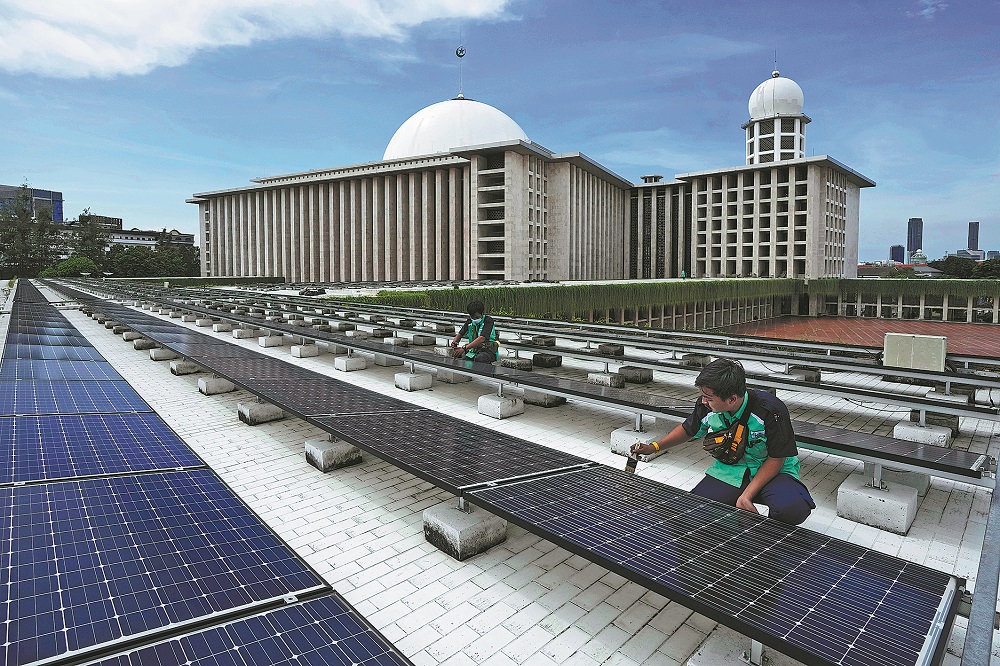
Workers carry out maintenance work on solar panels that provide partial electrical power to Istiqlal Mosque in Jakarta on March 29, 2023. TATAN SYUFLANA/AP
Indonesian President Joko Widodo said during his remarks on Sept 5 that Indonesia had over 3,600 GW of renewable energy potential and 3.3 million hectares of mangroves that could absorb up to 12 times the amount of carbon dioxide absorbed by tropical rainforests.
He said none of this would yield much if developed countries "don't have the courage to make investments, share their technology and provide affordable financing for developing countries".
Putra Adhiguna, managing director at the Energy Shift Institute, said that the government should focus on expanding renewable energy capacity and improving inter-island interconnections because electricity demand in Indonesia will continue to increase.
During the IISF, Indonesian state-owned electricity group Perusahaan Listrik Negara through two of its subsidiaries and Saudi utility developer ACWA Power signed a hydrogen purchase agreement with state-owned fertilizer company Pupuk Indonesia.
Last year, the companies signed an agreement to develop the largest green hydrogen facility of its kind, powered by 600 megawatts of solar and wind power, which is expected to start commercial operations in 2026. The project will enable 150,000 metric tons of green ammonia production annually.
Institute for Essential Services Reform Executive Director Fabby Tumiwa, however, cautioned that despite the many hydrogen developments in Indonesia, the government is planning for most of it to be exported.
He said that the country has yet to see an upward trend of hydrogen use domestically.
State-owned oil and gas company Pertamina also signed an agreement to jointly study the potential development of carbon capture and storage with partners, including Pupuk Indonesia and South Korean steel giant POSCO, at the IISF in September.
Rachmat Kaimuddin, undersecretary for transportation and infrastructure at the Office of the Coordinating Ministry for Maritime and Investment Affairs, reiterated during the IISF the country's commitment to fighting pollution in its cities, especially Jakarta.
Rachmat said the government hoped it could soon introduce "much cleaner" gasoline in the first quarter next year and biodiesel before the end of this year.
He acknowledged that Indonesia had been lagging behind on determining emissions standards for its coal plants but he gave an assurance that the government was working to improve its capability in this area.
THE JAKARTA POST, INDONESIA
