

An enamel work by Wei Yun, co-curator of The Shining Moments in Life [Photo provided to chinadaily.com.cn]
Vibrant, glossy and shimmering — such qualities of enamel have enthralled many visitors to The Shining Moments in Life, a contemporary enamel art exhibition that opened on Saturday at Beijing's Alliance Francaise (Guangcai Center).
On display are dozens of artworks spanning miniature paintings, installations, jewelry and watch dials — all featuring vitreous enamel — created by seven Chinese artists and two French artists.
A type of powdered glass that is specially manufactured for enameling, enamel can be sieved directly or ground and washed, then applied to a metal surface and fired in a kiln with a temperature between 700 and 800 degrees Celsius. The enamel then melts and fuses to the metal, which creates stunning jewelry and decorative pieces.
It is believed that the earliest colors of enamel were meant to replicate specific gemstones. The earliest-known enamel pieces date back as far as the 13th century BC when Mycenaean goldsmiths inlaid enamel into gold rings.
“Vitreous enameling is a highly-demanding craft fusing both science and art, which requires rapt attention to detail and huge patience,” said Zheng Chun, who co-curated the exhibition with Wei Yun, a participating artist.
“However, it is also a magical craft. Once enthralled, enamellists can spend hours or days on end in their studios to create a single piece,” she added.
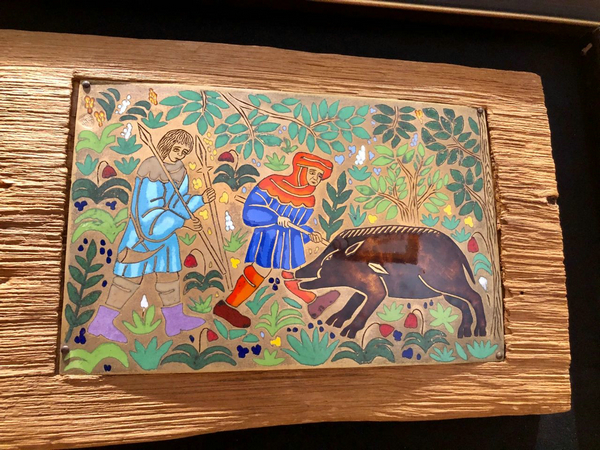
A work by French enamellist and jeweler Jean Francois Dehays on display at The Shining Moments in Life [Photo provided to chinadaily.com.cn]
The exhibit is made possible because of an enameling workshop held by French enamellist and jeweler Jean Francois Dehays 10 years ago in Beijing as all the participating Chinese artists were trained by him, according to the exhibit’s co-producer Li Jin, a freelance art journalist who manages the WeChat-based blog CCARTWALK.
Li noted that, even though enameling is an ancient craft and was introduced to China in the late 13th century, giving rise to the local enameling craft known as Jingtailan, still little remains known to the contemporary public.
Jingtailan is essentially cloisonné, a major enameling technique that entails affixing thin metal strips to the pre-drawn surface of a metal object. This creates many small compartments — the French cloisons means partitions — into which a paste of finely ground, colored glass and water is placed. The piece is then fired, turning the glass into enamel and fusing it with the metal.

Installation Mom Is Not Home II [Photo by Yang Xiaoyu/chinadaily.com.cn]
Artworks made with cloisonné enameling at the Beijing show are mostly by artists Wang Yuan, Su Jia and Chen Wen. The installation Mom Is Not Home II jointly made by Wang, Su, Wei and Nie Jinghui, features cloisonné enameling and strikes a chord with many viewers. Within an album frame are four 3D printed TV sets, and on their screens are cartoon figures such as Nezha, Monkey King and Little Eggshell, which are from the artists’ favorite childhood cartoons.
Visitors to the exhibit can also spot works made with champlevé, another major enameling technique. To make a champlevé piece, artists usually etch or engrave a metal surface to create desired images, which are recess on the surface. Enamel is placed into the recess and then fired.
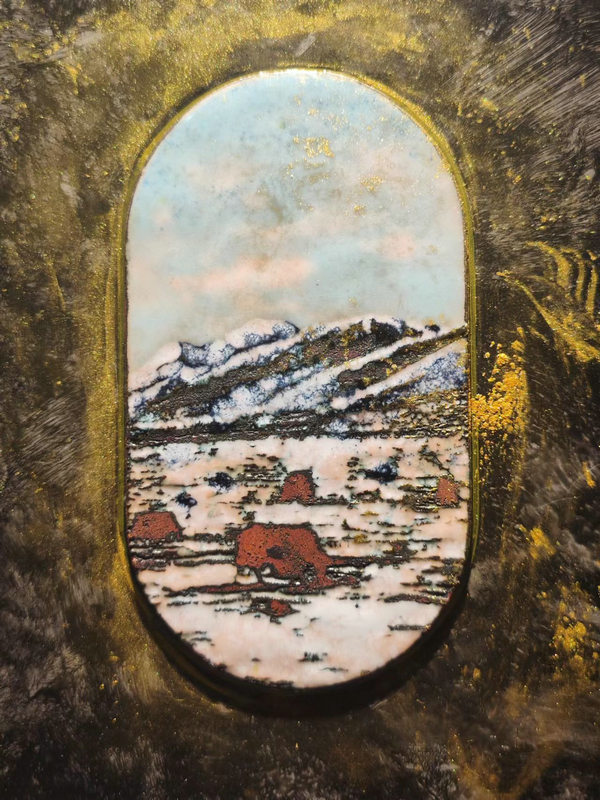
A part of A Moving Train [Photo by Yang Xiaoyu/chinadaily.com.cn]
A Moving Train, collectively made by six artists, is an example of such a technique. Six train-window-shaped copperplates are placed next to each other, depicting scenes including cottages, trees at dawn and snow-capped mountains that their creators have cherished.
Plique-à-jour is another enameling technique that is spotlighted at the show, represented by the hairpin made by contemporary jewelry artists Jean-Marc Waszack and Wang Xiaojia, co-founders of L’Atelier Studio in Beijing.
Made of titanium, the hairpin features a multi-layered transparent enamel decoration that strikes viewers as miniature stained glass, which is the desired effect of plique-à-jour, where enamel is applied in the cells pierced out of a sheet of metal. It is similar to cloisonné, but without backing in the final product so that light can shine through transparent or translucent enamel.
Hence this technique is considered technically demanding — both time-consuming and prone to failure, according to the curators.
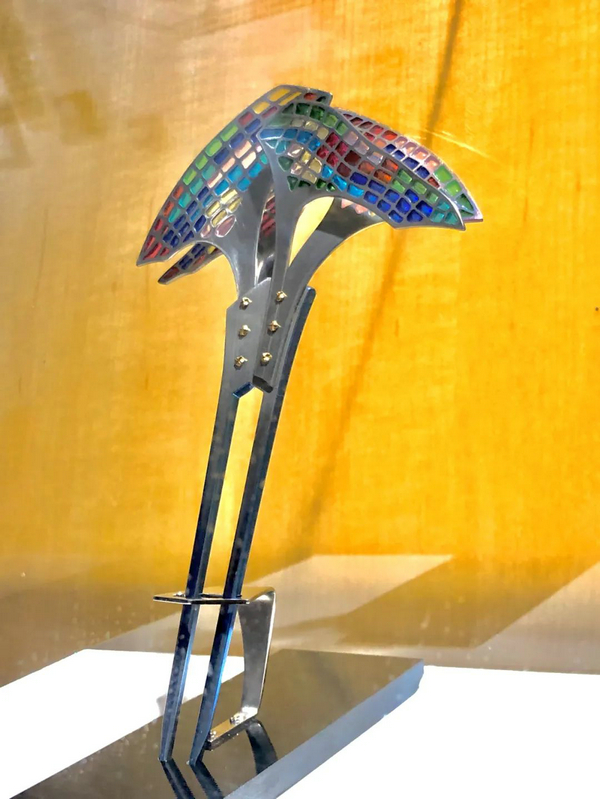
Jean Marc Waszack and Wang Xiaojia’s hairpin features plique-à-jour, which is known for its miniature stained glass effect. [Photo provided to chinadaily.com.cn]

A enamel miniature by Nie Jinghui [Photo by Yang Xiaoyu/chinadaily.com.cn]
The most challenging enameling technique, according to Zheng, is none other than painting miniature portraits in enamel.
Portrait miniature painting in watercolor had a long tradition in Europe from the 16th century to the 19th century. But from the 1630s, patrons had the additional choice of miniatures painted in enamel — a technique invented by French enamellist Henri Toutin and made popular by Swiss enamel painter Jean Petitot. Miniatures painted in enamel were attractive for their vibrancy and durability – unlike miniatures painted in watercolor, which were easily damaged by fading and water.
To create enamel miniatures, powdered glass and metal oxides are mixed with oil to make a paste which is then painted color by color onto a small opaque, usually white enamel surface annealed to a gold or copper plate. The metallic paints are slightly fused to the enamel surface through heating. After cooling, the completed picture is covered with transparent vitreous enamel and heated again to give the image a glazed appearance.
“Making enamel miniatures not only requires extraordinary painting skills but also a great command of kiln temperatures,” Zheng said.
Chinese artist Nie Jinghui is considered a master in this medium. She used to study under both French and British enamellists. A roster of her enamel miniature portraits, of both people and animals, marveled the audience for their exquisite details on bases no bigger than coins.
The exhibit is free to the public and runs through July 2.
Two enameling workshops will be held during the event to offer the audience a hands-on opportunity to learn more about the craft.
If you go:
9:00 am – 6:30 pm, Monday – Sunday; Alliance Francaise (Guangcai Center), 2ndfloor of Institute Francais, No. 18, Workers’ Stadium West Road.

A Buried Bee, an installation by Nie Jinghui [Photo provided to chinadaily.com.cn]

Watch dials featuring enamel miniatures created by Wang Yuan and Nie Jinghui [Photo provided to chinadaily.com.cn]

A work of Wang Yuan inspired by Marc Chagall’s painting [Photo provided to chinadaily.com.cn]

A work of Yang Yilun [Photo provided to chinadaily.com.cn]
