
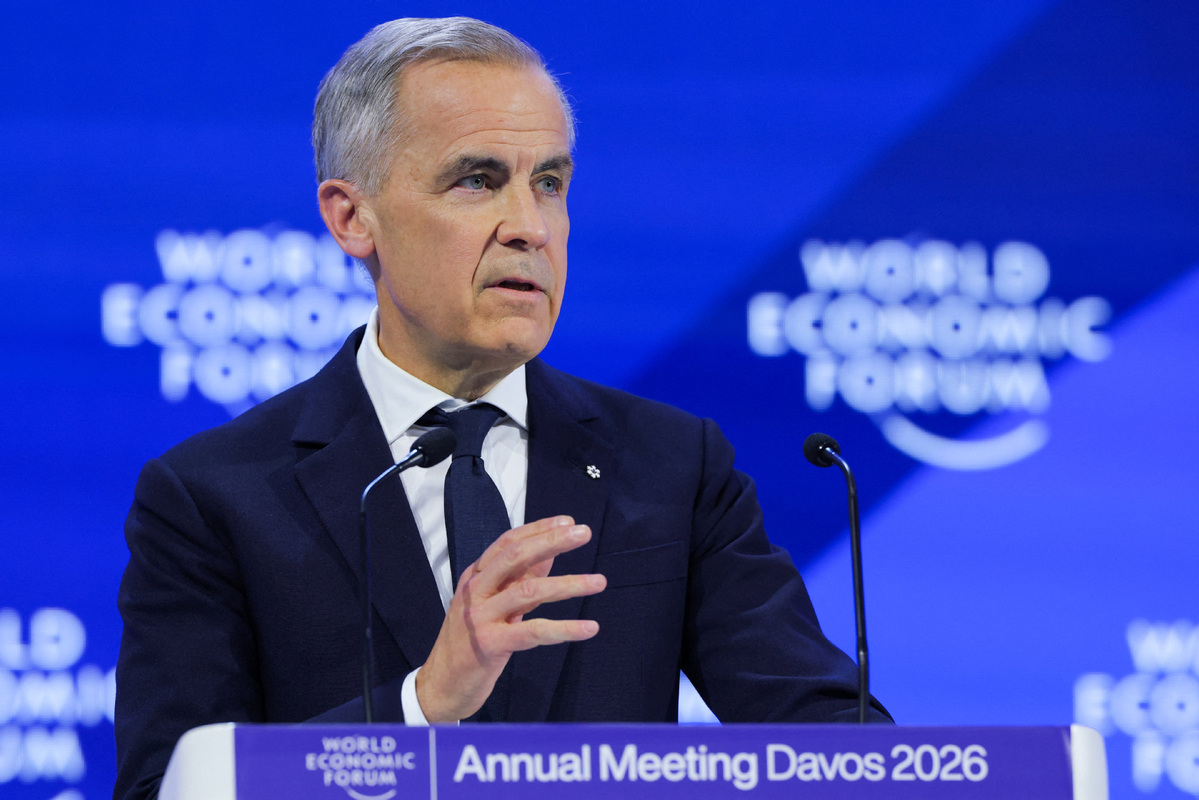
Canadian Prime Minister Mark Carney speaks during the 56th annual World Economic Forum (WEF) meeting in Davos, Switzerland, Jan 20, 2026. [Photo/Agencies]
Canadian Prime Minister Mark Carney's remarks in Davos that the old international order is over reflect a broader reassessment of the postwar system as global politics moves toward fragmentation and fewer restraints, experts said.
In a speech at the World Economic Forum in Davos, Carney said that the rules-based international order was partly illusory and that "middle powers" must adapt to a more fragmented and coercive global environment.
"The old order is a somewhat vague concept referring to international relationships, the world order, that emerged after the Second World War," said Ronald Stagg, a history professor at Toronto Metropolitan University.
"Nations generally treated each other with respect, and you knew where you stood when dealing with them," Stagg told China Daily.
That system relied heavily on international institutions, he said. "Nations joined international organizations such as the United Nations to work out problems," Stagg said.
But that the postwar order was never as solid as often portrayed.
"Of course, this supposed world order never really fully existed, despite Carney's generalization," he said. "Powerful nations subscribed to it as long as it suited them."
What has changed, Stagg said, is the return of openly coercive behavior by major powers.
"I believe that what Carney is referring to is the return of 'Great Power' politics, using force to get what you want, and treating other nations, including allies, with disrespect," he said.
"He, of course, is referring specifically to the United States here," Stagg added, pointing to Washington's withdrawal from international organizations and its treatment of allies.
The United States, he said, "has dropped out of some international organizations, constantly criticized the United Nations, and treated allies badly."
Stagg said Carney does not see a coherent new global order replacing the old one. Instead, he described a system defined by self-interest, unless states cooperate.
"We are in a new situation, where it is every nation for itself, unless nations band together," Stagg said, noting that Carney was referring to cooperation among what he called middle powers.
Adam Chapnick, a defense professor at the Royal Military College of Canada, said the system of multilateral international institutions set up after World War II "was rules-based; there was an assumption that all states would generally follow those rules; and when states did not follow them, there would, at the very least, be stigma attached to breaking them".
Carney said that such a universal system no longer exists. Chapnick said the prime minister appears to see today's world as one increasingly defined by competing blocs rather than shared rules.
Without a universal framework, he added, constraints on power are weakening.
"It follows that without a universal system, there is much less preventing the strongest powers from using military and economic might to advance their interests without regard for the maintenance of an international system," he said.
Asked whether a coherent new global order is emerging, Chapnick said Carney's diagnosis points instead to instability rather than replacement.
"The new order, according to the prime minister, seems to be defined by its instability, caused by the lack of restraints on states that have the capacity to impose the idea that might is right," he said.
Carney also mentioned that countries like Canada are not powerless if they act collectively, rather than negotiating alone with major powers.
"I think that the prime minister is arguing that Canada will have more freedom and power in the world by seeking out and building a series of alliances, sub-alliances and coalitions based on common interests and objectives," Chapnick said.
Stagg said this message resonated with many countries at Davos, adding that it also triggered a backlash from Washington.
He pointed to US President Donald Trump's response following the speech. Trump later rescinded an invitation for Carney to sit on a proposed "Board of Peace" to address the situation in Gaza, Stagg said.
Trump has since said that "Canada lives because of the United States" and criticized Carney for showing "no gratitude." Stagg said such remarks reflect Trump's worldview.
"Donald Trump sees the world, and the behavior of the United States, in transactional terms," Stagg said. "What is the value for the United States in any arrangement?"
"He sees that Canada is protected by the United States, (true), but takes advantage of it in trade (false)," Stagg said. "He expects Canada to pay up in some form."
Stagg said that this approach could complicate upcoming trade talks. "This does not bode well for the upcoming review of the United States-Mexico-Canada free trade agreement," he said.
"In this new world order survival must take precedence over less pressing objectives," he said, "though they will not be forgotten."
gaoyang@chinadailyusa.com
