
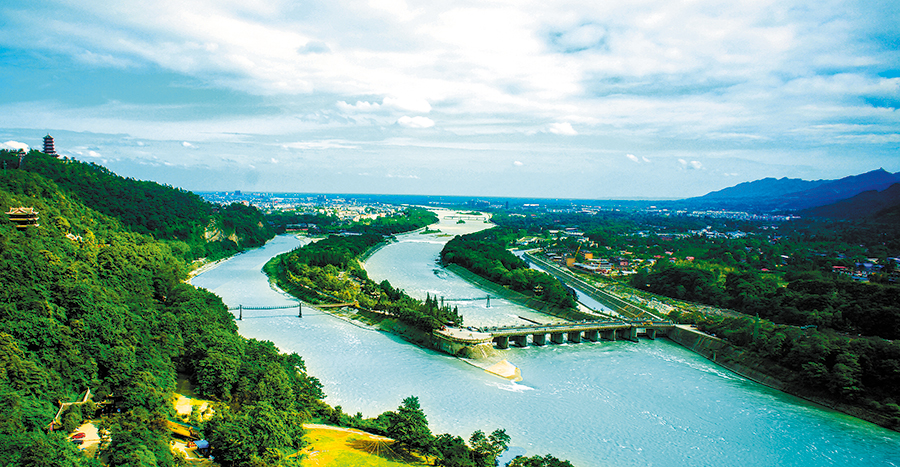
The Dujiangyan Irrigation System still functions more than 2,000 years later. CHINA DAILY
In early winter, the emerald mountains of Dujiangyan in Chengdu, the capital of Southwest China's Sichuan province, are mirrored in the waters coursing through channels built more than two millennia ago.
During a visit to the historic Dujiangyan irrigation system — the world's only ancient irrigation project still in operation today — President Xi Jinping and French President Emmanuel Macron, accompanied by their spouses, strolled along the waterways that stand as enduring symbols of human ingenuity and harmony with nature.
Xi told Macron during the visit earlier this month that Dujiangyan embodies the Chinese spirit of self-reliance, resilience and pioneering courage. "Every time I come to Dujiangyan, I can deeply feel the greatness of our ancestors in adapting to local conditions, following the natural course, achieving harmony between humanity and nature, and harnessing water resources for the benefit of the people," Xi said. "From this, I draw wisdom for state governance."
Scholars have noted that the Dujiangyan irrigation system reflects profound strands of traditional Chinese thinking.
Wang Huiyao, founder and president of the Beijing-based think tank Center for China and Globalization, said the irrigation system embodies principles such as adapting to local conditions and guiding water in accordance with its natural momentum.
"Its techniques, such as deepening the riverbed and lowering the weir, illustrate the value of leveraging natural forces and making decisions in harmony with the environment," Wang said. A weir is a low barrier in a stream or river to control water flow.
"Applied to the contemporary world, these ideas continue to offer meaningful insights: The trend of the world resembles a mighty tide, and recognizing and following the trend is essential for any country seeking long-term success," Wang said.
Wang emphasized that just as Dujiangyan channels water to nourish the Chengdu Plain, China's openness and inclusiveness can energize the world economy, stabilize the global flow of goods, capital and talent, and allow more countries to share in common prosperity. "In this sense, the world may move closer to becoming a global 'Land of Abundance', highlighting the contemporary relevance of Chinese wisdom," he said.
Profound symbolism
The wisdom of water runs deep in Chinese culture. In 2014, at a welcoming banquet during the 22nd APEC Economic Leaders' Meeting in Beijing, held at the National Aquatics Center, known as the Water Cube, Xi noted that water carries profound symbolism in Chinese civilization.
Quoting Lao Tzu, the ancient Chinese philosopher — "The highest good is like water, which benefits all things without contending" — Xi expressed the hope that the Asia-Pacific Economic Cooperation forum member economies, linked by the waters of the Pacific Ocean, would work together for peace, development, prosperity and progress in the Asia-Pacific region.
Xi has frequently employed water metaphors on international occasions to articulate China's development philosophy and global vision. These metaphors convey a cooperative approach grounded in openness, inclusiveness, mutual benefit and win-win outcomes.
At the Boao Forum for Asia Annual Conference in 2015, he cited a Chinese proverb — "When big rivers have water, the small ones are filled; and when small rivers have water, the big ones are filled"— urging the abandonment of zero-sum thinking in favor of common development.
When underscoring inclusiveness in global governance, Xi often quotes sayings such as "the ocean is vast because it admits all rivers", advocating mutual learning among civilizations, democracy in international relations, and universally beneficial and inclusive economic globalization.
In a 2014 speech at the Korber Foundation in Germany, Xi cited another saying by Lao Tzu that "a big country should be like the lower reaches of a river," symbolizing that a big country should be as inclusive as the lower reaches of a river that admit numerous tributaries.
"China is eager to strengthen dialogue and exchange views with the rest of the world and listen to the voices of other countries with an open and inclusive mind," he said, while also expressing the hope that the world would view the country in an objective, historical and multidimensional light.
Speaking at the 15th BRICS Summit in 2023, Xi once again invoked the ancient Chinese saying that the sea admits hundreds of rivers. "Human history will not end with a particular civilization or system," Xi said, calling on BRICS countries to uphold inclusiveness, promote peaceful coexistence and harmony between civilizations, and respect all countries' right to independently choose their modernization paths.
While boosting the confidence and voice of developing countries in global governance, Xi has also used water-related metaphors to emphasize that pragmatic, incremental cooperation can yield transformative results.
At the 19th G20 Summit in 2024, Xi invoked a water metaphor — drops of water can penetrate stone over time — citing China's poverty alleviation achievements as proof of what persistence and sustained effort can accomplish. "With endurance, perseverance and striving spirit, other developing countries can eliminate poverty," he said.
Creative application
Chen Xulong, a professor at the University of International Business and Economics in Beijing, said Xi's frequent use of water-related metaphors reflects the creative application of traditional Chinese wisdom in the context of the new era.
"These classical references embody the inclusiveness and resilience of Chinese civilization," Chen said. "They help China maintain strategic composure amid a rapidly evolving international environment."
The China-proposed Belt and Road Initiative, for example, represents a practical expression of traditional Chinese thinking, emphasizing peaceful development, openness and inclusiveness, and win-win cooperation, Chen added.
Championing the principle of extensive consultation, joint contribution and shared benefits, China has signed more than 230 cooperation documents on Belt and Road cooperation with over 150 countries and more than 30 international organizations.
At the Second Belt and Road Forum for International Cooperation in 2019, Xi said that the flow of goods, capital, technology and people would power global growth, just as "the ceaseless inflow of rivers makes the ocean deep". He called for greater trade and investment liberalization and facilitation, and voiced firm opposition to protectionism.
Wang Yiwei, a professor at Renmin University of China in Beijing, said that Xi Jinping Thought on Diplomacy is deeply rooted in the rich heritage of traditional Chinese culture, drawing on its essence while adapting it to address contemporary global challenges.
Beyond water-related metaphors, Wang noted that the concept of "harmony in diversity", rooted in Confucian thought, emphasizes seeking common ground while respecting differences. This principle is reflected in China's advocacy of respecting the sovereignty and independent development paths of all countries, as well as its commitment to resolving international disputes through dialogue on an equal footing, he said.
The ancient concept of "building a world of great harmony" is embodied in Xi's call for the building of a community with a shared future for humanity, the professor added.
This philosophical foundation also underpins the China-proposed Global Development Initiative, Global Security Initiative, Global Civilization Initiative and Global Governance Initiative.
"Taken together, these initiatives form a comprehensive framework offering Chinese solutions to pressing global challenges," Wang Yiwei said. "They reflect China's efforts to help steer the world toward a more stable, inclusive and sustainable future."
zhaojia@chinadaily.com.cn
