
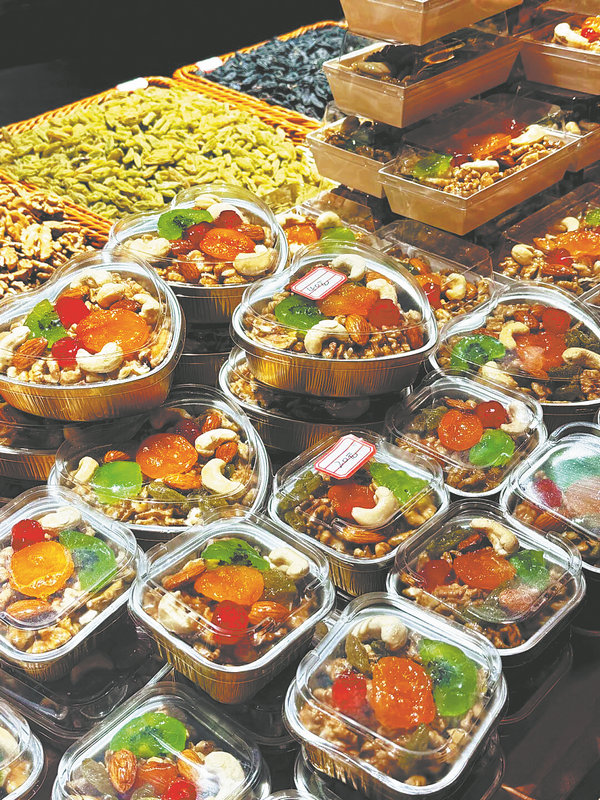
Uygur cakes are made of fruits and nuts. [Photo provided to China Daily]
Urumqi's Fruit Bazaar is a treasure trove that dazzles the tongue.
Ruby-red jujubes, jade pears, amethyst grapes, sapphire plums, golden apricots and amber apples — these are the glistening regalia orchards wear in the Xinjiang Uygur autonomous region, hailed as "the Kingdom of Fruits and Melons".
Vines sport brooches of grape clusters. Tree branches clutch pomegranates that open like lockets to reveal crimson arils. Fig boughs cradle round pouches packed with delectable gold.
These harvests are hoarded in the 2,500-square-meter bazaar, which is an Aladdin's Cave come true. Fittingly, this folktale is set in Xinjiang. The cavern he stumbles into hosts a garden of trees laden with diamonds, pearls and emeralds, rather than apples and oranges. The difference is that the fruits in the market are real gems in their own right.
More than 100 varieties shine in 12 themed chambers in the fruit arcade, which is part of the Urumqi Grand Bazaar.
These tributes hail from every corner of the "kingdom" — red dates from Hotan; gray jujubes from Ruoqiang; apples from Aksu and Ili; fragrant pears from Korla; grapes from Turpan; apricots from Yingjisha and Kuqa; and Hami melons, named after their region of origin.
Many are crowned with royal titles. The "King of Grapes" has ruled Turpan's vineyards for centuries. In Wensu, the grand "King Walnut" wears a silken shell so thin it yields to a gentle squeeze. The tart sea-buckthorn berry has conquered the bitter desert to claim its throne as the "King of Vitamin C".
These fiefdoms forge qiegao as royal seals. Ornate Uygur cakes — also called sokmak — are bejeweled with fruits and nuts like gems and beads gilded with black honey and an earthy meringue sugar veneer.
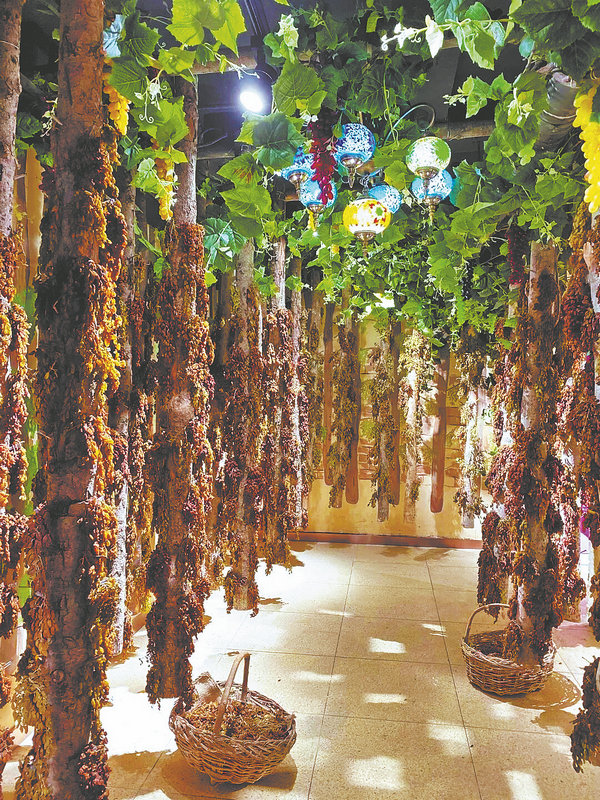
A small air-drying barn is displayed at Urumqi's Fruit Bazaar. [Photo provided to China Daily]
Qiegao literally translates as "cut cakes", since these gleaming tablets are sliced into smaller squares from larger slabs, often big enough to cover vendors' tricycle carts.
Its ingredients hold court in the bazaar's designated chambers.
In the Grape Hall, raisins twinkle in every hue — emerald green, spinel red, onyx black, imperial topaz, coral blush, and tanzanite purple.
In a back corner, vines festooned with grapes garland a small liangfang — Turpan's traditional air-drying barn.
Its walls are assembled from adobe bricks stacked in lightning-bolt patterns to create zigzagging lattices that form diamond-shaped openings like honeycombs. These perforations permit sweltering air to drift through while keeping the fruit shaded.
The liangfang structures have not changed for centuries. Their enduring design bears testimony to the ingenuity of the ancient architects and agriculturalists who cultivated and constructed this timeless convergence of sky and soil.
Nearby, the Walnut Hall overflows with cashews shaped like Chinese ingots, pine nuts like pearls, and hazelnut bulbs. Baskets brim with these woody beads, their shells serving as tiny vaults concealing riches within.
The neighboring Melon Hall is likewise piled with orbs that must be cleaved open like geodes to reveal cores that shimmer like crystals. Local varieties carry names as colorful as they are — golden egg, red crisp, black phoenix. Each is a portable oasis, a true treasure in the desert, where water is invaluable and calories are currency.
A local adage pays homage to their seasonal nature: "Wear a fur coat in the morning and thin linen at noon, and eat watermelon around the fire at night." This saying harks back to the region's summer temperature swings — contrasts that concentrate sugars into the syrupy sweetness, conferring a heavenly mandate upon the Kingdom of Fruits and Melons.
Urumqi's Fruit Bazaar is a glittering emporium of Xinjiang's plentitude, where reality outshines Aladdin's mythical cave of riches. Here, true wealth comes not from cold stones buried underground but from gems that grow from the land to shine beneath the warm sun.
They're bright living treasures worth cherishing, in every sense.
