
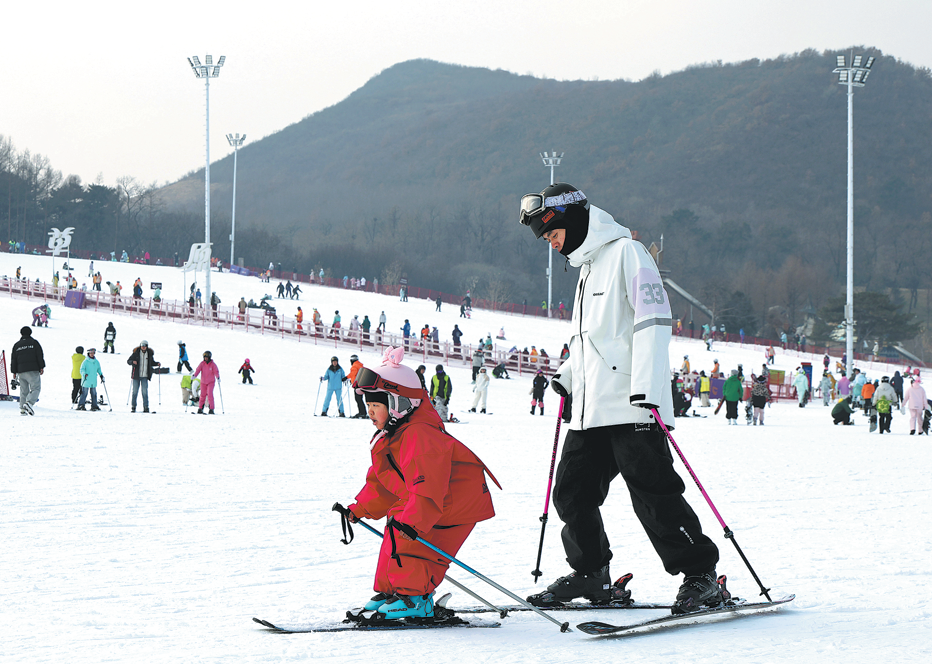
Ski enthusiasts gather at a venue in Shenyang, Liaoning province, on Saturday. LI GANG/XINHUA
China's major airlines have extended free refund and rescheduling policies for Japan-bound tickets as weekly Sino-Japanese flight volumes sink to their lowest level in a month and Chinese travelers redirect their winter holiday plans toward emerging hubs in Russia, Central Asia and domestic ice-and-snow destinations.
On Friday, major domestic airlines, including Air China, China Eastern Airlines and China Southern Airlines, extended their previous Dec 31 deadline for refunds and rebooking to March 28 next year, the end of the winter-spring travel season.
The extensions follow China's travel advisories issued in mid-November discouraging trips to Japan after erroneous remarks by Japanese Prime Minister Sanae Takaichi regarding China's Taiwan. Chinese airlines have since recalibrated capacity, with reductions concentrated in leisure-heavy routes.
Data from Flight Master, a travel services platform, show that round-trip Sino-Japanese flights fell to 1,167 during the week of Nov 24-30, the lowest weekly volume in a month, with the recovery rate sliding to 78.1 percent, a new low. As of Dec 1, the projected cancellation rate for Sino-Japanese flights scheduled in December rose to 26.4 percent, continuing an upward trend.
Industry insiders said that the impact is likely to extend beyond the Spring Festival period, with aircraft redeployed to Southeast Asia and domestic routes.
As travelers look beyond Japan for winter sports and seasonal scenery, travel demand is rising across a widening set of destinations. One of the most significant shifts is toward Russia following Moscow's decision to grant Chinese citizens visa-free entry for up to 30 days through Sept 14 next year.
UTour, a Beijing-based travel agency, said inquiries doubled immediately after the policy took effect, driven largely by Spring Festival travel plans.
Huang Zhaoyang, the company's Russia product manager, said Murmansk, known for its aurora and ice-snow resources, is attracting attention under the new policy. Russia's overall appeal is expected to strengthen and help woo a wider range of Chinese travelers, he added.
Outbound travel is also pivoting notably toward Central Asia and Northern Europe, with Kazakhstan rapidly emerging as a winter sports hub. Tongcheng Travel data show that flight bookings from major Chinese cities to Kazakhstan between early December and the New Year holiday climbed more than 50 percent year-on-year, while hotel reservations climbed more than 80 percent, with Almaty and Astana ranking as top choices.
Analysts at Tongcheng's tourism research institute said the "Japan substitution effect" has accelerated since late November, with outbound ski demand that once concentrated on Japan increasingly shifting toward Kazakhstan and Nordic destinations. They added that domestic ski areas are also becoming popular alternatives to Japan's ski destinations.
European destinations are witnessing a similar upswing. Hotel bookings in Germany and Spain have increased by more than 300 percent year-on-year, while Denmark and Switzerland have posted gains exceeding 200 percent.
Domestically, local governments are racing to capture winter travelers through substantial incentives. Jilin province rolled out 100 million yuan ($14.1 million) in ice-snow vouchers and offered free ski passes to university students, while the Inner Mongolia and Xinjiang Uygur autonomous regions have introduced similar discounts.
Qunar, a Beijing-based online travel agency, said hotel bookings in Xinjiang's Bortala region rose more than 80 percent year-on-year from November to late January of 2026, while reservations in the northeastern cities of Dandong, Liaoning province, Liaoyuan, Jilin province and Yichun, Heilongjiang province, each grew around 30 percent.
Demand for trips to glaciers and snow mountains has also surged, with ticket bookings for sites such as Meili Snow Mountain in Yunnan province and Xiling Snow Mountain in Sichuan province doubling year-on-year.
According to a white paper on China's ski industry, China currently has 748 operational ski resorts, including 66 indoor centers. Total ski visits reached 26.05 million last winter, up 12.9 percent.
The white paper also noted that China's total ski visits last season surpassed Switzerland's 23.1 million, reflecting the growing scale of China's winter sports market. Average ski days per participant in China rose from 1.80 to 1.92, indicating increasing skier engagement and loyalty.
