
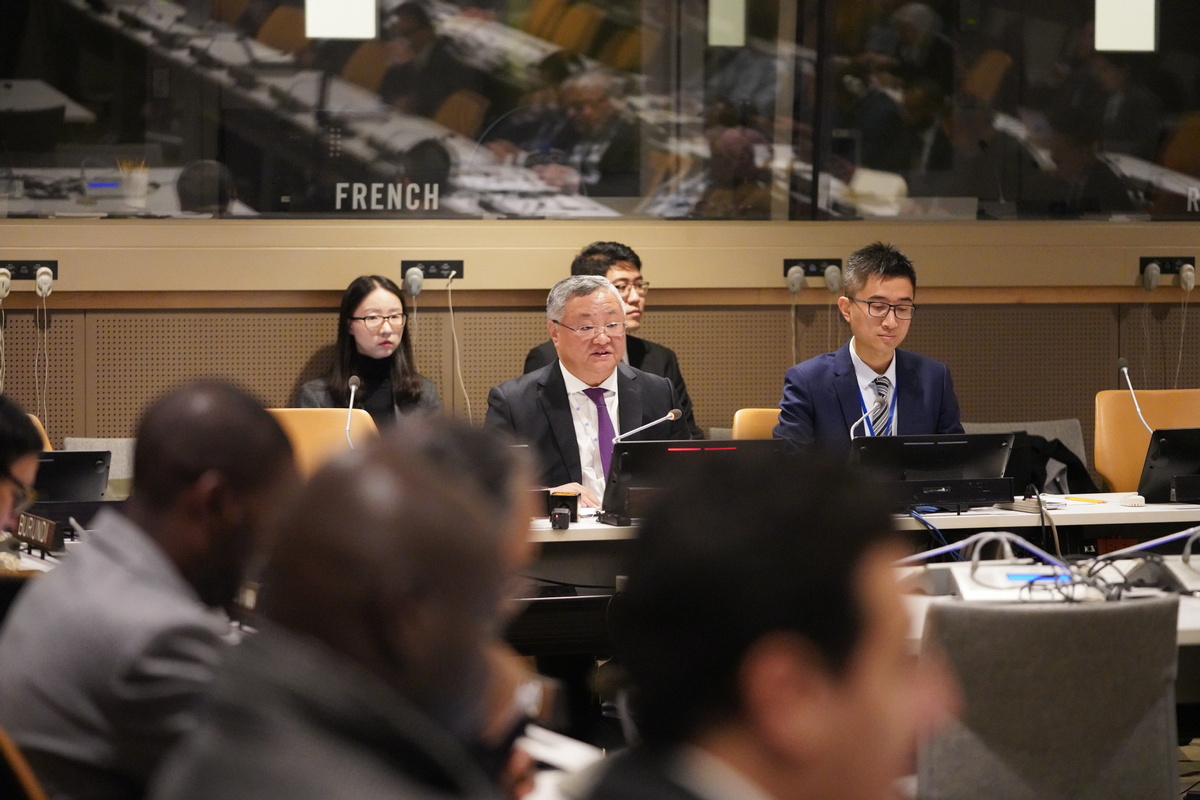
Fu Cong, China's permanent representative to the United Nations, speaks at a meeting to launch the Group of Friends of Global Governance at the UN headquarters in New York, on Dec 9, 2025. [Photo/Xinhua]
The Group of Friends of the Global Governance was officially established at United Nations Headquarters in New York on Tuesday, marking a new step in advancing international cooperation on global governance under the framework.
Fu Cong, China's permanent representative to the United Nations, said the group, which includes 43 founding member countries, was launched under the guidance of the Global Governance Initiative amid growing pressures on multilateralism and global governance.
Founding members include countries such as Cuba, Iran, Kenya, Kazakhstan, Morocco and Malaysia.
The Global Governance Initiative, or GGI, is the fourth global initiative launched by Chinese President Xi Jinping, following the previous initiatives on development, security and civilization. The initiative "offers China's wisdom and solutions to reforming and improving global governance", Fu said at the inaugural meeting of the group.
The initiative has received support from more than 140 countries and international organizations since its establishment in September, said Fu.
"We have found ourselves in a new period of turbulence," he said, noting that "multilateralism and the role of the United Nations have come under severe strain, and global governance has reached a new crossroads."
Marking the 80th anniversary of the United Nations this year, Fu said the international community should not forget the historical lessons that led to the UN's creation.
"Eight decades ago, the international community, based on the profound lessons learned from the scourge of two world wars, resolved to turn the page in history," he said. "This gave birth to the United Nations and opened a new chapter of global governance."
Fu said the GGI was proposed in this context. "It is anchored in five core principles, namely: sovereign equality, international rule of law, multilateralism, a people-centered approach and emphasis on real actions," he said.
Fu stressed the importance of safeguarding international fairness and justice. "We must never forget the untold suffering that fascism and militarism once inflicted on people around the world," he said, warning any attempt to "whitewash aggression, distort history, or revive militarism is an affront to human conscience and a threat to global peace and stability".
"We must promote the correct historical narrative of World War II, defend the victorious outcomes of the war, and safeguard the international system with the United Nations Charter at its core, the international order underpinned by international law, and the basic norms governing international relations based on the purposes and principles of the UN Charter," he added.
He also stressed that security and development must be addressed together, adding that the international community should help developing countries build capacity for self-driven development and effective governance, "so that they may bridge the development divide and achieve long-term stability".

Representatives from nearly 40 founding member states attend a meeting to launch the Group of Friends of Global Governance at the UN headquarters in New York, on Dec 9, 2025. [Photo/Xinhua]
Fu told reporters after the meeting that the Group of Friends is designed as "an open and inclusive platform". He encouraged more countries to take part and said China is willing to work with all partners through the United Nations framework.
Ernesto Soberon Guzman, Cuba's permanent representative to the United Nations, told reporters that Cuba "welcomes and supports the Global Governance Initiative".
"We are also convinced that an initiative like this will contribute to the democratization of international relations," Guzman said, noting that the current international environment is "marked by widening inequalities and political tensions."
He said the initiative "is also aiming to reduce double standards and to help countries defeat unilateral measures."
Cuba "really values the will of the People's Republic of China to strengthen multilateralism, to promote international cooperation and to promote international dialogue", Guzman said.
He added that the initiative "will contribute to the unity of the Global South" and "will also contribute to promoting the Global South's interests in the multilateral field".
Zephyrin Maniratanga, Burundi's permanent representative to the United Nations, said Burundi was "one of the first countries to join the Group of Friends of the Global Governance".
"We believe, and we are very confident, that the Group of Friends of the Global Governance is of vital importance given the many challenges the world is facing now," Maniratanga said.
"Together with member countries of the Group of Friends, we will be able to address many challenges that the multilateral system is facing today. Alone, we cannot do it," he said.
Aida Kasymalieva, Kyrgyzstan's permanent representative to the United Nations, highlighted the practical role of the group.
It is "a mechanism for uniting the collective voice of developing countries and also small landlocked states", she said, and "a tool for practical cooperation, especially in building the capacities of Global South countries, and a catalyst for bringing together national, regional and global initiatives".
The Group of Friends also released a joint statement on the occasion of its launch, reaffirming members' commitment to the UN-centered international system and the principles of sovereignty, territorial integrity and non-interference.
The group said it would use the platform to "deepen dialogue and coordination on global governance issues, amplify our collective voice, build and expand consensus, and deliver concrete outcomes" and extended an invitation to other like-minded UN member states to join the initiative, according to the statement.
minluzhang@chinadailyusa.com
