
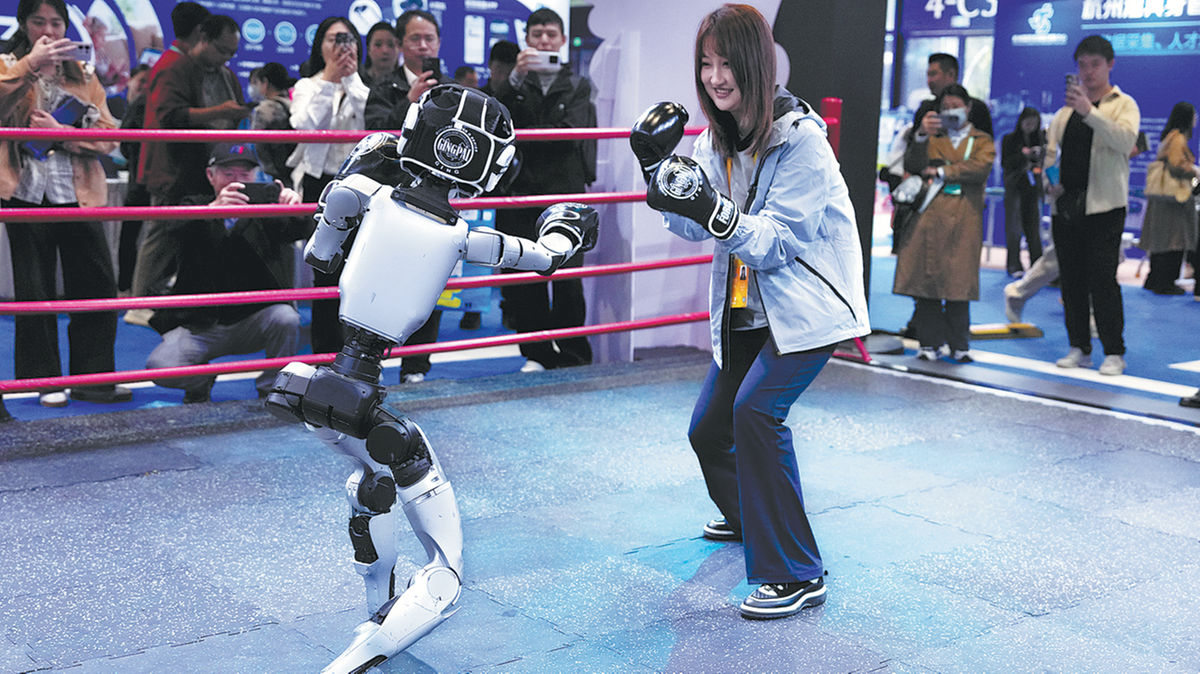
A participant boxes with a humanoid robot from Unitree Robotics during the 2025 World Internet Conference Wuzhen Summit in Wuzhen, Zhejiang province, on Nov 6. HUANG ZONGZHI/XINHUA
China's resolve to deeply integrate artificial intelligence into a wide range of fields will help the country foster new growth drivers and provide strong impetus for high-quality economic development, solidifying its position as a global innovation powerhouse, said company executives and industry experts.
As China recognizes AI as an essential tool in nurturing new quality productive forces, the application of AI will promote the transformation and upgrading of traditional industries as well as help the country gain the edge amid increasingly fierce international competition.
China's AI industry continues to demonstrate strong momentum. The country holds the largest number of AI-related patents worldwide, accounting for 60 percent of the global total, according to a report by the Chinese Academy of Cyberspace Studies.
Data from the China Academy of Information and Communications Technology show that the nation has maintained its position as a global leader in AI innovation and released 1,509 AI models to date, ranking first among the 3,755 models launched globally until now.
Wu Yongming, CEO of Chinese tech heavyweight Alibaba Group, said the company is increasing investment in AI infrastructure and remains committed to open-sourcing its large language models, empowering developers worldwide to build transformative AI applications.
Wu made the remarks at the 2025 World Internet Conference Wuzhen Summit, which was held in Wuzhen, Zhejiang province, last month. Alibaba has announced plans to invest more than 380 billion yuan ($53.8 billion) in building cloud and AI hardware infrastructure over the next three years.
Wu said the speed of AI industry development and the demand for AI infrastructure have far outpaced expectations.
"In the future, large AI models will be deeply integrated into a wide range of devices, functioning like operating systems — equipped with persistent memory, seamless cloud-edge coordination and the ability to continuously evolve."
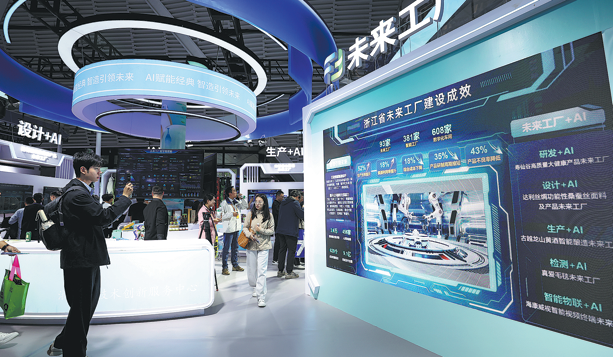
A visitor takes photos of the "Future Factory" exhibition board during the 2025 World Internet Conference Wuzhen Summit on Nov 6. ZOU HONG/CHINA DAILY
Since the launch of its first generation Qwen large language models in 2023, Alibaba has open-sourced over 300 AI models built on its two foundation models. With over 600 million downloads and 170,000 derivative models created, Alibaba's AI models have become one of the most widely adopted open-source AI series globally.
Ma Hongbin, senior vice-president of Chinese video-sharing platform Kuaishou Technology, said AI is shifting from technological breakthroughs to large-scale application and innovation, driving the in-depth integration of technology and industry. Ma highlighted that the company has expanded its investment in AI research and development.
Kuaishou has launched its AI-powered video generation model Kling with continued iterations and upgrades, which has the potential to reshape the global video production industry.
Ma said AI can reduce the production costs of film and television to one-tenth of traditional methods and shorten production time by about 60 percent, driving a profound transformation in the industry's ecosystem and creation logic.
Currently, Kling has more than 45 million global users and has partnered with over 20,000 enterprises and developers, with its application scenarios covering film and TV production, advertising and marketing, and game development.
Apart from the video generation model, Kuaishou has been advancing the widespread adoption of AI and deeply integrating AI into its various business segments, such as content production, recommendation, distribution and e-commerce search to improve operational efficiency and user experience.
China issued a guideline to implement the "AI Plus" initiative in August, promoting the extensive and in-depth integration of AI across various fields to accelerate the cultivation of new quality productive forces.
According to the guideline, the country will promote the application of AI in science and technology, industrial development, consumption upgrades, people's well-being, governance and global cooperation.
By 2027, China will extensively and deeply integrate AI in six key sectors, with the penetration rate of new-generation intelligent terminals and AI agents surpassing 70 percent, and this figure will exceed 90 percent by 2030, the guideline said.
It noted that efforts will be made to improve the basic capabilities of AI models, strengthen the innovation of data supply, enhance intelligent computing power, promote the development of open-source ecosystems and reinforce the construction of talent teams.
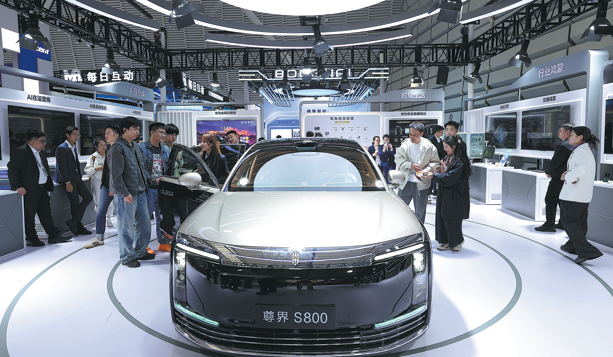
A MAEXTRO S800 sedan, jointly developed by JAC Motors and Huawei, is displayed during the 2025 World Internet Conference Wuzhen Summit on Nov 6. ZOU HONG/CHINA DAILY
"AI and digitalization are profoundly transforming all industries, and the medical aesthetics industry is no exception," said Jin Xing, cofounder, director and CEO of So-Young International Inc, a leading Chinese aesthetic treatment platform connecting consumers with online services and offline treatments.
Digital technologies and AI have greatly enhanced the safety, quality and accessibility of medical aesthetics services, Jin said. Currently, AI investment is mostly focused on general large models, with a scarcity of models for specific fields and difficulty in data collection, posing significant challenges for the deep penetration of AI in traditional industries, he noted.
The company has explored multiple AI-assisted diagnostic and operation scenarios, including intelligent skin detection, design of auxiliary treatment plans and cross-regional store management, and leveraged digital technologies to provide real-time user feedback, allowing stores to adjust their services promptly and improve service quality.
"The core challenge of AI for most traditional industries is the cost. It requires two to three years of investment in application scenarios and model training, with annual expenses reaching tens of millions or even hundreds of millions of yuan, which is a huge pressure for many enterprises," Jin said, adding that the deep application of AI relies heavily on large amounts of multimodal data.
If technological breakthroughs can be achieved, the application space for AI in the medical aesthetics industry will be broader, he added.
"As a disruptive technology, AI will not only reshape production and people's lifestyles, but also serve as the main battlefield for technological competition among the world's major economies," said Su Jian, a professor of the School of Economics at Peking University.
"AI will penetrate into a wide range of sectors, such as manufacturing and services, restructure production processes and improve efficiency," Su said, highlighting that China's efforts to promote the application of AI across various industries comply with the trend of technological revolution and industrial transformation, and will help the nation gain a competitive edge amid mounting external uncertainties.
Noting that AI technology is witnessing rapid iteration and explosive growth, Zhu Keli, founding director of the China Institute of New Economy, said it is vital to boost its application in diversified scenarios and fields, and accelerate the integration of AI with the real economy.
Zhu emphasized that China's complete industrial system, vast consumer market and abundant industrial application scenarios present unique advantages for the development of AI. "The adoption of AI can reduce production costs, improve the quality of products and optimize resource allocation, thus bringing about huge economic benefits."
Xianyu, Alibaba Group's online trading platform for secondhand goods, is stepping up efforts to use AI to improve the transaction efficiency of idle goods, and elevate the platform's AI service capabilities for buyers.
Ding Jian, president of Xianyu, said the essence of idle goods trading lies in reallocating underused social resources to those who need them, adding that the company aims to improve the matching efficiency of transactions based on the multimodal understanding capabilities of Alibaba's Qwen large models.
Ding said the company has built proprietary AI functions that can precisely understand product content and pricing. For instance, the AI-powered smart search uses interactive searches to better understand the needs and purchasing preferences of users, with the aim of matching suitable items and sellers with buyers, and providing detailed shopping advice.
Ding said Xianyu's AI applications are currently used by 45 million customers, with the cumulative transaction of AI-driven merchandise exceeding 10 billion yuan. It has built a comprehensive set of AI agents tailored to the trading scenario of idle goods, integrating AI across the entire transaction chain.
Although AI brings about new development opportunities, challenges remain with regard to privacy, data security and copyright protection.
Safeguarding large models is of vital importance to bolster the application of AI across various sectors, said Hu Zhenquan, president of Chinese cybersecurity company 360 Digital Security Group.
New and complicated cybersecurity challenges, such as data leakage and malicious misuse of data, have emerged along with the integration of AI with a wide range of fields, he said, while calling for efforts to jointly solve the security issues brought about by AI.
The company has released a white paper on the security of large models, which systematically elaborates on key risks in large model operation and proposes security solutions.
"AI security governance remains a long-term and challenging task that requires concerted efforts across the entire industry," Hu said, adding that the company will work with industry partners to build a solid AI security defense system to promote the safe and steady development of the AI industry.
fanfeifei@chinadaily.com.cn
