
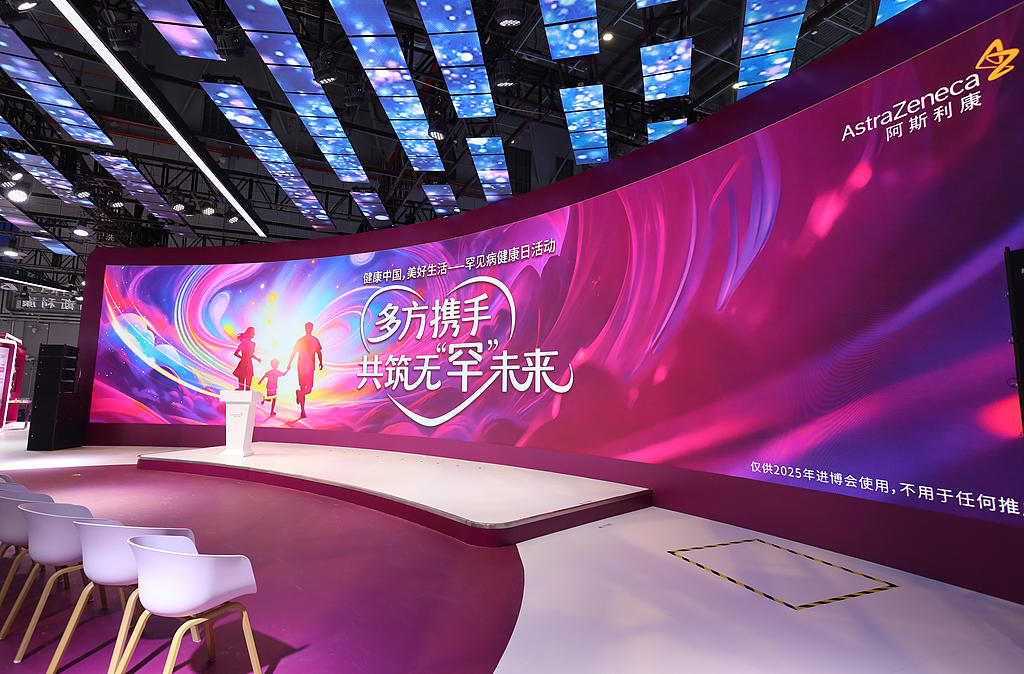
This photo taken on Nov 7, 2025 shows the booth of AstraZeneca at the Medical Equipment and Healthcare Products Exhibition Area of the eighth China International Import Expo (CIIE) in East China's Shanghai. [Photo/VCG]
AstraZeneca's decision to invest more than 100 billion yuan ($14.39 billion) in China by 2030 marks a new chapter for the British drug-maker in a market it increasingly sees as central to global pharmaceutical innovation, said its chief executive officer, as China and the United Kingdom move to deepen economic and scientific cooperation.
The investment plan was announced on Thursday during British Prime Minister Keir Starmer's visit to China.
"We have been very committed to China for many years," Pascal Soriot, CEO of AstraZeneca, said in an interview with China Daily. "In the last five or six years, China has become a fundamental part of innovation in our sector, with great science and increasingly strong companies."
Under the plan, AstraZeneca will expand pharmaceutical manufacturing and research and development in China through to 2030, leveraging the country's scientific research strengths, advanced manufacturing capabilities and growing biotechnology ecosystem.
Soriot said China's importance to the company now extends well beyond its large patient base.
"There are many patients in China who need innovative medicines," he said. "But equally important is the ability to partner with Chinese companies, manufacture here and export products from China to the rest of the world."
The investment will cover the full pharmaceutical value chain, from drug discovery and clinical development to large-scale manufacturing. A major focus will be advanced treatment modalities, including cell therapy and radioconjugate drugs.
Building on its 2024 acquisition of Shanghai-based Gracell Biotechnologies, AstraZeneca said it will become the first global biopharmaceutical company to establish end-to-end cell therapy capabilities in China.
These investments build on AstraZeneca's expanding R&D footprint in China. The company operates two global strategic R&D centers in the country — one in Shanghai and one in Beijing — placing China alongside Europe and the United States as a core pillar of its global research network.
"China is a fundamental part of our global R&D system," Soriot said.
According to the company, the two centers in China collaborate with more than 500 hospitals and have led a large number of global clinical trials over the past three years.
On the manufacturing side, AstraZeneca has production sites in Wuxi and Taizhou, with facilities planned or upgraded in Qingdao and Beijing. Medicines produced in China are supplied domestically and exported to more than 70 markets worldwide.
The latest investment will further expand this footprint, with new production facilities to be announced in due course. AstraZeneca said its workforce in China will grow beyond 20,000 employees, with thousands of additional jobs expected across the broader healthcare ecosystem.
Collaboration with Chinese biotechnology companies remains a cornerstone of AstraZeneca's China strategy. The company said the investment will support deeper partnerships aimed at bringing Chinese innovation to global markets.
AstraZeneca already works with several Chinese biotechs. On Friday, the company announced a strategic R&D collaboration and licensing agreement with Hebei province-based CSPC Pharmaceutical Group Ltd, to develop long-acting peptide therapies, using CSPC's sustained-release drug delivery platform and AI-powered peptide discovery technology.
Soriot said such partnerships illustrate the rapid rise of China's biotech sector. "China is already a fundamental part of innovation in our industry," he said. "The US is one pillar, and China is quickly emerging as the other."
The investment comes as China-UK economic ties continue to deepen. Bilateral goods trade reached $103.7 billion in 2025, while two-way investment stock stood at nearly $68 billion, according to China's Ministry of Commerce. Trade in services is expected to exceed $30 billion.
Soriot said the two countries' strengths are highly complementary, particularly in life sciences, artificial intelligence and the green transition.
