
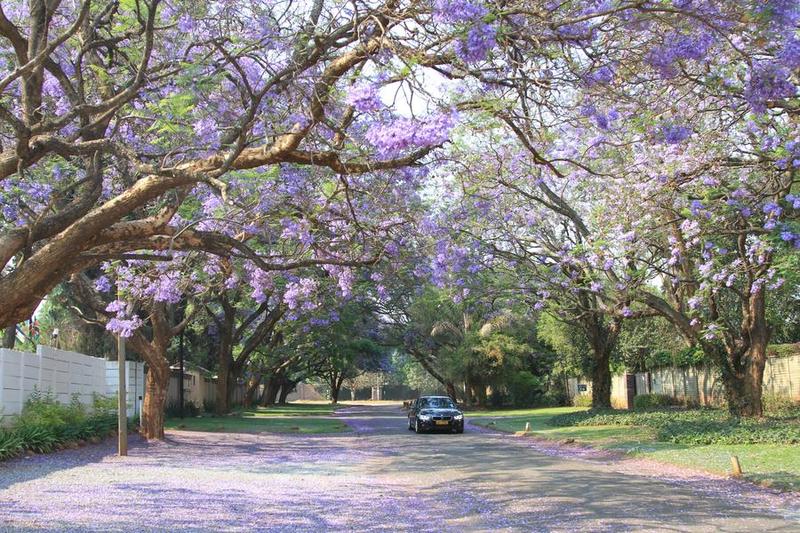
Blossoming jacaranda trees are seen along a street in Harare, Zimbabwe, Oct 14, 2023. [Photo/Xinhua]
While making preparations for a photo exhibition to mark the 45th anniversary of diplomatic relations between China and Zimbabwe last year, staff members at the Chinese embassy in Harare, the capital city of the African country, made a special discovery.
They uncovered a series of old photographs documenting Zimbabwean soldiers receiving military training either in China, or from Chinese instructors at a training camp in Tanzania, during the 1960s and 1970s — a pivotal period in Zimbabwe's national liberation war.
Realizing that the veterans were the living witnesses to a profound historical bond, the embassy team managed to identify and locate several soldiers featured in the photos.
In September, they received special invitations to attend the Chinese National Day reception at the embassy, where the photo exhibition was held.
Their reunion at the embassy, stirring deep memories, planted a seed. "The hospitality the Chinese people showed at the gathering …reminded us of the unwavering support we received during our struggle," recalled Lobo Mushangwe, who received military training from Chinese instructors in Tanzania in 1976.
The shared sentiment among the group crystallized into a concrete action: they decided to write a letter to President Xi Jinping.
Two months later, 17 veterans returned to the embassy with a heartfelt letter retracing the special bond forged during those formative years of training and solidarity.
In the letter, they expressed gratitude for China's support, noting that the political and military instruction they received — covering guerrilla warfare, mass mobilization and the principle of army-people unity — proved vital to Zimbabwe's liberation struggle. "This knowledge became a key force in achieving our victory in the Zimbabwean liberation struggle," they wrote. The veterans also praised China's modernization achievements and reaffirmed their commitment to an enduring bilateral friendship.
On Wednesday, their gesture was met with a profound response. President Xi sent a reply, bridging decades with a message that honored a shared past and expressed a firm belief in a common future. He acknowledged the veterans' dedication to China-Zimbabwe and China-Africa friendship, and expressed hope that they would inspire more African youths to join the cause.
Over the past 70 years, China has always been a good comrade and partner in Africa's quest for national liberation, development and rejuvenation, Xi noted in his reply. With mutual respect and mutual support, China and its African friends have navigated challenging times together and jointly embarked on a new journey toward modernization, he added.
The correspondence sheds light on a pivotal historical chapter in the 20th century, when China firmly supported African nations against imperialism and colonialism.
"The Chinese approach to training was holistic," said veteran Humphrey Makuyana, reflecting on the experience that transformed inexperienced youths into resilient guerrillas. "Freedom fighters were taught to understand the deeper meaning of liberation — beyond the battlefield — and to connect with the masses as our lifeline."
This philosophy left an indelible mark on a generation of freedom fighters, as long before Zimbabwe achieved independence in 1980, thousands of young Zimbabweans left their homes, families and everything familiar to embark on a journey of military training.
Among them was Emmerson Mnangagwa, who is now the president of Zimbabwe. In 1964, as a young freedom fighter, Mnangagwa received his military training at the Chinese People's Liberation Army's Nanjing Army Command College in Jiangsu province. There, he and four fellow Zimbabweans underwent a 10-month training, determined to acquire the skills necessary to fight against colonialism and for Zimbabwe's liberation struggle.
Six decades later, as the leader of an independent Zimbabwe, Mnangagwa returned to the academy in 2024. Visibly moved by the experience, he expressed his sentiments on social media: "Reflecting on this journey, I am deeply thankful for the role this institution played in shaping our fight for freedom."
China further demonstrated its commitment by establishing diplomatic relations with Zimbabwe on April 18, 1980 — the very day the African nation gained independence. The depth of this fraternal bond was also personally acknowledged by Xi ahead of his 2015 state visit to Zimbabwe.
In a signed article published in Zimbabwean media, the Chinese president said he was touched to learn that many Zimbabwean freedom fighters who received training from the Chinese instructors can still sing Chinese revolutionary songs, such as The Three Rules of Discipline and the Eight Points for Attention.
"China and Zimbabwe, in spite of the vast distance between them, have maintained a traditional friendship that is deep and firm," he stressed.
Xi's reply letter has deeply inspired the veterans, for whom it is both a recognition of their historical role and a call to action for the future.
Mushangwe emphasized that the letter bears a profound imprint of the friendship between Zimbabwe and China. "The significance of this letter does not end with us," he said, adding that the veterans, together with the Chinese embassy, would present it to President Mnangagwa.
"The letter is highly motivational," said another veteran, Nation Zongoro. "It reinforces my confidence in the Chinese people and their continued willingness to assist us in various forms, whether through projects or any other needed support."
Noting the steady growth of bilateral ties over 46 years, Chinese Ambassador to Zimbabwe Zhou Ding said, "We have consistently translated our profound friendship into tangible outcomes."
He pointed to flagship projects, such as the new parliament building, the Robert Gabriel Mugabe and Victoria Falls airports, the Hwange and Kariba South power stations, industrial parks, hospitals, schools, boreholes and irrigation facilities, as vivid reflections of the substantive cooperation. Statistics showed that bilateral trade reached a historic high of $4.39 billion in 2025.
To carry forward the bond forged in the fires of Zimbabwe's liberation struggle, Zhou stressed that it is a solemn and shared duty to safeguard the enduring foundation laid by war veterans, and pass it on faithfully to future generations, who he described as "torchbearers and successors of this great relationship".
"We now entrust this torch to your hands," he said, calling on the young people to "carry its flame forward with courage and vision, and write its new and vibrant chapters for generations to come".
