
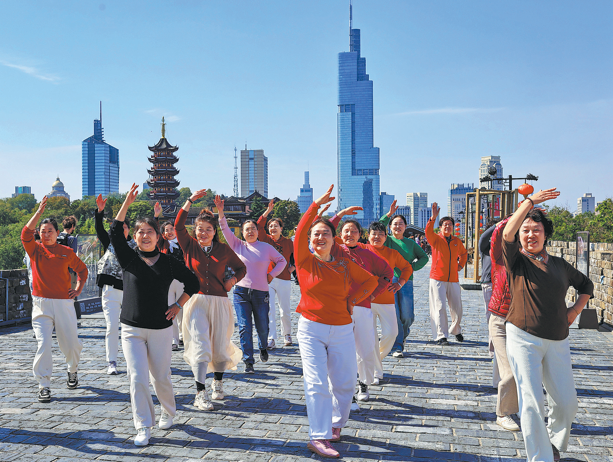
Senior citizens perform square dancing at the Nanjing City Wall of the Ming Dynasty to celebrate the Chongyang Festival (or Double Ninth Festival) on Oct 29 in Nanjing, Jiangsu province. SU YANG/FOR CHINA DAILY
I am in a few dozen WeChat groups and I found that the most active ones are those for some of the classes I am attending at universities for senior citizens.
I am in this Chinese painting class and my classmates there are always enthusiastic to show off their work. Then there is this other WeChat group for a singing class I go to and whenever I open that chat group, I am prepared to be bombarded with audio clips of worn-out voices — high, low or hoarse. Most of my classmates are around 70 years old and they take their classes and homework seriously. After all, many of them are actually fulfilling their childhood dreams.
China's first university for the elderly opened 40 years ago in Shandong province. It took a long time for Chinese people to accept that it was perfectly alright for senior citizens to go to university to learn something new after retirement. For a long time, people held the view that educational resources were scarce and should not be wasted on retired people. It was only in 1996, when a law made it clear that senior citizens have a right to continue their education, that universities for the elderly began to sprout.
According to Ministry of Civil Affairs data, by the end of 2024, there were 105,000 universities for senior citizens in China, enrolling 30 million students. That year, China's population of people aged above 60 was recorded at 310 million. It means less than 10 percent of the retired people had access to universities designed specifically for them. Senior citizen's demand for university education remains high.
Unlike other universities which are approved and supervised by education departments at different levels, the universities for senior citizens are operated by town-to-provincial level local governments.
Formal universities usually run one or two teaching institutions for senior citizens, to meet the needs of their retired employees, while many ministries and large-scale State-owned enterprises also operate such universities for their retirees.
When I tried to enroll in a district-run university five years ago to learn Chinese painting, I had to wait till someone backed out because the classroom could accommodate no more than 40 students. Now, it is much easier thanks to more universities coming up and the fact that now senior students can even take classes online. These universities are nonprofit and the tuition fee for one semester is just 300 yuan ($43).
The singing class is even cheaper — costing only 160 yuan per semester. Managed by a university in my neighborhood, whenever there are vacancies in a class, it accepts people like us. The teachers in these elderly schools are mostly retired professionals who know our demand well."Take it easy" is what they keep on reminding us.
The subjects offered include classical literature, poetry, calligraphy, painting, paper-cutting and Peking opera singing. Those interested in fashion can take classes on how to pose as a model. Then there are classes teaching street dancing, rap singing and even ballet. A new subject starting from the upcoming spring semester is artificial intelligence. I assume it is designed to teach us how to use AI to make our lives more colorful and convenient.
Within a 1,000-meter perimeter of my home there are at least four universities for the elderly. The first one is the one I go to, to learn singing; the second one is run by the national pharmaceutical group; the third one is operated by the district authorities; and the fourth one, in the basement of an apartment building just across my street, is operated by my community service center and offers free classes in singing, dancing, painting, musical instrument playing and many more.
Some people have criticized the coming up of such universities for senior citizens, arguing that names of universities should not be randomly used by institutes that come up in small buildings or in their basements. They insist that such universities should be streamlined and put under the supervision of a single government department.
As an insider, I sneer at this proposal. After all, I enjoy this model that makes it cheap and convenient for us to learn whatever we want to learn in a relaxed manner. The introduction of more formalities, I believe, will lead these universities nowhere.

Kang Bing
The author is former deputy editor-in-chief of China Daily.
