
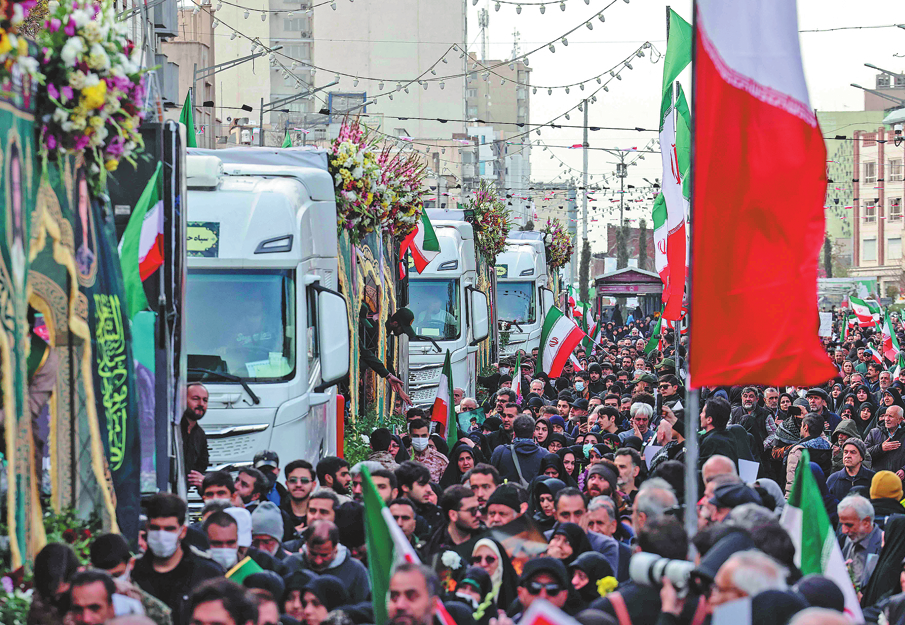
Iranians attend the funerals for security forces killed in recent protests in Tehran, on Wednesday. ATTA KENARE/AFP
The world is on high alert amid mounting fears of imminent US military strikes against Iran, but the latest comment by US President Donald Trump that "the killing of protesters has stopped" in Iran has added much ambiguity to the situation.
Previously, Washington had ordered the evacuation of personnel from its largest Middle East military base and sent an aircraft carrier strike group to the region, arousing suspicion that it will initiate military attacks on Iran very soon.
US military intervention could come in the next 24 hours, Reuters reported on Wednesday night, citing two European officials. An Israeli official said it appeared Trump had decided to intervene, although the scope and timing remained unclear.
Tehran, for its part, has briefly closed its airspace and declared its forces are at the "peak of defensive readiness" to counter any aggression.
However, the war prospect has become blurred as Trump later said multiple times that he "understands the killing (of protesters) in Iran has stopped" based on information he had received. Asked whether that meant the US would refrain from military intervention, as he previously threatened, Trump said Washington would "watch and see".
Sina Toossi, a senior nonresident fellow at the Center for International Policy, told Al Jazeera that Trump's claim appears, on the surface, to be a "face-saving way" to avoid military intervention, although it does not entirely rule out such an option.
Mark Kimmitt, a former US State Department official, told Al Jazeera that Trump was "remaining ambiguous" over the possibility of taking military action after showing the Iranians that he was more willing than previous US presidents to do so.
Crude oil prices slid 3 percent following Trump's new comments, reversing a recent sharp rally that had been driven by his escalating threats against Iran over ongoing domestic protests, which had stoked widespread concerns about possible disruptions to global energy supplies.
The United Nations Security Council was scheduled to meet on Thursday afternoon for "a briefing on the situation in Iran", as the Pentagon has reportedly ordered the USS Abraham Lincoln Carrier Strike Group to steam toward the Middle East, with the transit expected to take nearly a week.
Iranian Foreign Minister Abbas Araghchi also sought to tone down the rhetoric, urging the US to find a solution through negotiation. Asked by Fox News what he would tell Trump, he said: "My message is: Between war and diplomacy, diplomacy is a better way, although we don't have any positive experience from the United States. But still diplomacy is much better than war."
Iran reopened its airspace on Thursday morning after a nearly five-hour closure. Tracking service Flightradar24 showed that five flights from Iranian carriers Mahan Air, Yazd Airways and AVA Airlines were among the first to resume services.
Some personnel have been advised to leave the US military's Al Udeid Air Base in Qatar by Wednesday evening, Reuters said, quoting three anonymous diplomats.
Qatar said the withdrawal from the air base was part of "measures being undertaken" in response to regional tensions as Iran said "all US bases" would be legitimate targets for retaliation should the US launch any strikes against Iran.
"All the signals are that a US attack is imminent, but that is also how this administration behaves to keep everyone on their toes. Unpredictability is part of the strategy," a Western military official told Reuters.
cuihaipei@chinadaily.com.cn
