
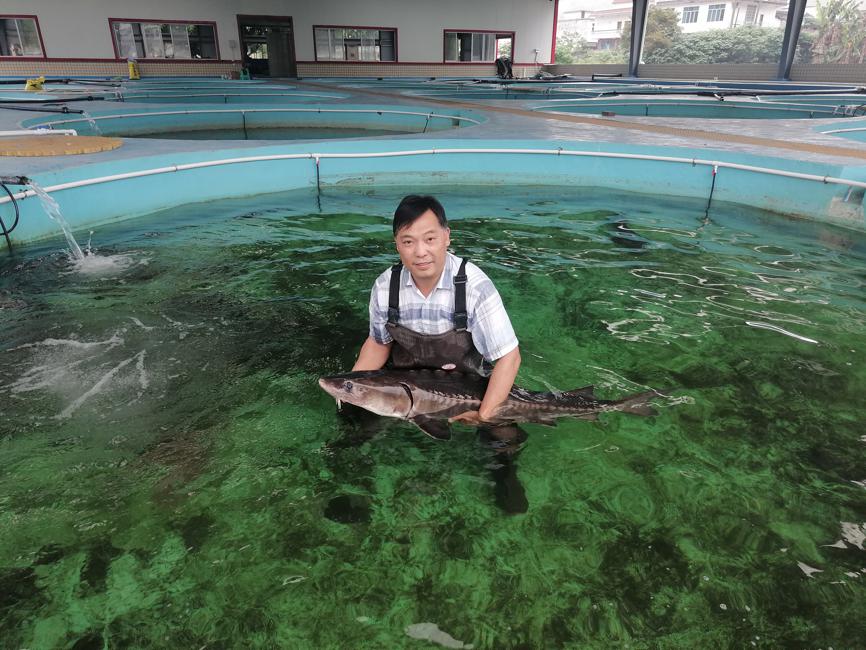
Zhou Liang, head of the Yibin Institute of Rare Aquatic Animals, inspects a captive-bred Yangtze sturgeon. [Photo provided to chinadaily.com.cn]
After more than three decades of dedication, Zhou Liang finally sees hope on the horizon for fulfilling his and his late father's lifelong dream of restoring the wild population of the Yangtze sturgeon.
Zhou, 53, is head of the Yibin Institute of Rare Aquatic Animals, the first private organization for the protection and study of rare fish in the country's longest waterway, the Yangtze River.
Instead of pursuing a career in big cities after college, Zhou returned to his hometown of Yibin in Sichuan province to assist his father, Zhou Shiwu, in establishing the institute.
At that time, many fish species endemic to the Yangtze River faced severe threats from overfishing, sand and rock dredging, and dam construction. By around 2000, naturally bred juvenile Yangtze sturgeons could no longer be found along the entire stretch of the river.
A breakthrough came in 2004, when Zhou and his team figured out how to breed the species on a large scale. That year, tens of thousands of Yangtze sturgeon fry hatched at the institute's breeding farm.

Artificially bred Yangtze sturgeon are released into the Yangtze River in Yibin, Sichuan province. [Photo by Zhuang Geer / For chinadaily.com.cn]
In 2007, with support from relevant authorities, the institute began conducting regular annual releases of artificially bred Yangtze sturgeon into the river.
In 2018, the Ministry of Agriculture and Rural Affairs launched an action plan for Yangtze sturgeon conservation. Since then, the institute has released between 10,000 and 100,000 sturgeon fry annually.
In 2020, China began a decade-long fishing moratorium in 332 conservation areas along the 6,300-kilometer Yangtze, a measure Zhou believes provides an excellent opportunity for the recovery of fish populations.
"Restoring the wild population of the Yangtze sturgeon is now only a matter of time," Zhou said. "Over the next five to 10 years, we will collaborate with more research institutions to achieve the species' natural reproduction and sustainable survival."
