
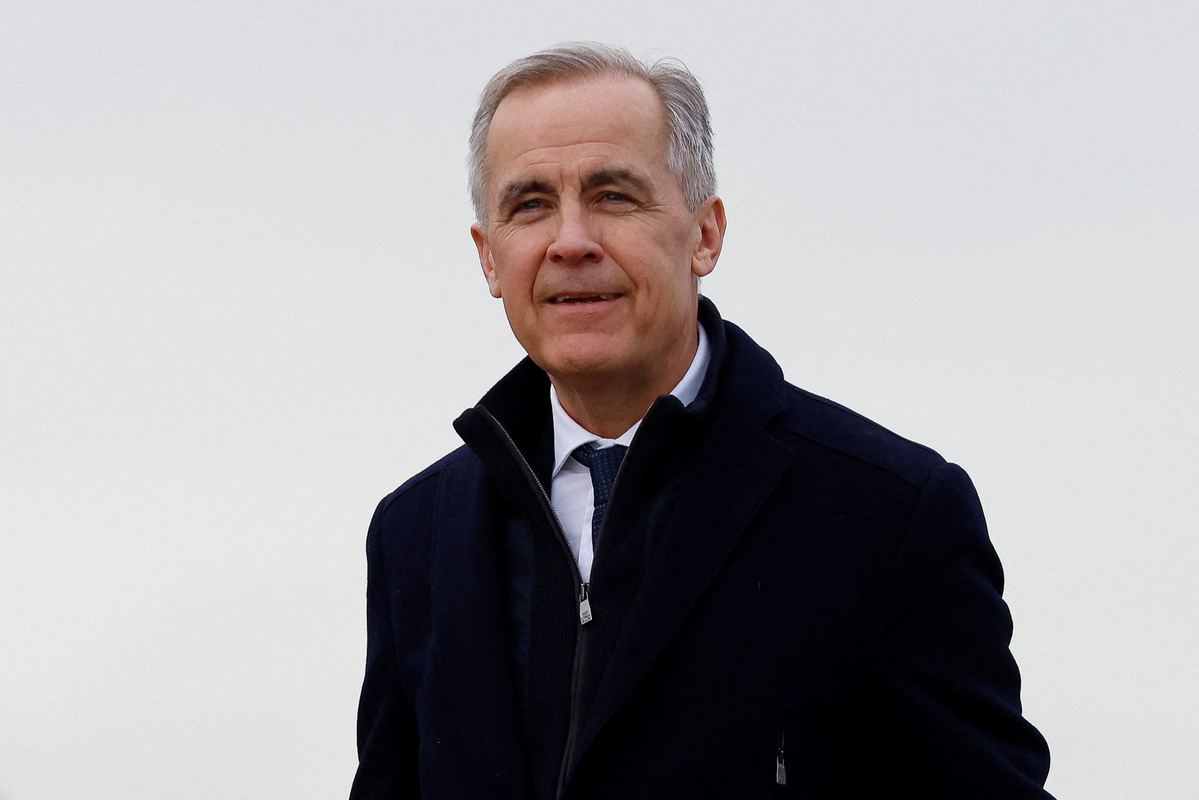
Canada's Prime Minister Mark Carney walks to board a plane to depart for China at Vancouver International Airport in Richmond, British Columbia, Canada, Jan 13, 2026. [Photo/Agencies]
Canada is reassessing its longstanding economic and security dependence on the United States amid deepening trade tensions and political uncertainty, with Prime Minister Mark Carney set to visit China this week to diversify trade ties, Canadian experts say.
According to trade data released by Statistics Canada on Thursday, Canada's share of exports to the US fell in October to its lowest level in decades, excluding the pandemic period.
Ronald Stagg, a history professor at Toronto Metropolitan University, said the decline points to "general unease" in both countries, driven by tariffs and uncertainty over future trade policy.
"The drop in exports is a result of a combination of the tariffs already imposed on major export sectors such as steel, aluminum, automobiles and auto parts," Stagg said.
"There is also a general unease on both sides of the border as to what the future will bring in the way of tariffs."
Historically, such a shift is highly unusual, he said. "Since the integration of the two economies during and after World War II, Canadian trade with the United States has only increased, especially after the original free trade agreement was signed in the 1980s."
Canada's reliance on the US for trade has become an expectation, but that expectation is now being challenged, he said.
Referring to the current geopolitical climate and Washington's stance on its neighbors, Stagg said, "It is Greenland that is in the cross-hairs right now, but Canada will be next."
He emphasized the need for Canada to diversify trade as much and as quickly as possible, "though this is not something done overnight".
The implications go beyond trade into national defense, he said, citing Washington's increasingly unpredictable posture toward its allies.
"Because of the erratic attitude of the (US) government to traditional allies, and its attitude that the Western Hemisphere is the United States' domain, looking to partner with other nations for defense is essential.
"Hence Canada's push to join the European defense industry pact, which could also bring industrial benefits," he said.
On trade, Stagg said Carney's recent diplomatic outreach reflects a deliberate effort to reduce Canada's exposure to US political risk." Carney is working hard to diversify our trade with Europe and Asia."
Carney will pay a four-day visit to China starting Wednesday — the first by a Canadian prime minister since 2017.
The trip comes as Ottawa faces mounting pressure from protectionist trade policies under US President Donald Trump's administration.
"The visit would play an important agenda-setting role," said Jeff Mahon, former deputy director of the China division at Global Affairs Canada.
"This visit will set a high-level consensus on the direction for the relationship," Mahon said. "The rest of the year will be about carefully and diligently implementing this with tangible actions."
Sustained progress will depend on whether both sides can move beyond symbolism and focus on practical outcomes, he said.
"Canada and China need to identify key principles to set a solid foundation for the relationship. This must begin with acknowledging sensitivities and using those to frame cooperation by targeting reasonable and plausible objectives."
Any meaningful work plan should balance near-term problem-solving with longer-term cooperation, he said. "The work plan needs to have two goals in mind: solving the current irritants while expanding areas of cooperation."
Stagg said Canada is also seeking closer economic ties in Southeast Asia. It is attempting to negotiate a free trade agreement with the region and has already concluded a bilateral trade agreement with Indonesia.
