
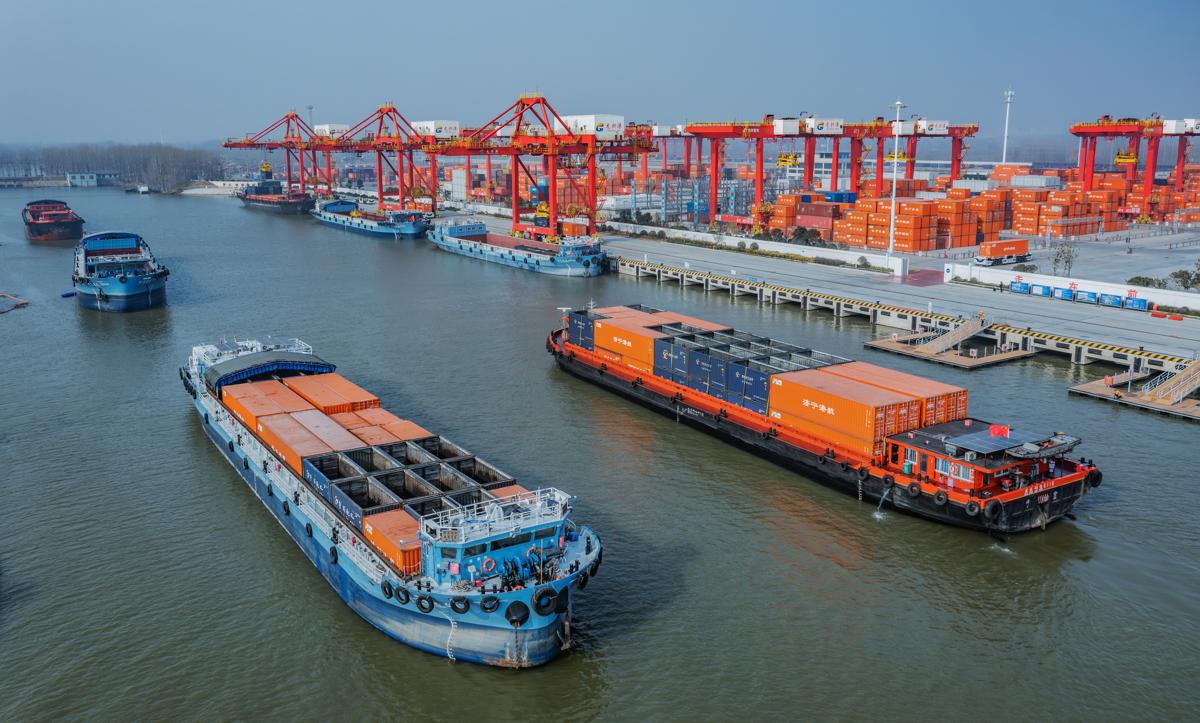
New energy-powered vessels travel along the Longgong River, a tributary of the Beijing-Hangzhou Grand Canal, off the Longgong Port of Jining, Shandong province. [Photo provided to chinadaily.com.cn]
A section of the historic Beijing-Hangzhou Grand Canal in Shandong province is being upgraded with automated port systems and lower-emission vessels as local authorities push to modernize inland shipping.
At Longgong Port, automated rail cranes and unmanned trucks now handle most container movements, with operations monitored from a centralized control room. According to port officials, tasks that once required about 60 truck drivers across three shifts are now managed by three operators overseeing 16 autonomous vehicles using Beidou navigation and 5G connectivity.
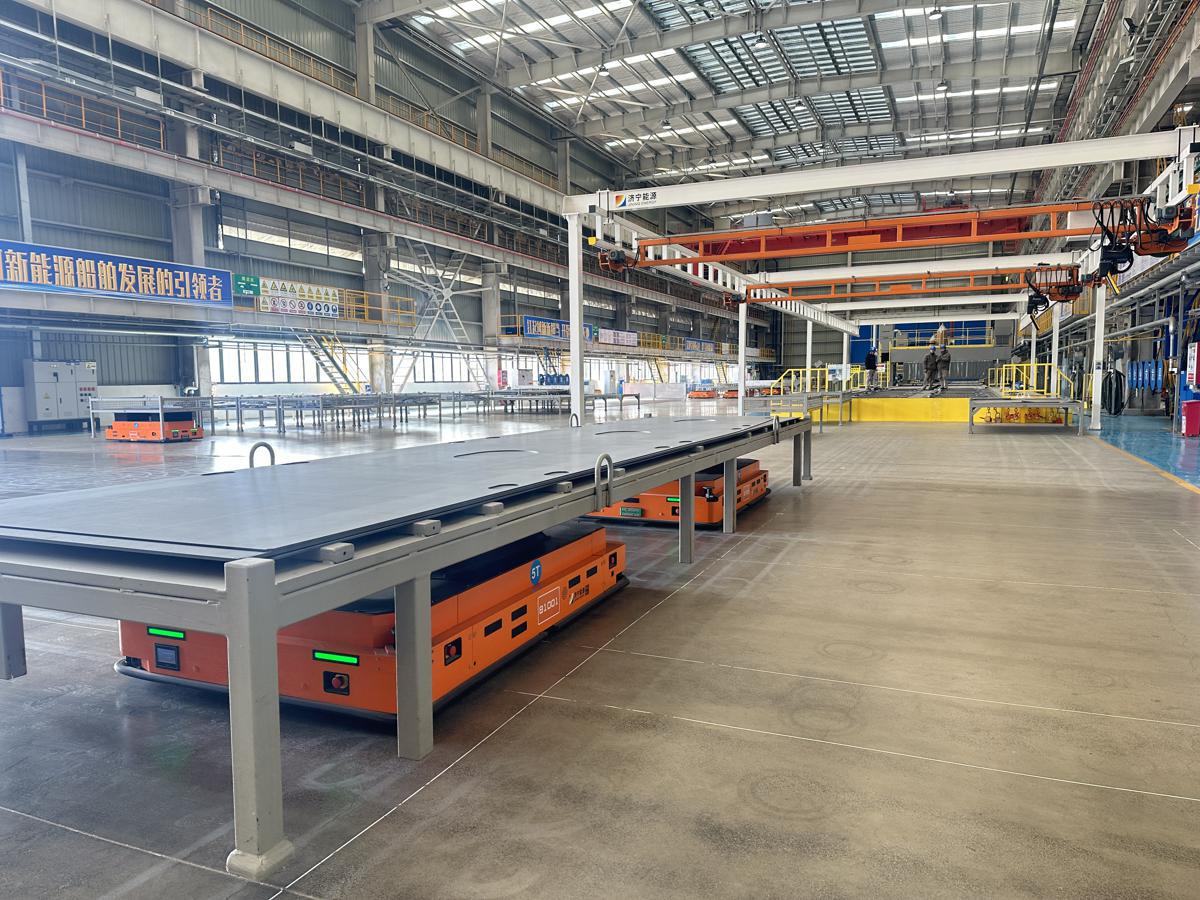
Inside the Shandong Xinneng Shipbuilding workshop in Jining, Shandong province, an automated guided vehicle steadily transports steel plates toward the next stage of production. [Photo by Zhao Ruixue/chinadaily.com.cn]
On a crisp winter morning, a 90-meter-long vessel departs from the port, carrying over 4,000 metric tons of coal in standard containers destined for Changzhou, Jiangsu province. After a seven-day journey along the canal, it returns to Jining fully loaded with iron ore and other materials.
"This round trip cuts carbon emissions by 15 percent while also shortening the voyage time," said Yang Yongjun, a captain with nearly three decades of experience. "In the past, diesel-powered ships were noisy and carried unpleasant odors. Now, with well-defined zones and complete household amenities, it's like living in a moving river-view apartment."
The ships are built with dual LNG engines that reduce nitrogen oxide and particulate emissions by more than 90 percent, according to their manufacturer, Shandong Xinneng Shipbuilding.
