
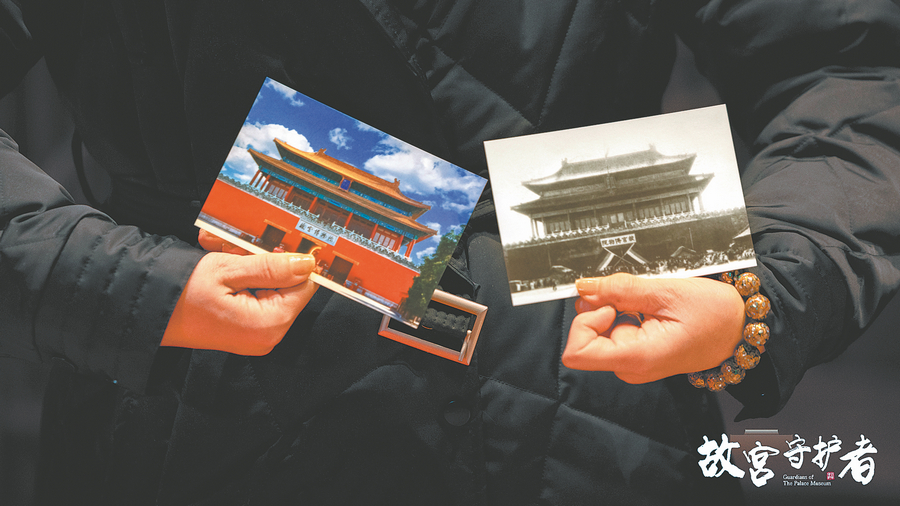
A scene from Guardians of the Palace Museum features two photos showcasing the evolution of the historical landmark over the past century. CHINA DAILY
As the Palace Museum, also known as the Forbidden City, marked its centenary last year, transitioning from an imperial palace (1420-1911) to a public museum, a new documentary program turns the spotlight on a lesser-told story: how its priceless artifacts were safeguarded through decades of upheavals.
The six-episode program, Guardians of the Palace Museum, produced by video streaming platform Youku and the Forbidden City Publishing House, has been airing on Youku since Dec 15.
In the program, an exploration team comprising veteran TV host Ni Ping and other celebrities, like actors Chen Jianbin and Zhang Xiaolong, and historian Yu Gengzhe, embarked on trips in Beijing, Leshan in Sichuan province, Xiamen in Fujian province and Hong Kong to trace the century-long journeys of the objects now displayed in the museum, revealing the human dedication behind their survival.
"We had visited the Palace Museum many times before. Whenever we saw the cultural relics displayed as national treasures, we took their presence for granted, feeling that it was natural that they were there," says Wang Cong, a member of the team.
"We never stopped to think about how they ended up there for us to see today."
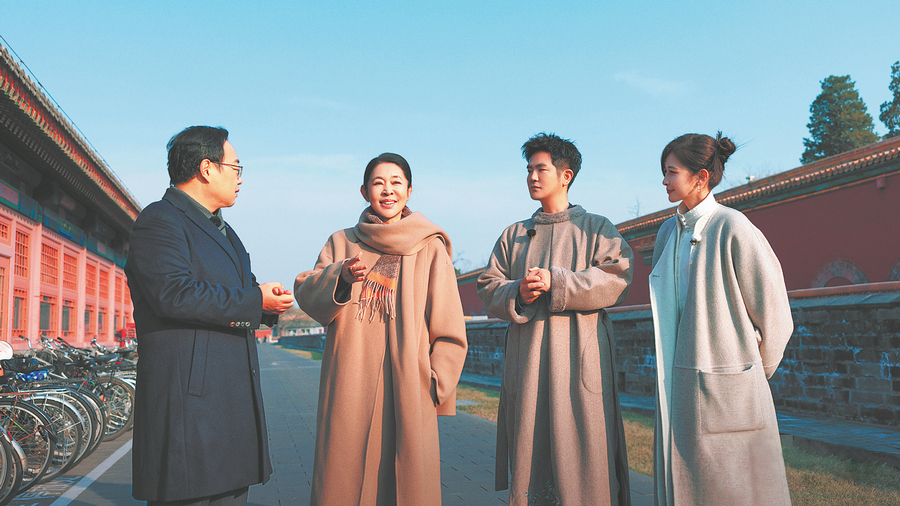
From left: Historian Yu Gengzhe, TV host Ni Ping, actor Zhang Xiaolong and TV host Wang Cong featured in Guardians of the Palace Museum. CHINA DAILY
After filming the series, she adds, her feelings toward the artifacts have fundamentally changed.
For example, one episode revisits the recovery of Boyuan, a rare calligraphy model from the Eastern Jin Dynasty (317-420), which was displayed during the Palace Museum's centennial exhibition.
During the turbulent final years of the Qing Dynasty (1644-1911), many precious artifacts went missing. Therefore, in the 1950s, when Zheng Zhenduo, then the country's cultural heritage administration chief, learned that two calligraphy works, including Boyuan, were about to be auctioned in Hong Kong, he immediately reported the situation to the State Council, China's Cabinet.
Upon receiving the report, Premier Zhou Enlai ordered specialists to verify the authenticity of the works and approved a substantial sum to secure their return. After complex negotiations, the calligraphy pieces were successfully purchased and brought back to the Chinese mainland, becoming part of a broader effort that recovered numerous cultural treasures during that decade.
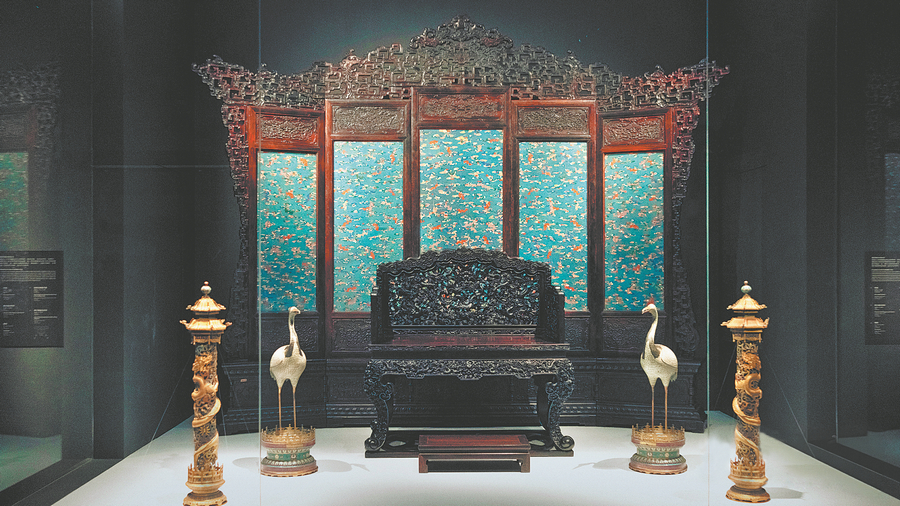
An exhibition at the Hong Kong Palace Museum showing Qing Dynasty (1644-1911) emperors' lives at the court. CHINA DAILY
"Usually, we only appreciate the outward beauty of the artifacts, seeing them resting peacefully behind glass cabinets. This time, we dive deep into the stories behind them, about how they were protected. That enables us to cherish them even more, and understand their profoundness and cultural value," says Song Yingjie, another team member.
Ni says what strikes her most are the details of people who have devoted themselves to sheltering the museum's relics. For example, she is impressed by the temporary dwelling of the family of Ouyang Daoda, an archival specialist of the Palace Museum, in Leshan.
During the War of Resistance Against Japanese Aggression (1931-45), thousands of crates containing imperial artifacts were relocated southward to escape destruction, with some transported as far as Leshan. Ouyang was placed in charge of safeguarding one such batch.
"For eight years, he and his family members lived in the small, gloomy and cold dwelling and worked in the field like farmers while protecting the artifacts. He knew precisely which days were suitable for airing the artifacts and which items could safely be exposed to sunlight — no one else there possessed such knowledge," says Ni.
"Their unwavering dedication was guided by the principle: wherever the artifacts were, that's where their home was; wherever the artifacts were, that was where they belonged."
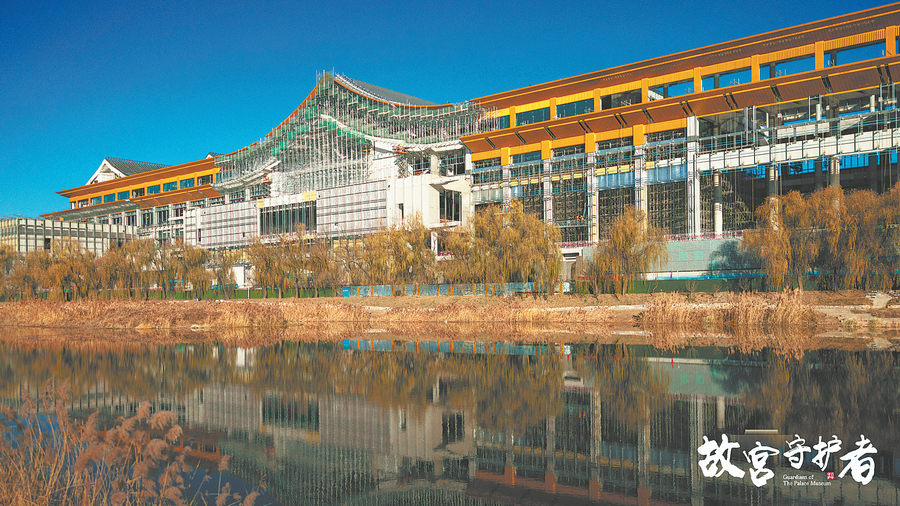
The north branch of the Palace Museum in Beijing is now under construction. CHINA DAILY
The series also highlights the meticulous work of restorers responsible for producing exact replicas of ancient paintings housed in the Palace Museum. Some replicas take nearly two years to complete, with artisans painstakingly reproducing every brushstroke and pigment.
"At first, I wondered why such immense effort was devoted to creating a copy," Ni says.
"Later, I realized that after 1,000 years, the original paintings would inevitably deteriorate. In that distant future, such replicas would become vital for preserving the artworks' legacy. That is why the copy must be perfect."
Zhou Jun, general director of the series, says: "Along our journeys, from the Palace Museum in Beijing to Leshan, Hong Kong, and Xiamen, we discovered that the guardianship of the museum extends far beyond its walls — it lies wherever its cultural legacy reaches and continues to evolve with the passage of time. It is the spirit of 'passing on the legacy, guarding through the century' that allows Chinese civilization to thrive with enduring vitality."
Contact the writer at wangru1@chinadaily.com.cn
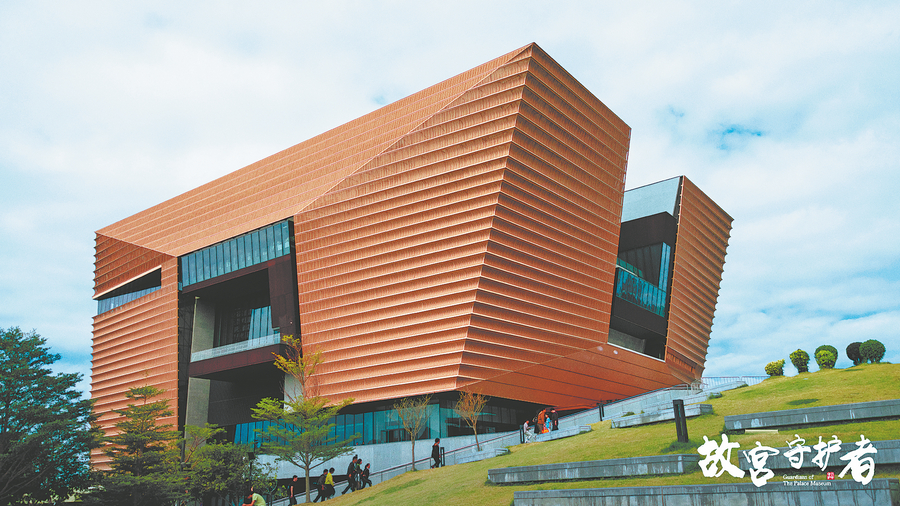
The Hong Kong Palace Museum, which opened to the public in 2022, has become a new cultural landmark in the city. CHINA DAILY
