
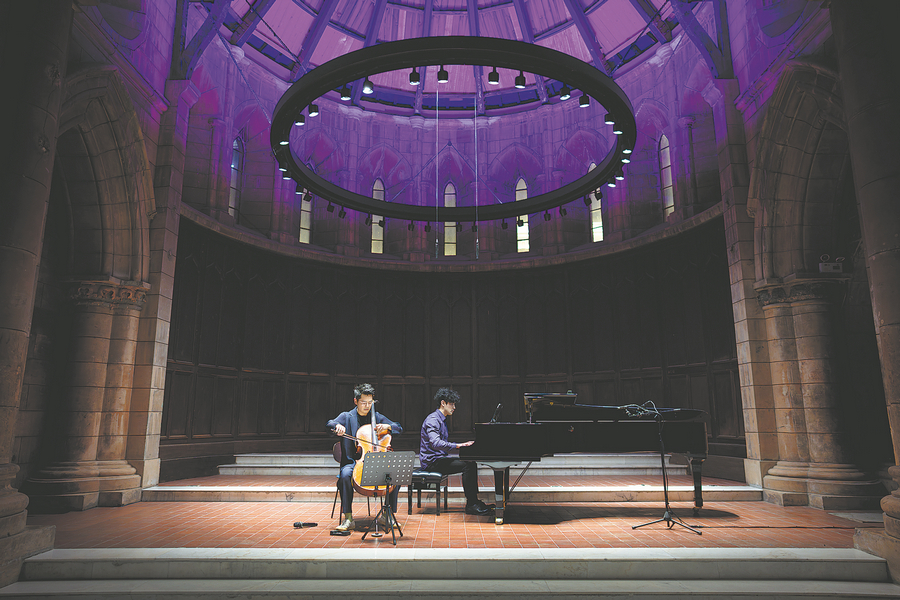
On Dec 28, cellist Chen Weiping and pianist Yue Zheng held their first concert in Tianjin's Anglican Art Centre — formerly the Anglican Church — a historical building constructed in 1903 by British Sinologist and architect Arthur Christopher Moule. CHINA DAILY
In the summer of 2025, during a music festival in Changzhou, Jiangsu province, cellist Chen Weiping and pianist Yue Zheng first crossed paths.
Both were invited musicians, but they performed on separate days. It wasn't until the following day, when they decided to add an extra performance, that they finally shared the stage.
In a spontaneous moment of artistic collaboration, they presented pieces by composers including Schubert and Mendelssohn. Despite the different genres, they immediately recognized a synergy between them.
"It was an interesting experience. Our energy was in sync and the way we approached the music felt very similar. It wasn't just about performing; it was about a shared love for music, a passion that goes beyond the career aspect. We are both driven by our inner love for the art form," recalls Yue, 28, who was born into a musical family and graduated from the Manhattan School of Music.
Chen, too, found an instant connection. "Before we even spoke, we communicated through the music. I immediately felt that Yue's musical interpretation resonated with mine. It was like meeting someone who understands you without needing to explain," says Chen, 45, an associate professor at the Shanghai Conservatory of Music.
Chen highlights their shared understanding of time and rhythm, emphasizing that classical performance is not about rigidly following a metronome but allowing the music to flow like emotion. This mutual respect for timing and phrasing allows for a natural musical conversation between the cello and piano.
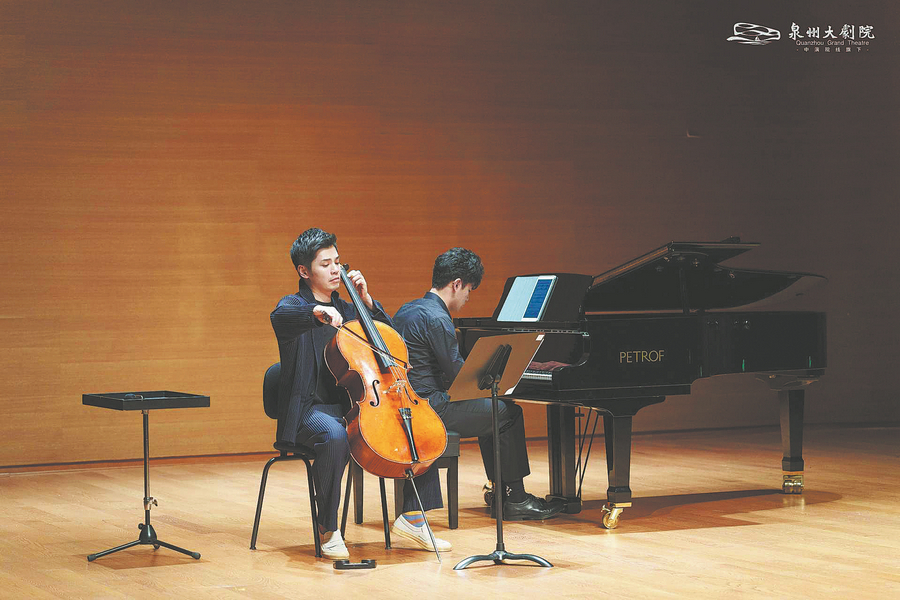
From Dec 28 to Jan 17, cellist Chen Weiping and pianist Yue Zheng are performing together in a series of concerts in Chinese cities, including Tianjin, Quanzhou, Chengdu, and Shanghai, featuring original musical compositions and adaptations of well-known musical works. CHINA DAILY
From Dec 28 to Jan 17, they are performing together in concerts in Chinese cities including Tianjin, Quanzhou in Fujian province, Chengdu in Sichuan province, and Shanghai.
The theme is titled The Gallery Beside My Ears, an idea from the concerts' music director, composer Li Bo, who is also an associate professor at the Shanghai Conservatory of Music.
For Chen, the goal was always to create an immersive experience for the audience. "The best music, in my opinion, should evoke images," he says. "When you listen, it should paint a picture in your mind — like a gallery of sounds. The audience should be able to form their own visual representations of the music."
With this vision in mind, their performance became more than just a concert — it was an auditory journey, a curated experience of music that transcended traditional boundaries.
Yue, inspired by Chen's approach, began reflecting on his own performance philosophy. "Music is an abstract medium. Sometimes, I find it difficult to express its true essence in words. It's a process of transformation, one that can't always be neatly packaged," he says. "But with Chen, we're able to create something fresh. His guidance has been invaluable in helping me find new ways to express my music. Our collaboration feels like a form of storytelling — a way to share our life experiences through the music."
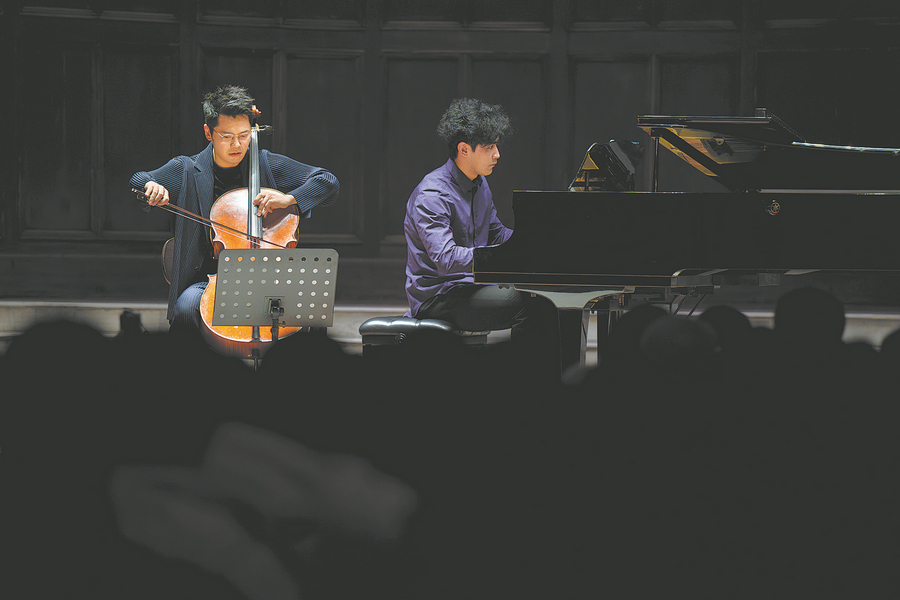
From Dec 28 to Jan 17, cellist Chen Weiping and pianist Yue Zheng are performing together in a series of concerts in Chinese cities, including Tianjin, Quanzhou, Chengdu, and Shanghai, featuring original musical compositions and adaptations of well-known musical works. CHINA DAILY
Moonlight, adapted by Li from Debussy's Clair de Lune, opens the concert series, which is deeply rooted in Chen's life experiences, and reflects his journey as a young artist.
The story begins in the summer of 2001. At that time, Chen, still a student, had been invited by the renowned conductor Seiji Ozawa to participate in a music festival in Japan, which was aimed at supporting and showcasing young musicians.
"What left the deepest impression on me wasn't the stage lights, but one evening on the Okushiga (highlands in central Japan). That day, I was lying on the grass with a few Japanese friends I had just met. It was there, for the first time in my life, that I saw the vast, complete sky and the Milky Way," recalls Chen. "That moment was overwhelming, and I was just 20 years old. To this day, whenever I feel lost, I always think back to that night — the moonlight and the stars. I remind myself that it was my starting point, my purest passion for music.
"It's not just about performing someone else's work; it's about telling my own story. That's where the real connection happens. When I perform, I'm not just playing an instrument; I'm sharing a part of myself," he adds.
The performance itself was also intimate and reflective with the premiere of Li's original work, titled A Letter From Afar.
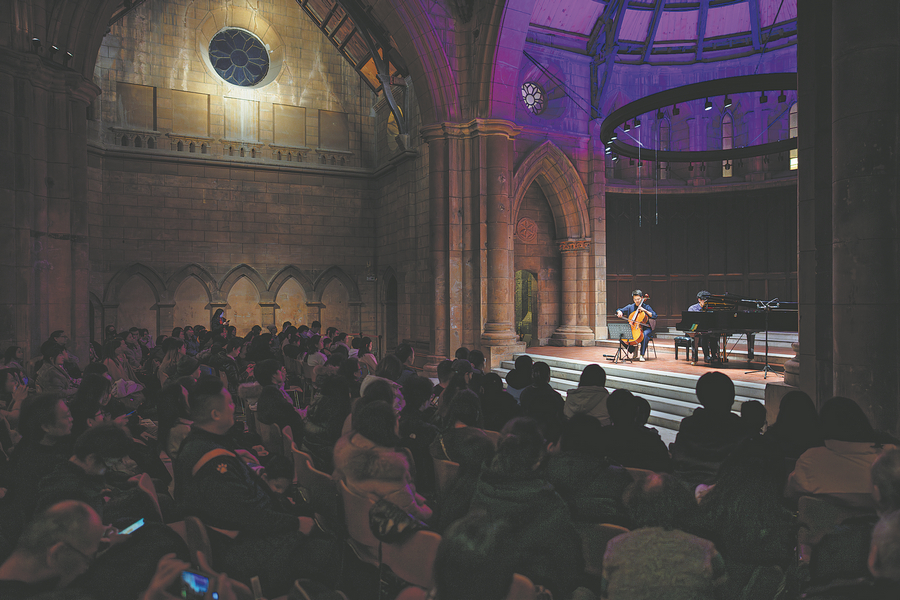
From Dec 28 to Jan 17, cellist Chen Weiping and pianist Yue Zheng are performing together in a series of concerts in Chinese cities, including Tianjin, Quanzhou, Chengdu, and Shanghai, featuring original musical compositions and adaptations of well-known musical works. CHINA DAILY
This piece resonates deeply with the experiences of Chinese students studying abroad, capturing the complex emotions of those far from home. The musical language is layered and multifaceted, incorporating harmonies and structures not traditionally found in classical compositions. There is an openness to the music, a jazzlike quality in its rhythm — shifting from slow to fast, with elements of improvisation that evoke a sense of freedom. At the same time, it carries the distinct colors of Eastern music, grounding it in a rich cultural heritage.
"Even as we walk through unfamiliar worlds, the piece reminds us that our roots are never lost. The feelings of longing for home, the adventurous spirit, and the courage to face challenges are woven into the very fabric of the music," says Yue.
According to Chen, the cello, with its deep, resonant tones, speaks like the soliloquy of a traveler, restrained yet powerful — never showy, but always filled with meaning. Meanwhile, the piano echoes like the distant sound of home, with its gentle resonance representing both reality and memory, pulling at each other with a tension that grows stronger as the piece unfolds.
The collaboration between Chen and Yue pushed them to redefine the roles of their instruments, transforming the piano-cello dynamic into something far more intricate.
"The cello and piano can easily overshadow one another, but we made sure to complement each other. The cello would lift the piano, and the piano would provide a gentle backdrop for the cello. It was about creating a dialogue, one between two instruments that are so different in nature," says Chen.
Contact the writer at chennan@chinadaily.com.cn
