
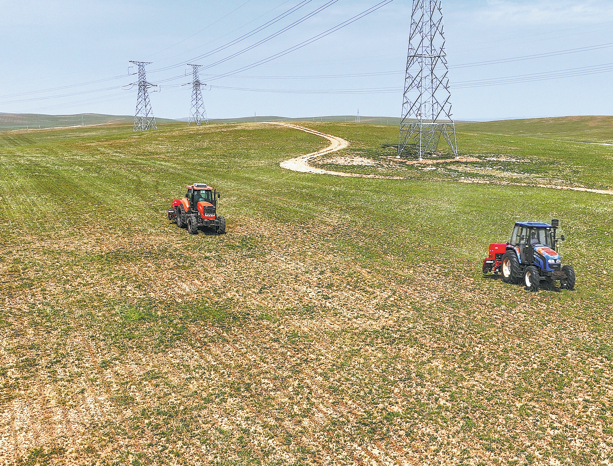
Seeders plant grass seeds in Siziwang Banner, Inner Mongolia autonomous region. LIU ZHISHUAI/FOR CHINA DAILY
For villager Liu Cunxi, planting shrubs to combat desertification comes with dual benefits — he's doing something that is good for the environment and he gets a paycheck from it, too.
The 69-year-old farmer from Yujiahao village in the Inner Mongolia autonomous region's Siziwang Banner said: "We plant trees and shrubs to prevent wind erosion and stabilize the sand. At the same time, we can earn 160 yuan ($22.7) a day."
Ulaanqab, the city that administers Yujiahao, promotes a work-for-relief model, combining restoration projects with labor remuneration, to encourage local residents to take part in efforts to curb desertification and land degradation.
Liu said he joins the project each year to supplement his income during the summer farming off-season, typically from May to October. Around 20 farmers like him participate in the project, performing tasks such as planting and harvesting shrubs.
"I earned 2,400 yuan in just half a month," said Liu, who added that the model not only motivates farmers and herders to engage in ecological rehabilitation, but also helps increase their incomes.
As various measures to restore degraded land are implemented in Ulaanqab, such as planting shrubs and restricting grazing, local residents can contribute in different ways.
Herders can earn about 150 yuan per hectare by participating in grazing bans. They can also take part in planting, fertilizing, nurturing and managing grasslands, earning an average of more than 150 yuan per day.
By transporting grass seeds, sheep manure, fertilizer, fencing materials, and domestic and ecological water for construction companies, each household can obtain a direct payment of about 165 yuan per hectare, in addition to management fees of about 180 yuan per hectare for grassland maintenance.
Pang Chengxiu, 55, from another village in Siziwang Banner, organizes local herders to join grassland restoration efforts. With his help, 105 households have participated in restoring more than 14,000 hectares of grassland.
"Almost every household in the area has taken part," Pang said, praising the model.
"It not only improves the ecological environment but also boosts our earnings," he added. Pang's tasks have included setting up net fences, transporting water, and helping to manage and maintain the grassland. He also helps coordinate and resolve grassland disputes among herders.
Last year, Pang earned more than 15,000 yuan in labor remuneration, and the grassland showed significant signs of recovery.
Ulaanqab has also organized training programs centered on the work-for-relief model to enhance the skills and understanding of those involved, while steadily expanding the program so that more farmers and herders can participate.
"It has allowed me to contribute to ecological conservation while doing something truly helpful for local herders," Pang said.
